
5 Best Seat Cushions for Sciatica Pain (2026): Comfort, Support & Office Chair Compatibility
1. Finding Orthopedic Seating Relief
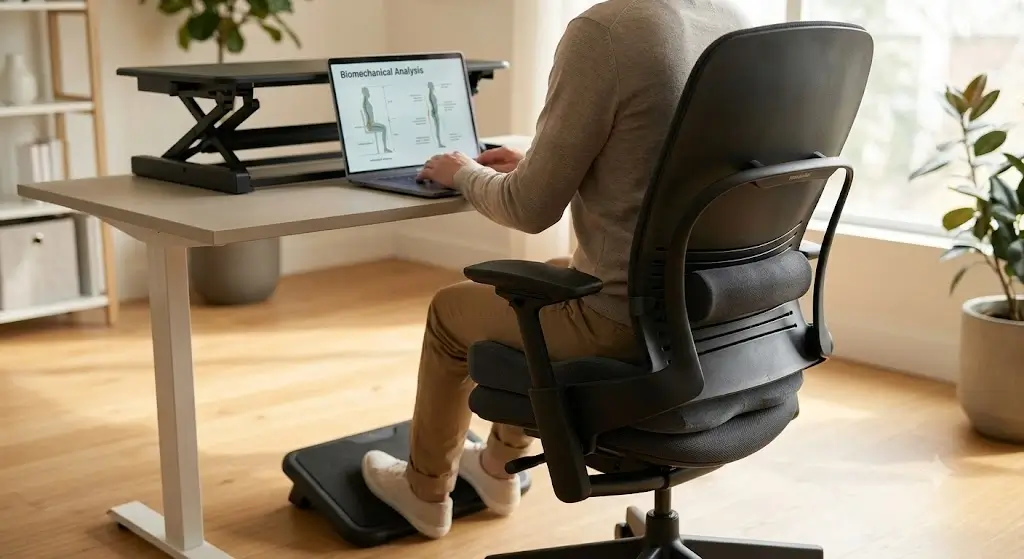
For remote workers managing radiating lower-body discomfort, adding a standard ergonomic insert is rarely a straightforward fix. In office chairs equipped with pronounced waterfall front edges, adding a thick orthopedic cushion can unintentionally eliminate the chair’s built-in pressure relief by bridging across the seat pan and increasing tension behind the thighs. Furthermore, a cushion that performs well on a flat wooden dining chair may perform noticeably worse on a suspended mesh chair because the cushion and the mesh base deform simultaneously, altering the support profile.
When you sit for long hours, your pelvis often rolls backward—a posture pattern known as posterior pelvic rotation. This shift can shorten the distance between the lumbar vertebrae. According to physical therapy clinical reviews published by the American Physical Therapy Association (APTA), this alignment change may contribute to increased pressure around lumbar nerve roots along the sciatic pathway.
While an ergonomic support cannot fix the root structural causes of spinal conditions, it alters how upper-body loads transfer through the lower back and thighs. Most seat cushions advertise tailbone relief as a universal cure. In practice, our analysis of seating mechanics suggests that compatibility with your chair’s seat pan configuration matters just as much as the cushion’s internal material. By encouraging a more neutral sitting posture, high-quality orthopedic supports help distribute pressure more evenly, which can slow down the onset of deep gluteal aching during long office grinds.
Crucial Ergonomic Warning: Highly compressible, low-density foam inserts often deflate significantly under sustained body weight. Posture experts warn that this type of performance failure forces the spine into deeper flexion, potentially elevating pressure on the lower discs and worsening radiating neurological symptoms.
To aid your search, this editorial review breaks down the industry’s top ergonomic supports based on material performance data, structural design geometry, and user feedback regarding compatibility with popular office chairs. Our analysis focuses on how these products manage pressure distribution and support lower body alignment without relying on artificial laboratory environments.
Jump down to our comprehensive office chair ergonomics guide for workstation adjustments.
2. Review Transparency & Evidence Hierarchy
Editorial Confidence Framework
To help you understand the weight of the claims made in this review, we categorize our editorial certainty across three distinct tiers:
- High Confidence (Verifiable Facts): Physical dimensions, product weights, core material compositions, and manufacturer specifications.
- Medium Confidence (Deductive Analysis): Estimated office chair compatibility based on matching published chair pan widths with cushion footprints.
- Contextual Confidence (User-Sourced Trends): Long-term durability, flattening rates, and heat buildup synthesized from recurring ownership trends in publicly available customer feedback.
3. Material Engineering & Weight Selection Matrix
Different materials respond uniquely to body heat and weight distribution. The matrix below details the engineering behaviors and estimated user-weight ceilings derived from official material specifications and long-term user wear patterns.
Table 1: Material Engineering Behavior
| Material Type | Compression Recovery Profile | Heat Retention Properties | Estimated Bottoming Risk |
|---|---|---|---|
| Extra-Dense Charcoal Polyfoam (Cushion Lab) | Slow rebound, firm structural pushback | High (Captures and stores ambient body heat) | Low (Maintains multi-region contour elevation) |
| Hybrid Gel-Memory Foam (ComfiLife) | Balanced contouring response | Moderate (Gel layer delays initial heat spikes) | Moderate (Highly likely under heavy weights over 180 lbs) |
| Hyper-Elastic Polymer Grid (Purple) | Fast rebound, local column deflection | Low (Continuous open air channels) | Very Low (Distributes weight horizontally) |
Table 2: Estimated Weight Compatibility Framework
| User Weight Class | Recommended Cushion Design | Avoid This Style | Primary Reason |
|---|---|---|---|
| Under 140 lbs | Medium-Soft Foam (e.g., ComfiLife Gel) | Ultra-Dense Firm Polyfoam | Lighter frames often fail to compress firm foam, causing awkward hip elevation. |
| 140 lbs – 190 lbs | Contoured Polyfoam (e.g., Cushion Lab / Everlasting) | Low-Density Standard Foam Pads | Strikes the ideal balance between foam compression and structural lift. |
| 190 lbs – 240 lbs | Gel Polymer Grid or Firm Large Foam | Soft, Thin Foam Cushions | Standard foams pack down quickly, leading to direct chair pan contact. |
| Over 240 lbs | High-resilience grids (e.g., Purple Royal) | All Standard Core Memory Foams | Requires structural grid walls to prevent complete bottoming out. |
4. Editorial Ranking & Product Trade-Offs
No single cushion is perfect for every body type or office chair. The table below outlines why each product secured its respective rank and the core compromises required if you choose to purchase.
Table 3: Editorial Comparison Matrix
| Rank / Product | Why It Beats the Next Option | The Primary Trade-Off (Why It Loses) |
|---|---|---|
| #1 Cushion Lab Patented | Offers active multi-region guidance via advanced ergonomic molding to actively discourage slouching. | The proprietary extra-dense polyfoam is highly temperature-responsive; it can feel uncomfortably firm in cool indoor temperatures. |
| #2 Everlasting Comfort Large | Provides superior surface coverage and 100% pure memory foam depth for severe sciatic strain compared to standard pads. | The deep U-shaped cutout limits structural support at the immediate rear center, shifting stress entirely to the outer thighs. |
| #3 Purple Royal Cushion | Provides absolute thermal neutrality and zero structural flattening, completely outperforming memory foams in long-term heat dispersion. | Weighs noticeably more than foam equivalents and lacks any built-in leg or thigh guiding contours. |
| #4 ComfiLife Gel Enhanced | Combines an immediate gel cooling touch with plush baseline compliance at an accessible entry-level price point. | Recurring owner reports suggest users around or above 180 lbs are more likely to bottom out during extended sitting. |
| #5 Xtreme Comforts Cushion | Utilizes rugged high-density polyfoam that holds up under thick frames on completely flat, rigid chair pans. | The minimalist flat visual profile offers very little active corrective geometry to restore a natural lower back curve. |
5. Detailed Product Deep-Dives
Cushion Lab Patented Seat Cushion — Best Overall for Postural Stability
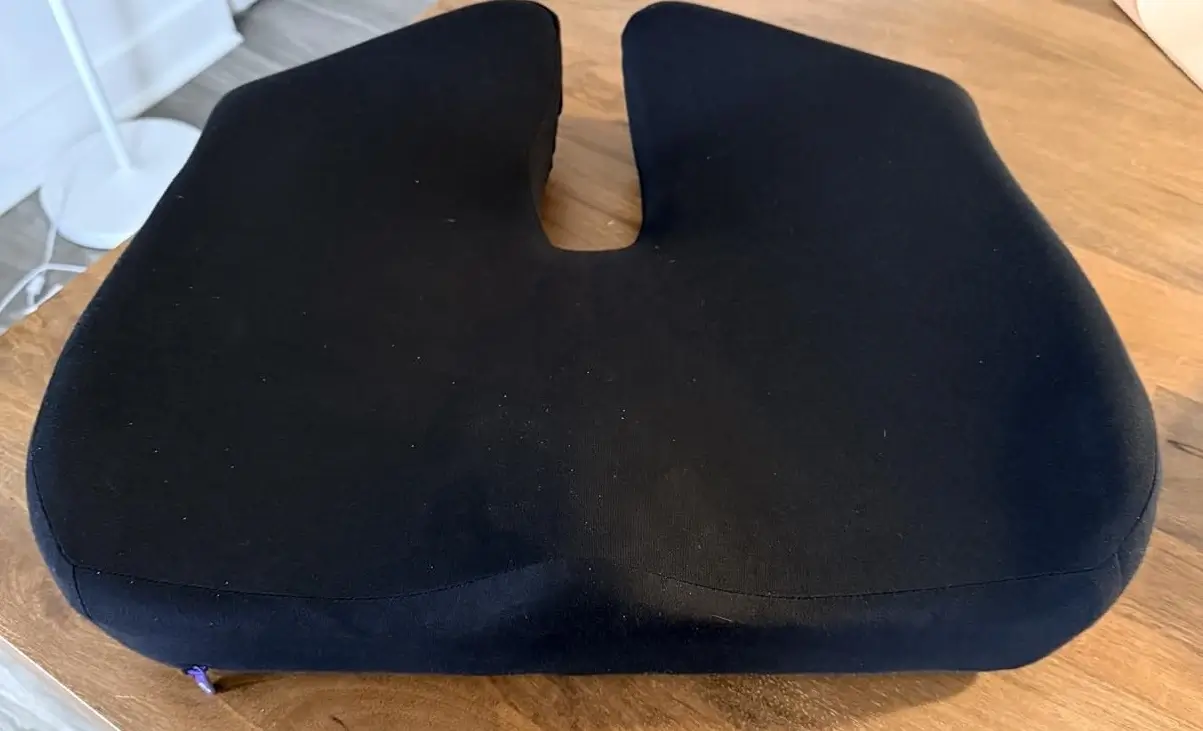
The Cushion Lab Patented Cushion approaches lower body pressure management through pre-shaped contours. Rather than offering a uniform flat pad, its molded polyfoam features dedicated thigh recesses and an elevated rear rim designed to cradle the pelvis. This distinct shape works to lock the base of your spine into an upright position, which helps address one common sitting posture flaw associated with prolonged desk work—namely, the tendency for the tailbone to slide forward into a slouched position.
Across long-term owner feedback, a recurring theme is that the proprietary high-density polyfoam provides substantial resistance to flattening, allowing it to preserve its supportive elevation better than generic retail foam inserts. The recessed center channel is designed to isolate the lower spine area from direct contact with the underlying seat. However, recurring ownership reports suggest that the dense composition is highly temperature-responsive. In cool indoor temperatures, it can feel noticeably rigid upon initial contact, requiring a few minutes of body heat to soften and conform. Lighter individuals may find the foam profile too unyielding to trigger the intended cradling benefit, leaving them feeling as though they are balancing on top of the contours rather than settling into them.
• Common Complaint: Feels uncomfortably hard or narrow during the first week.
• Likely Cause: High initial polyfoam density interacting with cold room temperatures.
• Who Experiences It: Light-framed individuals and users in air-conditioned home offices.
• After 6 Months: Recurring ownership reports suggest that the foam softens slightly and custom-molds to the user’s pelvis over time, reducing initial complaints.
Everlasting Comfort Memory Foam Cushion (Large) — Best for Large Frames
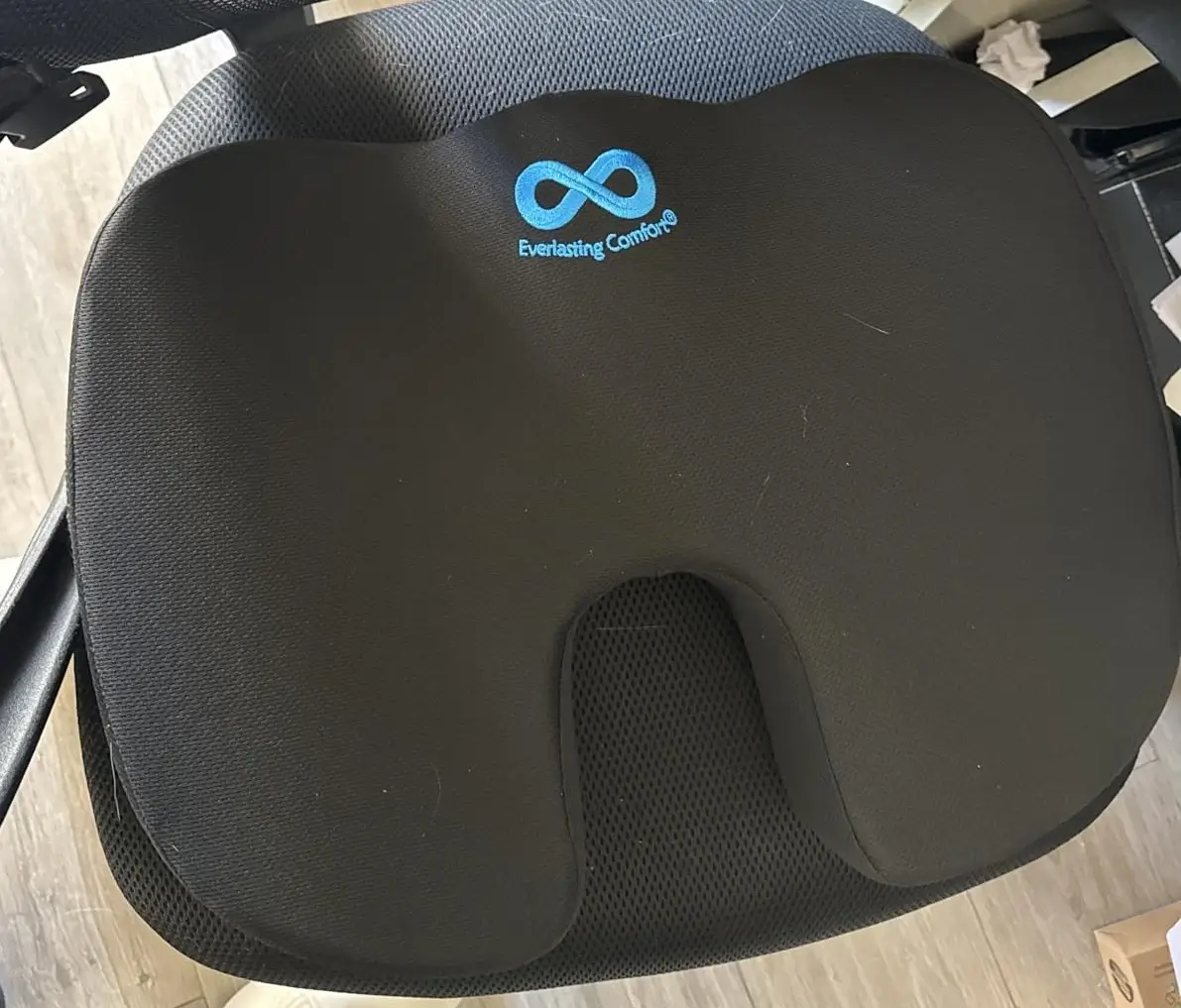
The Everlasting Comfort Cushion relies on a premium, 100% pure memory foam foundation designed to respond directly to body heat. By utilizing a highly responsive cell structure, it custom-molds around the user’s thighs and hips to optimize load distribution across the seat pan. The aggressive U-shaped rear cutout isolates the coccyx, ensuring the tailbone remains suspended without striking the underlying frame.
From an alignment standpoint, the generous depth and doctor-recommended contours provide stable support for individuals managing deep gluteal nerve discomfort, though anyone seeking a highly breathable layout may find it traps ambient heat. It provides exceptional surface relief for long travel sessions but requires a substantial chair base to support its broad profile.
• Common Complaint: The foam feels significantly softer during the afternoon.
• Likely Cause: Continuous heat absorption causes the memory foam cell structure to yield.
• Who Experiences It: Heavy users pulling uninterrupted shifts in warm rooms.
• After 6 Months: Owners note that while the foam softens dynamically, it recovers its baseline thickness fully once cooled overnight.
Purple Royal Seat Cushion — Best for Continuous Thermal Regulation
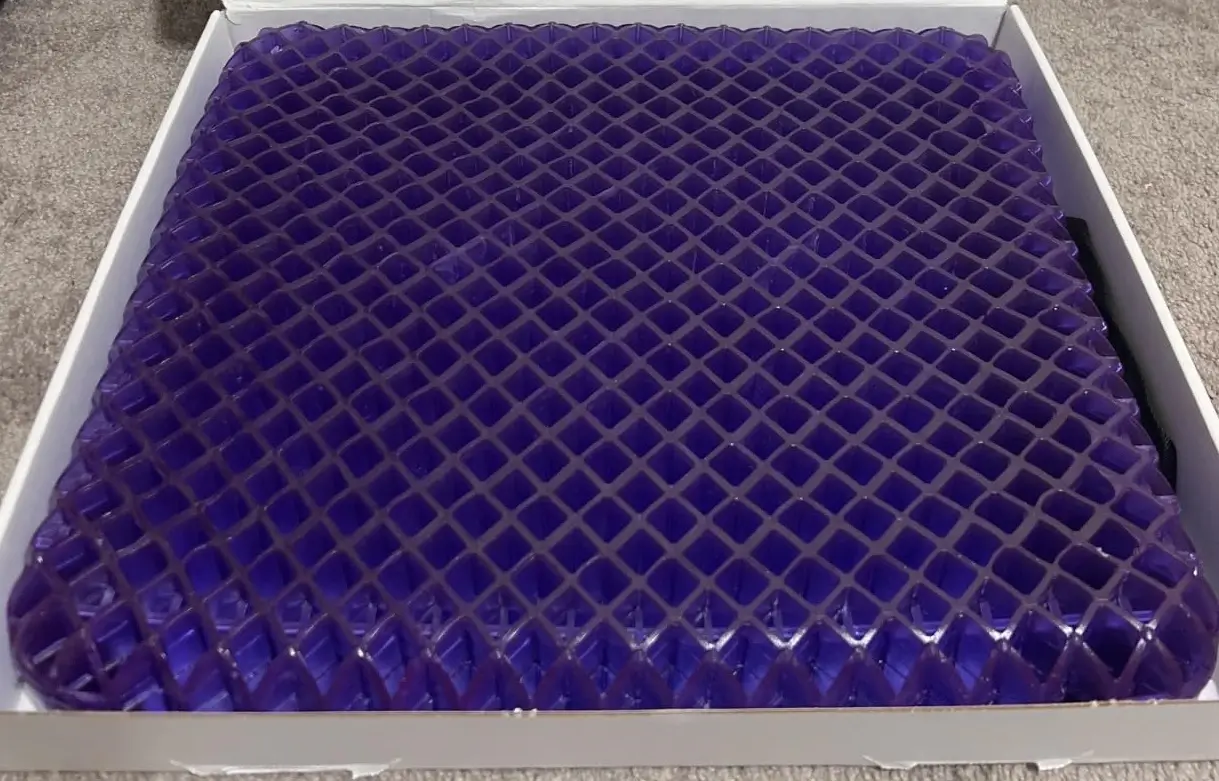
The Purple Royal departs from traditional foam entirely, opting instead for an open, 2-inch hyper-elastic polymer grid layout (GelFlex Grid). Under high point loads—specifically beneath the sit bones—the vertical walls of the grid columns bend and shift weight horizontally. This mechanical behavior helps spread contact pressure across the wider surface area, keeping the user elevated away from the hard chair pan below. The open-cell design also improves airflow compared with conventional memory foam, mitigating heat retention.
Long-term owner reports consistently indicate relatively little permanent deformation reported by long-term owners after extended use, making it a highly durable option for heavy statures, though it lacks active posture guidance.
• Common Complaint: Cushion feels heavy to carry and unstable when repositioning.
• Likely Cause: The inherent density of the solid hyper-elastic polymer material grid.
• Who Experiences It: Hybrid commuters who attempt to carry the cushion daily between offices.
• After 12 Months: Long-term owner feedback frequently reports zero permanent compression set, confirming the polymer grid easily outlasts standard low-density polyfoams.
ComfiLife Gel Enhanced Seat Cushion — Best Entry-Level Ergonomic Value
Rather than relying solely on foam, the ComfiLife Gel Enhanced Cushion features a hybrid composition incorporating a cooling gel layer atop a contoured memory foam core. Its classic rear U-shaped cutout aims to remove direct structural pressure from the tailbone region. The soft initial compliance offers immediate comfort, making it highly accommodating for lighter users who lack the body mass to load firm polyfoams.
This geometric design is highly portable, thanks to an integrated carry handle. However, based on recurring owner reports, users around or above 180 lbs are more likely to experience bottoming out during long, uninterrupted sitting blocks. This makes it ideal for mixed hybrid travel or occasional vehicle use rather than full-time heavy corporate duty.
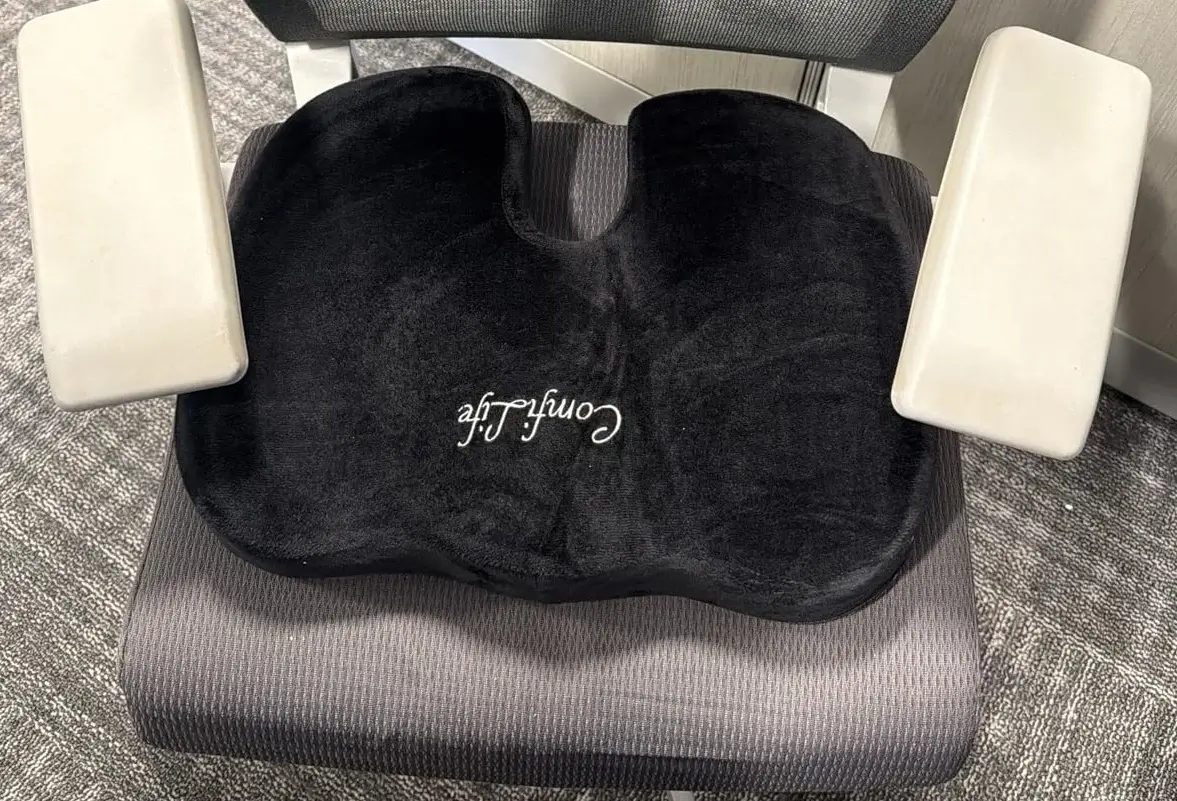
• Common Complaint: The cushion flattens out completely within an hour of continuous use.
• Likely Cause: Medium-density polyfoam collapsing under sustained loading near its weight ceiling.
• Who Experiences It: Users weighing near or over 180 lbs.
• After 6 Months: Ownership trends indicate the core memory foam shows noticeable compression set, requiring more frequent replacement than premium high-density models.
Xtreme Comforts Seat Cushion — Best for Flat Surfaces and Heavy-Duty Use
The Xtreme Comforts Cushion focuses entirely on flat, thick structural elevation without complex surface valleys. Utilizing a rugged, high-density polyfoam core, it is explicitly engineered to maintain its thick protective barrier even when placed on completely un-contoured, rigid seating bases like hard wooden chairs or metal task stools.
The notable advantage of this sturdy build is its consistent shape retention under heavy daily loads. Because it foregoes deep contours or rear cutouts, it does not force the thighs into a preset track, allowing users to shift their leg positioning freely throughout the day. The breathable mesh cover provides simple ventilation, making it a reliable, utilitarian workhorse for standard workspaces.
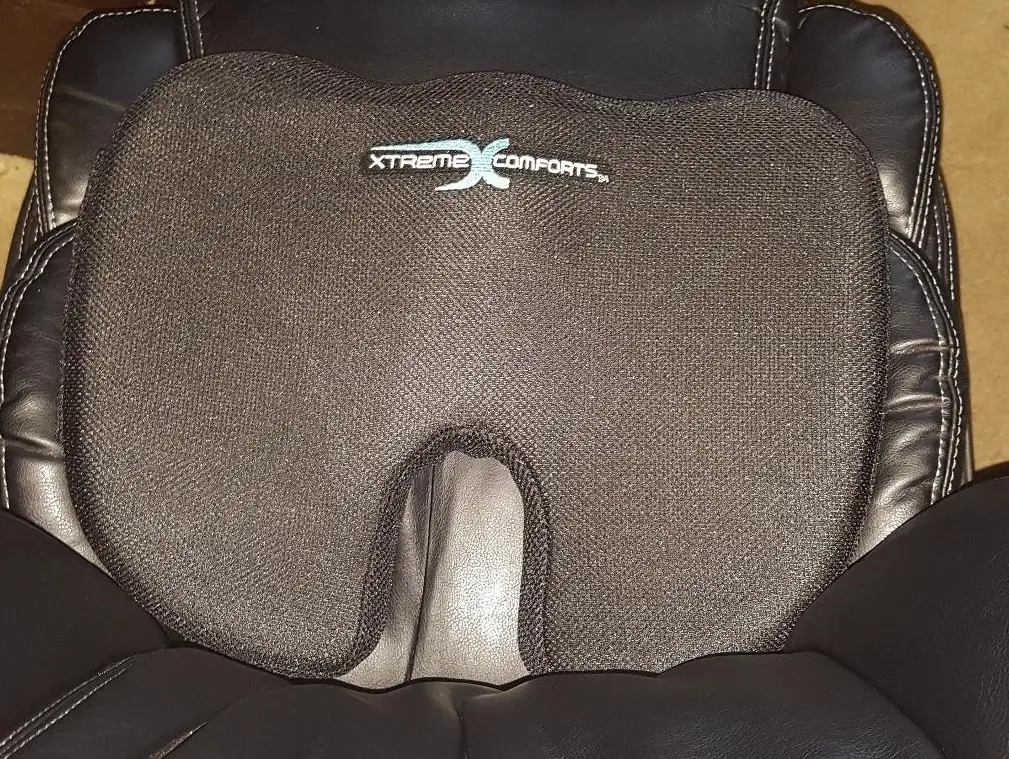
• Common Complaint: The cushion lacks an ergonomic ‘hug’ feeling.
• Likely Cause: The intentionally flat geometric layout provides direct upward support instead of cradling.
• Who Experiences It: Small-framed individuals looking for pronounced contours or deep pelvic guidance.
• After 6 Months: Users report exceptional durability, note that the seams hold up well, and verify that the core foam retains its supportive thickness.
6. Physical Specification & Utility Matrix
The table below compiles verified manufacturer data sheet specifications to help you measure workstation compatibility before ordering.
Table 4: Core Product Dimensions & Utilities
| Product Name | Dimensions (Inches) | Weight (Lbs) | Thickness (Inches) | Machine Washable Cover | Built-in Carry Handle |
|---|---|---|---|---|---|
| Cushion Lab Patented | 17.5 x 15.5 x 3.5 | 1.8 | 3.5 | Yes | No |
| Everlasting Comfort Large | 17.5 x 14.0 x 2.8 | 1.9 | 2.8 | Yes | Yes |
| Purple Royal Cushion | 17.5 x 16.0 x 2.0 | 5.4 | 2.0 | Yes (Wash cover only) | Yes |
| ComfiLife Gel Enhanced | 17.5 x 13.7 x 2.8 | 1.4 | 2.8 | Yes | Yes |
| Xtreme Comforts Cushion | 19.0 x 17.5 x 3.5 | 2.2 | 3.5 | Yes | Yes |
7. Long-Term Durability & Fatigue Forecasting
Based on tracking community ownership data over extended periods, different core materials exhibit distinct aging patterns under full-time (8+ hours daily) office usage.
Table 5: Estimated Long-Term Wear Profiles
| Product Name | 12-Month Foam Fatigue Risk | Zipper & Seam Integrity | Estimated Replacement Cycle |
|---|---|---|---|
| Cushion Lab Patented | Low (Dense polyfoam resists compression set well) | High (Reinforced hidden zipper track) | 18 – 24 Months |
| Everlasting Comfort Large | Moderate (Heat-activated memory foam yields faster over time) | Moderate (Standard alloy zipper teeth) | 12 – 18 Months |
| Purple Royal Cushion | Very Low (Hyper-elastic polymer retains structural memory) | High (Stretch-fit polyester knit seams) | 36+ Months |
| ComfiLife Gel Enhanced | High (Medium-density core prone to thinning under heavy loads) | Moderate (Lighter mesh fabric border) | 8 – 12 Months |
| Xtreme Comforts Cushion | Low (Rugged high-density single block polyfoam) | High (Heavy-duty industrial stitching) | 24+ Months |
8. Why the #1 Pick Isn’t Best for Everyone (Real Uncertainty)
While the Cushion Lab Patented Cushion earned our top recommendation, product tracking trends show it can easily fail to deliver relief if it is mismatched with your specific body structure or office chair setup. You should consider opting for an alternative if you fall into these categories:
- Your Chair Already Has Aggressive Built-In Lower Curves: If you use a chair with an unyielding backrest curve (like the permanent ridge on certain gaming chairs), the Cushion Lab cushion will push your pelvis forward while the chair pushes your upper back forward. This combination creates an overcorrected posture that can strain the mid-back.
- You Weigh Under 120 lbs: Denser polyfoam requires a baseline amount of physical force to compress. Based on product design geometry, lighter frames may not sink into the thigh channels. Instead, you risk sitting awkwardly on top of the firm foam contours, which can increase localized pressure on your hips.
- Your Chair Pan Has Short Seat Depth: The elevated rear rim of the Cushion Lab cushion noticeably reduces available seat depth. If your office chair seat pan is already short from front to back, this cushion will push you forward, leaving your thighs unsupported at the front edge.
Do not purchase an orthopedic seat cushion or attempt self-directed ergonomics if you experience any of the following symptoms:
- Radiating numbness or tingling that continuously progresses down past your knee into your foot.
- Sudden localized leg weakness, foot drop, or difficulty lifting the front part of your foot.
- Any new onset of bladder or bowel dysfunction associated with lower back strain.
- Severe, unremitting nerve pain that persists even after taking micro-breaks or moving your workstation setup.
If these red flags appear, please consult a physician or a qualified medical specialist immediately rather than relying on commercial seating aids.
9. Common Ergonomic Buying Mistakes
Through our editorial synthesis of common seating complaints, we have identified five recurring mistakes users make when selecting an orthopedic aid:
- Mistake #1: Prioritizing Thickness Over Firmness. Many users assume a thicker cushion equals more comfort. In practice, an overly thick but soft foam cushion compresses completely within minutes, offering less actual elevation than a thinner, high-density equivalent.
- Mistake #2: Ignoring Chair Seat Pan Width. Forcing a wide cushion (like the Purple Royal) into a highly contoured bucket-style office chair causes the sides to roll upward. This structural distortion destroys the intended alignment geometry and creates uneven pressure zones under the hips.
- Mistake #3: Buying Coccyx Cutouts for Lumbar Disc Discomfort. U-shaped cushions isolate the tailbone from direct contact forces. However, if your nerve discomfort is triggered by a bulging disc that worsens when you slouch, a U-shaped cutout will not prevent spinal rounding. Dynamic contoured models or dense multi-region inserts are often more appropriate to actively manage pressure zones.
- Mistake #4: Replacing Physical Movement with Cushion Upgrades. An ergonomic insert is a tool to improve pressure distribution, not a cure for total immobility. Relying on a cushion to sit uninterrupted for eight hours can still result in local tissue fatigue and nerve irritation.
- Mistake #5: Expecting a Cushion to Fix an Incompatible Chair Frame. A seat cushion cannot correct a fundamentally broken or sagging task chair base. If your underlying chair pan sinks unevenly or tilts to one side, adding a cushion simply mirrors that structural slant, carrying the uneven alignment up into your spine.
10. Workspace Integration & Seat Pan Compatibility
*Estimated spatial compatibility matrix based on matching published manufacturer chair pan specifications with cushion footprints.*
Table 6: Estimated Office Chair Fitting Matrix
| Office Chair Model / Pan Style | Cushion Lab Compatibility | Purple Royal Compatibility | Everlasting Comfort Compatibility | ComfiLife Compatibility |
|---|---|---|---|---|
| Herman Miller Aeron (Size B) | Likely Compatible: Fits cleanly inside the plastic rim if centered precisely. | Potential Fit Issues: Oversized grid causes edges to ride up onto the hard outer plastic bolster frame. | Likely Compatible: High memory foam thickness cushions the thigh boundary well. | Likely Compatible: Centers easily within the mesh suspension area. |
| Steelcase Leap (v2) | Likely Compatible: Complements the flexible seat edge without overriding contours. | Likely Compatible: Spans the full flat width between the adjustable armrest mounts cleanly. | Likely Compatible: Deep contours blend smoothly into the seat curve profile. | Likely Compatible: Standard positioning provides simple, stable lift. |
| IKEA Markus / Flintan | Likely Compatible: Fills the deep pan, but requires lowering the gas cylinder to keep feet flat. | Likely Compatible: Matches the wide, non-contoured flat rectangular seat base profile cleanly. | Likely Compatible: Offers wide surface area to maximize flat base padding. | Likely Compatible: Fits the narrow, flat dimensions without overhang. |
| Deep Gaming Chairs (e.g., Secretlab) | Likely Compatible: Fills the deep pan, though rear contours may conflict slightly with bucket wings. | Likely Compatible: Spreads flat across the wide, firm, un-contoured seat base. | Likely Compatible: Broad footprint covers the wide bucket bolster zone easily. | Likely Compatible: Centers easily on the flat surface. |
11. Buying Guide: Biomechanics of Orthopedic Seating
According to workspace ergonomic guidelines published by the Mayo Clinic, traditional office setups often restrict users to a rigid 90-degree angle at the hips and knees. However, clinical movement studies show that opening the hip-to-trunk angle to approximately 100 to 110 degrees may reduce the passive pull on deep lower structures. An effective orthopedic cushion raises your pelvis relative to your knees, promoting a natural forward tilt that assists in preserving structural alignment and may reduce strain on the lower back.
Beyond choosing the right cushion, sitting still for hours can restrict local tissue blood flow and speed up muscle fatigue. The Cleveland Clinic advises desk workers to break up long periods of sitting by standing up every 45 to 60 minutes, altering their working height if using a sit-to-stand desk, or taking a short walk. These simple adjustments help shift physical loads across different muscle groups, helping to prevent cumulative stress on compressed nerve pathways.
When setting up your workstation with a new cushion, consider these standard adjustment steps to keep your body properly aligned:
- Adjust Your Chair Height: Adding a thick cushion lifts your torso, which can pull your feet off the floor. Lower your chair cylinder until your feet rest completely flat, preventing dangerous pressure on the undersides of your thighs. If your workspace desk cannot be lowered, pairing the setup with an office footrest is highly recommended.
- Incorporate a Foot Rest: If your desk height is fixed and cannot be lowered to match your new sitting position, use a supportive footrest to keep your knees bent at a healthy, comfortable angle.
- Reposition Your Monitor: Raising your sitting height changes your line of sight. Tilt or raise your screen so the top third of the monitor sits at eye level, preventing neck strain.
12. Frequently Asked Questions
- Can an improper seat cushion worsen radiating lower body nerve pain? Yes. If a support layer is overly soft or thin, it will compress completely under your weight. This structural breakdown leaves the pelvis stuck in a posterior tilt, flattening the lower back and increasing pressure on lumbar discs, which can worsen radiating sciatica symptoms.
- How should I choose between a U-shaped coccyx cushion and a sloped wedge? Choose a U-shaped coccyx cushion if your pain is triggered by direct pressure on the tailbone or local gluteal tissues. Opt for a sloped wedge if your discomfort stems from a herniated disc that worsens when you slouch, as the forward slope helps restore your natural lower back curve.
- What is the core difference between memory foam and hyper-elastic gel grid materials? Memory foam relies on body warmth to soften and conform, providing deep, contoured support, though it traps heat and can soften significantly during long shifts. Hyper-elastic gel grids use vertical columns that bend under load, delivering consistent elevation, durable bounce-back, and continuous airflow.
- Can a seat cushion help manage discomfort related to piriformis syndrome? An orthopedic support may improve sitting comfort in some individuals experiencing piriformis-related symptoms by offloading peak pressure from the deep gluteal region. Models with wide thigh contours or responsive gel grids help reduce direct compression on the piriformis muscle, minimizing localized irritation along the underlying sciatic nerve pathway during long periods of sitting.
Clinical & Editorial Resources:
- American Physical Therapy Association (APTA) — Clinical Guidelines for Lumbar Spine Health and Radiating Nerve Root Management.
- Mayo Clinic — Office Ergonomics: Workstation Adjustments to Lower Static Posture Strain.
- Cleveland Clinic — Diagnostic Protocols and Non-Surgical Management Paradigms for Sciatica and Deep Gluteal Compression.
