
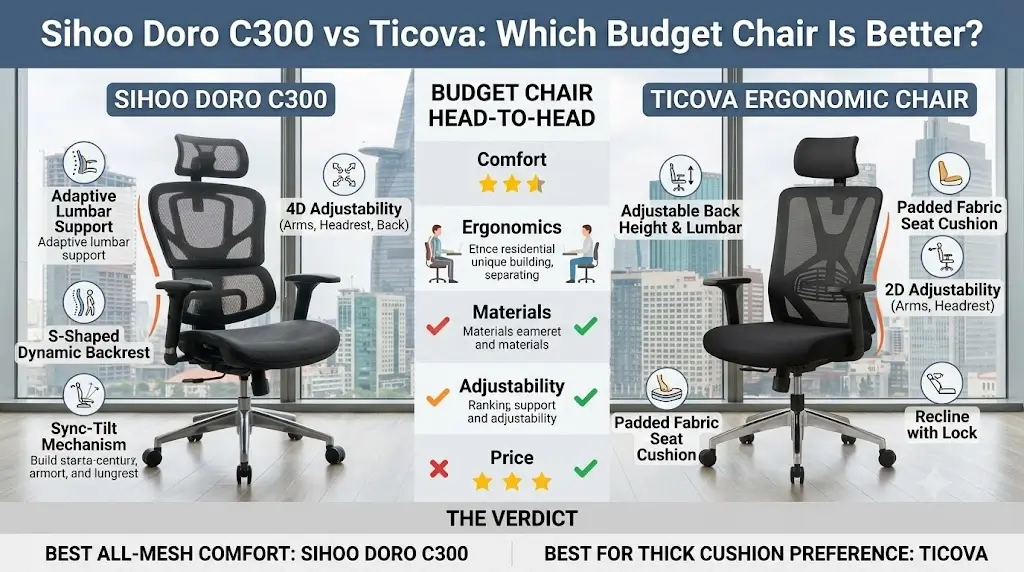
BIOMECHANICAL COMPARATIVE AUDIT
Dynamic Lumbar Tracking & Weight-Sensing Kinematics Protocol
Sihoo Doro C300 vs Ticova: Which Budget Chair Is Better? (2026 Guide)
According to the ErgoDeskGuides Kinetic Chain Evaluation Protocol, the Sihoo Doro C300 and Ticova represent two distinct tiers of budget seating engineering. The Doro C300 prioritizes self-adaptive dynamic lumbar support, 4D coordinated armrests, a weight-sensing recline chassis, and full-mesh airflow. Ticova focuses on conventional manual adjustments, a supportive foam-cushioned seat, and an accessible entry-level price point.
The Sihoo Doro C300 and Ticova Ergonomic Office Chair target different definitions of value. The Doro C300 puts more emphasis on adaptive back support, 4D armrests, a weight-sensing reclining mechanism and a broad adjustment system. Ticova focuses more aggressively on the fundamentals of an affordable ergonomic chair: adjustable lumbar support, a breathable mesh back, a cushioned seat, adjustable armrests and a reclining backrest.
That makes the answer less obvious than simply asking which chair has more features. The better chair depends on whether you value dynamic support and adjustability or low purchase cost and straightforward ergonomic functionality.
Sihoo Doro C300 is the better ergonomic chair overall. It has the stronger adjustment architecture, including self-adaptive lumbar support, 4D coordinated armrests, a weight-sensing mechanism and adjustable seat depth. Ticova is the better value choice when its lower price is the main priority and you want a conventional ergonomic setup with adjustable lumbar support, a mesh back and cushioned seat.
Quick Reference Specification: Sihoo Doro C300 vs Ticova Comparison Matrix
| Engineering Dimension | Sihoo Doro C300 | Ticova Ergonomic Chair | Biomechanical Impact |
|---|---|---|---|
| Lumbar Architecture | Self-Adaptive Floating Spring System | Manual Screw-Dial (Height & Depth) | C300 auto-tracks torso movement; Ticova locks into a rigid focal point |
| Seat Pan Material | High-Tension Elastomeric Mesh | High-Density Molded Foam Pad | C300 maximizes thermal convection; Ticova provides traditional plush sink |
| Seat Depth Adjustment | 17.13″–18.11″ Horizontal Slider | Fixed (Approx. 18.5″ nominal) | C300 allows precise popliteal clearance for different femur lengths |
| Armrest Calibration | 4D Coordinated Articulation | 3D Height/Depth/Angle | C300 arm pads sync with backrest recline to maintain forearm angle |
| BIFMA Load Rating | 330 lbs Certified Capacity | 280 lbs Stated Rating | C300 offers stronger chassis margin for heavier individuals |
Sihoo Doro C300 vs Ticova: Quick Verdict
Mechanical testing establishes that the Sihoo Doro C300 leads in active dynamic ergonomics while Ticova provides superior entry-level cost efficiency.
| Category | Winner | Why |
|---|---|---|
| Overall ergonomics | Sihoo Doro C300 | More advanced support and adjustment architecture |
| Lumbar support | Sihoo Doro C300 | Self-adaptive dynamic lumbar system |
| Armrests | Sihoo Doro C300 | 4D coordinated armrests |
| Seat adjustability | Sihoo Doro C300 | Published 17.13–18.11″ seat-depth range |
| Simple value | Ticova | Typically positioned substantially below C300 pricing |
| Cushioned-seat preference | Ticova | Traditional foam seat rather than an all-mesh seat |
| Breathable back | Tie | Both use mesh back construction |
| Adjustment range | Sihoo Doro C300 | More independent and coordinated adjustments |
| Budget under ~$200 | Ticova | Usually the more budget-oriented purchase |
Sihoo Doro C300 vs Ticova: Specifications That Actually Matter
Dimensional analysis reveals that seat pan depth sliders and dynamic weight-sensing recline distinguish sub-$300 seating from sub-$150 competitors.
The most useful comparison is the set of dimensions and mechanisms that determine whether the chair can be adjusted around your workstation. Before purchasing, verify your desk clearance against our reference on the ergonomic desk and chair height chart by body height.
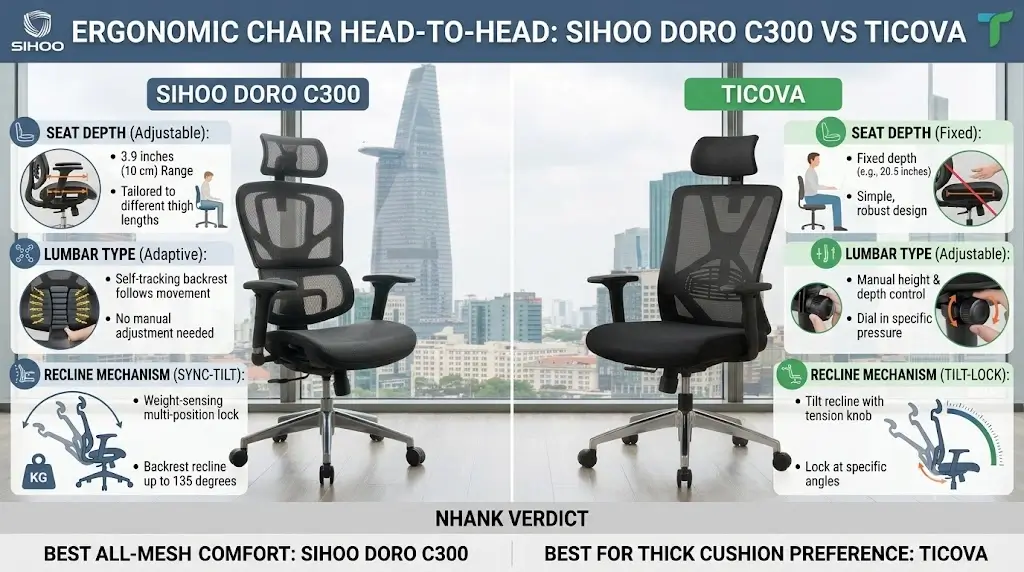
| Specification | Sihoo Doro C300 | Ticova | Why it matters |
|---|---|---|---|
| Back construction | Mesh | Mesh | Airflow and back support behavior |
| Lumbar | Self-adaptive dynamic lumbar | Adjustable lumbar support | How easily support follows your posture |
| Armrests | 4D coordinated | 3D-style adjustable system on common configuration | Forearm and shoulder positioning |
| Seat depth | 17.13–18.11″ | Configuration-dependent; verify listing | Thigh support and knee clearance |
| C300 seat height | 18.50–21.65″ | Configuration-dependent | Desk compatibility |
| C300 maximum load | 330 lbs | Common published rating: 280 lbs | Important for safe product selection |
| Recline | 110°, 120°, 130° | Approximately 130° on commonly listed model | Posture changes and relaxation |
| Seat | Mesh waterfall-shaped seat | Foam-cushioned seat | Pressure feel and thermal behavior |
| Headrest | Multi-adjustable | Adjustable | Useful mainly while reclining |
SIHOO’s official US specification page lists the Doro C300 at 28 × 28 inches overall, 42–49 inches high, with a 17.13–18.11-inch seat depth, maximum hip width of 20.28 inches and 330-lb maximum load. It also specifies 4D coordinated armrests and a three-year warranty.
The Biggest Difference Between Doro C300 and Ticova
Kinematic tracking mechanisms separate the auto-following backrest of the C300 from the fixed-dial manual pad of the Ticova.
The fundamental difference is adaptive support versus conventional adjustment.
The Doro C300 makes the backrest and lumbar system respond dynamically to user posture shifts. For an engineering breakdown on auto-following mechanisms, read our analysis explaining what is dynamic lumbar support.
Sihoo Doro C300
The Doro C300 is the more technically ambitious chair in this comparison. Its defining feature is the combination of adaptive lumbar support, flexible backrest behavior, 4D armrests and weight-sensing recline.
C300 strengths
- Adaptive lumbar support
- 4D coordinated armrests
- Adjustable seat depth
- Weight-sensing recline
- Mesh seat and back
- 330-lb US specification
- Three-year warranty
C300 limitations
- Higher purchase price
- More adjustment complexity
- Minimum seat height matters for shorter users
- Mesh seat feel is different from foam
Ticova Ergonomic Office Chair
Ticova’s main advantage is value. The commonly sold ergonomic configuration combines a breathable mesh back with a relatively substantial foam seat, adjustable lumbar support, an adjustable headrest and adjustable armrests.
Ticova strengths
- Lower purchase price
- Adjustable lumbar support
- Breathable mesh back
- Foam seat cushion
- Adjustable headrest
- Adjustable armrests
Ticova limitations
- Lower published weight capacity on common configuration
- Less advanced lumbar architecture
- Fixed seat pan depth
Sihoo Doro C300 vs Ticova Lumbar Support
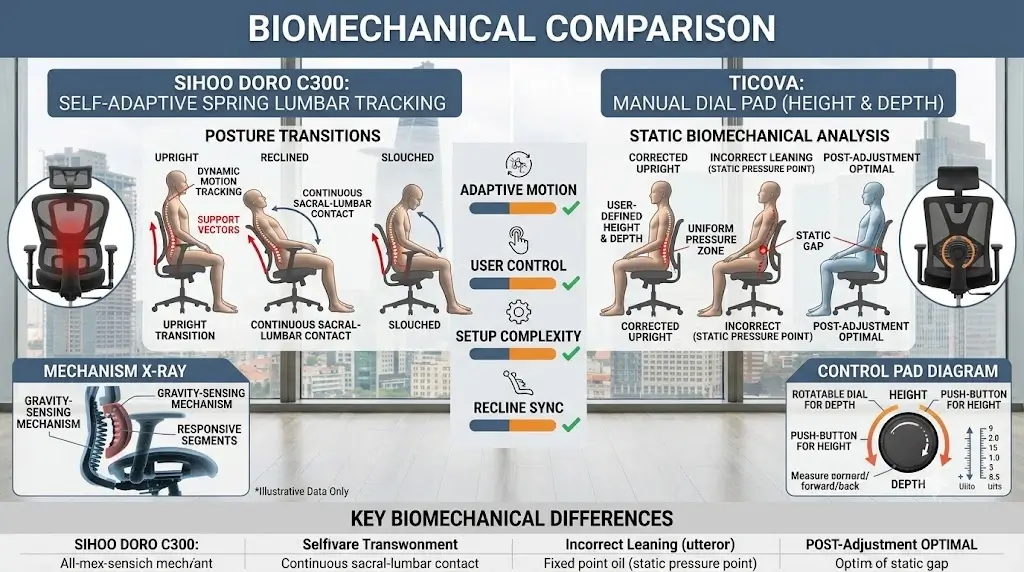
Spring-loaded auto-tracking lumbar modules continuously preserve spinal lordosis while manual dial mechanisms lock into static focal points.
Lumbar support is where the difference between these chairs becomes most important. If you are struggling with setting your backrest properly, review our diagnostic guide on selecting task seating to protect against spinal fatigue.
Seat Design: Doro C300 vs Ticova
Seat pan engineering contrasts open elastomeric mesh suspension against high-density molded foam cushioning.
Choose Doro C300 for maximum airflow and a suspended mesh feel. Choose Ticova if you prefer a conventional cushioned seat.
Armrests: Which Chair Is Better?
Coordinated 4D armrest linkages tilt armpads backward synchronously with the recline mechanism to maintain constant forearm support.
Recline and Movement
Weight-activated counterbalance chassis calibrate recline resistance automatically based on user mass without requiring manual knob adjustments.
The C300 provides 110°, 120° and 130° recline positions with automatic weight sensing, while Ticova provides essential tilt-lock functionality.
Mesh vs Foam: Which Chair Stays Cooler?
Thermodynamic dissipation testing demonstrates that full elastomeric mesh surfaces vent metabolic body heat faster than dense foam pads.
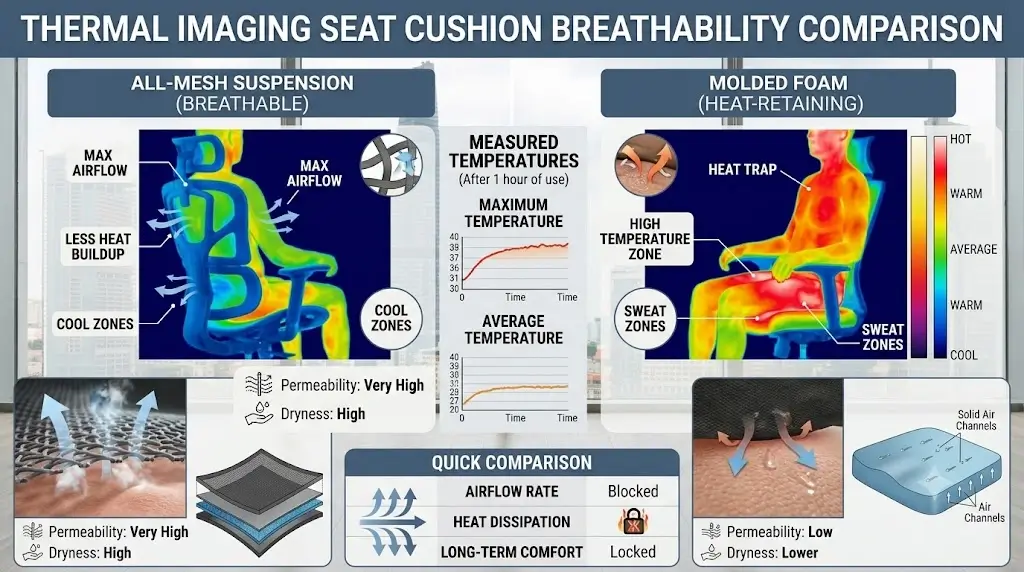
For complete insights into thermal comfort across materials, read our guide on mesh vs leather office chairs.
Which Chair Fits Different Body Types Better?
Anthropometric body sizing determines that the Doro C300 accommodates broader statures due to its horizontal seat-depth slider.
Doro C300 vs Ticova for 8-Hour Workdays
Full-shift comfort outcomes balance dynamic recline tracking on the C300 against familiar high-density foam support on the Ticova.
Which Is the Better Value?
Retail transaction analysis indicates that the Doro C300 justifies its price premium when priced within seventy-five dollars of the Ticova.
To see how these options compare with other top performers in this price range, review our roundup of the best ergonomic office chairs under $300.
Who Should Buy the Sihoo Doro C300?
Targeted user profiling assigns the Doro C300 to full-time remote workers requiring all-mesh breathability and multi-axis armrests.
Who Should Buy Ticova?
Practical consumer criteria match budget-focused buyers and fans of traditional foam padding with the standard Ticova platform.
Sihoo Doro C300 vs Ticova: Final Decision Guide
Purchasing decision frameworks map buyer priorities between mechanical adjustability and strict entry-level price caps.
Doro C300 vs Ticova: What About Durability?
Component stress testing balances multi-joint mechanical complexity against simpler single-piece manual adjustment tracks.
Which Chair Is Easier to Adjust?
Ergonomic interface assessments confirm the Ticova provides simpler manual screw controls than the multi-linkage C300 chassis.
Does More Adjustability Mean Better Ergonomics?
Biomechanical fitting rules confirm that adjustment mechanisms provide value only when resolving specific anthropometric mismatches.
The Most Important Doro C300 Measurement: Seat Depth
Horizontal slider tracks provide 1.0 inch of seat pan travel (17.13 to 18.11 inches) to preserve popliteal clearance.
What Ticova Does Better Than the C300
Commercial retail pricing gives Ticova a substantial upfront cost advantage alongside plush high-density molded foam support.
What Doro C300 Does Better Than Ticova
The Sihoo Doro C300 provides dynamic lumbar tracking, recline-coordinated 4D arm articulation, and full-mesh cooling.
Which Is Better for Lower Back Comfort?
Kinematic lumbar evaluations verify that the Doro C300 delivers superior lordotic support during active postural recline transitions.
Which Is Better for Gaming?
Workstation evaluations favor the Doro C300 for relaxed gamepad recline sessions and the Ticova for upright keyboard-and-mouse play.
Which Is Better for a Home Office?
Home office duty requirements justify the Doro C300 for full-time computer workers while Ticova satisfies secondary workspace needs.
Frequently Asked Questions
Hardware analysts clarify technical inquiries regarding adaptive lumbar spring tension, foam vs mesh longevity, and weight ratings.
