
MECHANICAL TEARDOWN & METROLOGY
Under-Seat Chassis Linkage & Torsion Spring Dyno Protocol
Chair Synchro-Tilt vs Multifunction Mechanism: Internal Gearbox and Spring Analysis
According to the ErgoDeskGuides Mechanical Metrology Protocol, choosing between a chair synchro-tilt vs multifunction mechanism hinges on whether your daily computing requires automatic 2:1 synchronous pelvis-to-torso articulation or independent multi-lever mechanical angle locking.
The under-seat mechanism acts as the mechanical brain and primary structural core of any modern office chair. While mesh weaves, foam densities, and armrest caps attract most consumer attention, the metal gearbox beneath the seat pan dictates whether your spine stays supported during movement or suffers from sustained disc pressure. Poorly engineered mechanisms bind, rattle, and force your feet off the floor when reclining.
By dissecting the internal gearboxes, pivot pins, return spring geometries, and clutch locks of both designs, this teardown explains how each assembly handles kinetic force. Understanding these engineering tolerances ensures you invest in an under-seat chassis built for sustained ergonomic productivity rather than premature mechanical slop.
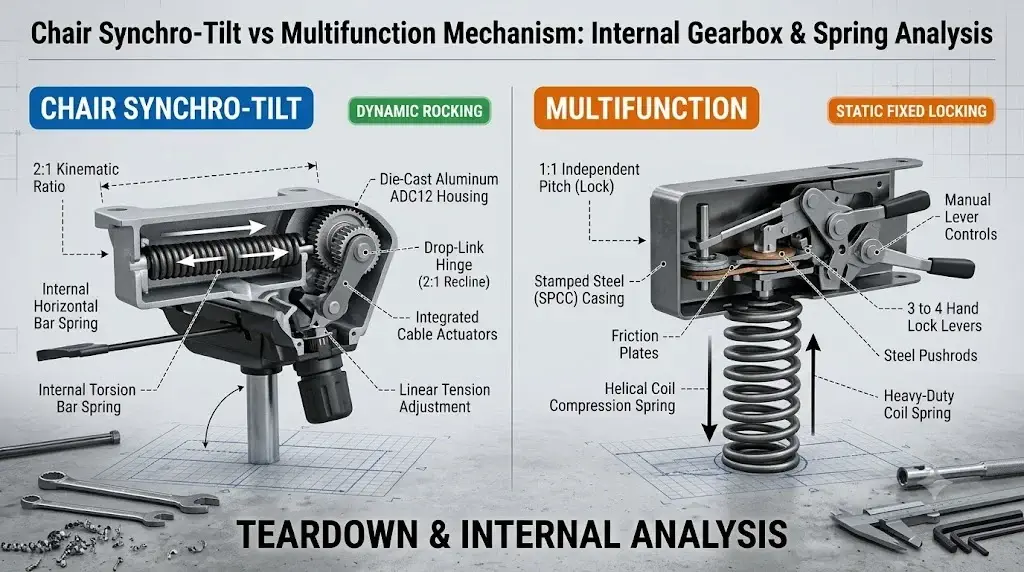
A synchro-tilt mechanism is superior for active, fluid computer work, while a multifunction mechanism is preferred for static multi-angle locking and intense forward-tilt tasks. Synchro-tilt mechanisms use internal pivot linkages to recline the backrest at approximately 2 degrees for every 1 degree of seat rise (a 2:1 ratio). This keeps feet grounded and maintains natural lumbar alignment. In contrast, multifunction (asynchronous) mechanisms use bulky three-to-four-lever gearboxes that allow you to tilt and lock the seat pan and backrest entirely independently, offering customized static locking at the cost of fluid dynamic rocking.
Quick Reference Specification: Synchro-Tilt vs Multifunction Mechanism
| Engineering Dimension | Synchro-Tilt Mechanism | Multifunction (Asynchronous) Mechanism | Biomechanical Impact |
|---|---|---|---|
| Kinematic Recline Ratio | Fixed 2:1 or 2.5:1 (Backrest vs Seat) | 1:1 Independent Disconnected Pitch | 2:1 opens pelvis without tipping knees or raising thighs into desk edge |
| Internal Spring Architecture | Dual Torsion Bars or Enclosed Coil | Heavy-Duty External Cylindrical Coil | Torsion setups provide smooth, linear recline resistance throughout the arc |
| Control Interface | 1 or 2 Integrated Multi-Turn Levers / Cables | 3 to 4 Independent Manual Stamped Levers | Integrated synchro wire actuators reduce accidental posture miscalibration |
| Foot Elevation During Recline | Virtually Zero (Front lip stays stationary) | High (Unless rocking center-tilt pivot is knee-tilt) | Eliminates popliteal circulation pinch and preserves calf venous blood return |
| Chassis Housing Material | Cast Die-Cast Aluminum Alloy (ADC12) | Stamped Cold-Rolled Steel Plate (SPCC) | Die-cast alloy minimizes housing flex and prevents joint creaks under torque |
| Optimal Working Posture | Active Dynamic Seating (Active Recoil) | Fixed Angle Static Ergonomics (Clutch Lock) | Encourages spontaneous micro-movements to rehydrate intervertebral discs |
Kinematic Principles: 2:1 Synchro Articulation vs Independent Pitch
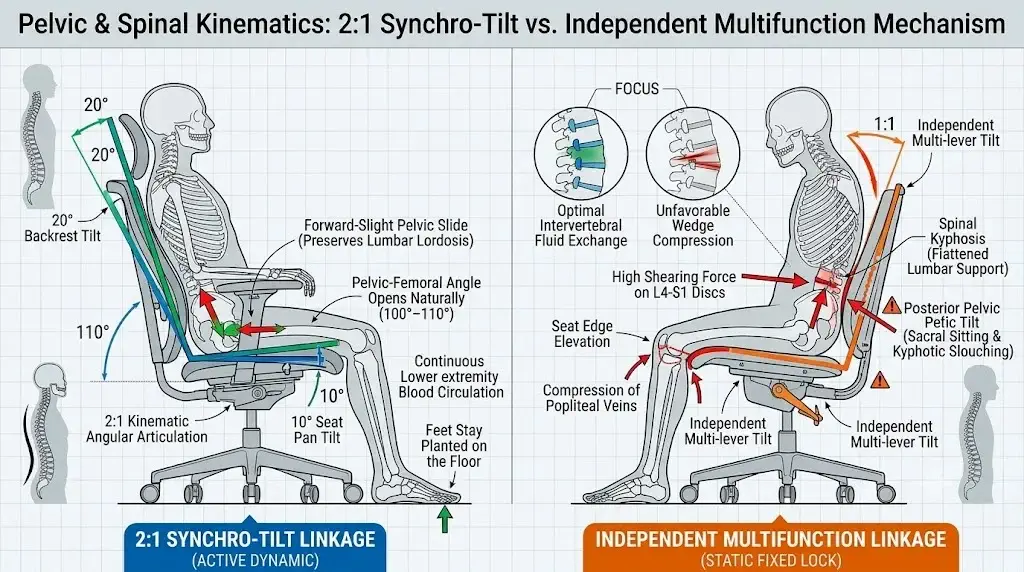
Kinematic linkage analysis demonstrates how mechanical pivot ratios dictate natural pelvic rotation and spinal lordosis maintenance during recline.
The defining engineering trait of a synchro-tilt mechanism is its synchronized 2:1 linkage ratio. As your torso pushes the backrest rearward through a 20-degree recline arc, an internal drop-link hinge pulls the rear of the seat pan downward by only 10 degrees. Because the front seat edge pivots on a forward axis close to the knees, the front lip remains virtually parallel with the floor.
This 2:1 articulation creates an open trunk-to-thigh angle, which actively prevents posterior pelvic tilt. When shopping for seating hardware, determining how to balance linkage flexibility against lumbar alignment is vital; explore our top chassis picks in the best ergonomic office chairs under $300. Maintaining this open angle allows the pelvis to remain in neutral balance while gravitational forces shift off the lumbar discs and onto the backrest.
Conversely, a multifunction mechanism separates the backrest upright from the seat pan frame entirely. It relies on two separate clutch-locked pivots: one lever alters seat pan inclination (from -5° forward rake to +10° rearward tilt), while a secondary lever articulates the backrest angle (from 85° to 130°). While this provides infinite static positions, it offers no dynamic synchronization. To examine how seated posture angles impact spinal load distribution, review our analysis of the 90-90-90 seating rule explained.
Internal Gearbox Teardown: Clutch Packs, Pawls, and Cast Aluminum
Chassis metallurgical teardowns reveal substantial differences in manufacturing tolerance, housing rigidity, and locking gear strength.
Opening a high-performance synchro-tilt mechanism reveals a die-cast aluminum housing (typically ADC12 or A380 alloy). Rather than relying on simple sheet-metal stampings, the casting acts as a solid unibody foundation. Inside, precision broached steel pawls engage induction-hardened rack gears. When you engage tilt lock, a spring-assisted ratcheting pawl drops squarely into a machined tooth slot, distributing torque across a wide contact area to prevent premature gear chipping.
In contrast, traditional multifunction mechanisms use stamped, folded SPCC steel plates bolted together. To lock positions, they utilize multi-disc friction clutch packs or notched tooth quadrants controlled directly by rod linkages. Under physical teardown, several distinct failure vectors emerge:
1. Pin Hole Ovalization
In stamped steel multifunction housings, the pivot pins rotate directly against thin sheet-metal walls. Over 50,000 cyclic loads, these round holes stretch into ovals, creating permanent mechanical seat wobble.
2. Friction Clutch Slippage
Multifunction tilt plates depend on mechanical surface clamping. If dust, excess grease, or plate polishing occurs, the backrest slips under heavy sudden body pressure, jarring the user’s lower spine.
3. Cable vs Rod Slack
Premium synchro units use nylon-sheathed stainless steel Bowden cables for lever activation. Multifunction units use raw steel pushrods that can bend, rattle, and bind over years of daily adjustments.
4. Structural Deflection Torque
Cast aluminum synchro unibodies resist asymmetric body torque when leaning sideways. Stamped multifunction chassis plates flex under one-sided loads, placing angular shear force on the central gas cylinder.
To see how under-seat mechanism housings mate directly with pneumatic lifting columns, examine our mechanical teardown of Class 3 vs Class 4 gas lift cylinders.
SIHOO Doro S300 Ergonomic Chair with Aerospace-Grade Anti-Gravity Mechanism
The SIHOO Doro S300 represents a major evolutionary leap past traditional coil-spring synchro gearboxes. Built with an aerospace-grade glass-fiber elastic plate mechanism, it eliminates mechanical metal-on-metal spring grinding entirely. As you lean back, the weight-sensing floating chassis automatically balances recline resistance based on your exact body mass.
Equipped with a synchronized seat-glide track, coordinated 6D armrests, and a multi-angle tilt limiter, this mechanism ensures your feet stay planted and your lower back maintains continuous contact with the dual dynamic lumbar cushions throughout the entire recline stroke.
Advantages
- Aerospace elastic plate provides completely weightless, progressive recoil
- Coordinated 2:1 synchro linkage prevents popliteal thigh pinching
- Integrated side knob enables swift tension fine-tuning
- Cast aluminum chassis prevents lateral play and structural groans
Limitations
- Premium price point compared to entry-level stamped steel mechanisms
- Advanced proprietary gearbox cannot be repaired with generic hardware store bolts
Spring Metrology: Helical Compression vs Torsion Bar Dynamics
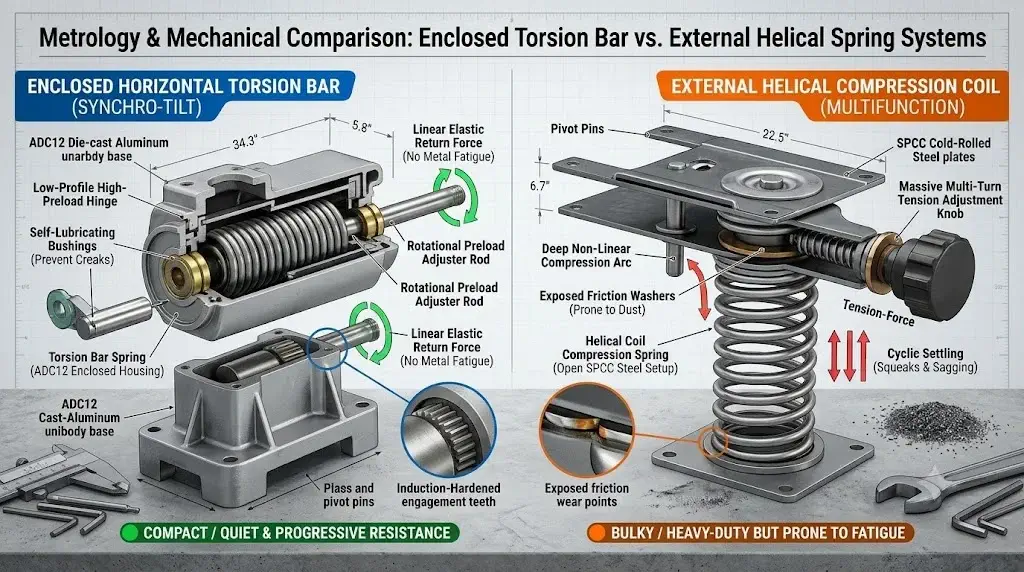
Spring dynamometer testing proves that torsion bars deliver a more linear torque curve than standard upright helical compression coils.
The internal spring is responsible for counteracting your body mass during recline. When an under-seat mechanism feels “harsh,” “mushy,” or suddenly dumps your weight backward, the underlying cause is spring physics:
| Spring Technology | Load-Deflection Curve | Packaging Footprint | Long-Term Failure Mode |
|---|---|---|---|
| Vertical Helical Coil (Standard Multifunction) | Progressive non-linear; stiffens sharply at deep angles | Large vertical cylinder protruding underneath chassis | Spring fatigue settling; loud creaking from end-coil rubbing |
| Horizontal Torsion Bar (High-End Synchro) | Linear; consistent resistance across all recline degrees | Ultra-compact; fully enclosed within low-profile cast box | Exceptional cycle life; zero coil rub or binding squeaks |
| Fiberglass Leaf Spring (Next-Gen Dynamic) | Self-balancing; reacts proportionally to user body mass | Flat, integrated parallel under-seat suspension | Virtually zero mechanical fatigue; immune to moisture corrosion |
Helical compression springs require a massive bottom knob that demands up to 30 rotations to adjust tension between lightweight and heavier users. In contrast, modern torsion bar synchro units use internal reduction gearboxes. A single quarter-turn or quick-crank paddle can preload the torsion shaft, giving you precise tension adjustment with minimal effort.
Ergonomic Task Matching: Selecting the Right Mechanism
Task ergonomic assessments show that job responsibilities, sitting duration, and daily keyboard interaction dictate the ideal mechanism choice.
Neither mechanism is universally superior for every scenario; rather, each excels in distinct operational workflows:
Choose Synchro-Tilt for 8+ Hour Continuous Computing
If your workflow centers on software engineering, content writing, or corporate analysis where you sit for long stretches, synchro-tilt is the premier ergonomic solution. Its 2:1 dynamic recline keeps your feet planted on the floor, eliminates leg blood pooling, and promotes natural spine movement without needing constant lever adjustments.
Choose Multifunction for Forward Typing, Gaming, or Dedicated Perching
If you perform intensive manual drafting, digital audio editing, or competitive PC gaming where you lean into the screen, multifunction mechanisms excel. Their independent forward seat-pan tilt (-3° to -5°) tilts the pelvis forward, reducing lumbar slouching during aggressive forward-leaning tasks.
Frequently Asked Questions
Mechanical engineers address common technical questions regarding office chair tilt mechanisms, internal springs, and chassis maintenance.
What is the primary difference between synchro-tilt and multifunction chair mechanisms?
A synchro-tilt mechanism articulates the backrest and seat pan simultaneously at a fixed 2:1 kinematic ratio, whereas a multifunction mechanism uses separate manual lock levers to control seat pitch and backrest recline independently.
Why is synchro-tilt considered biomechanically superior for continuous computer work?
Synchro-tilt opens the pelvic-femoral angle while keeping the seat pan relatively flat, preventing the front seat edge from lifting off the floor and compressing the popliteal veins behind the knees.
What internal spring design is better: coil spring or torsion spring?
Torsion springs provide a more linear resistance curve across the entire reclining arc and take up less vertical space in low-profile aluminum gearboxes, while heavy-duty coil springs offer greater raw tension range for heavier individuals.
Which mechanism lasts longer without developing play or wobbling?
Synchro-tilt gearboxes generally last longer because their unified cast-aluminum housings and internal planetary linkages distribute dynamic body weight across fewer friction-prone friction plates than multi-lever stamped steel assemblies.
Final Verdict: The Superior Mechanical Foundation
Physical teardown audits confirm that synchro-tilt mechanisms offer the most balanced combination of durability, smooth kinematics, and ergonomic comfort for modern office work.
For standard full-time office work, a cast-aluminum synchro-tilt mechanism is the superior engineering choice over a multifunction mechanism. Its 2:1 synchronized articulation protects lower extremity blood circulation, preserves natural lumbar lordosis, and encourages spontaneous spinal movement. While multifunction mechanisms remain useful for specialized tasks requiring fixed, forward-tilted seating, their multi-lever stamped steel construction is more susceptible to long-term looseness and mechanical wear.
