
HARDWARE TEARDOWN & METROLOGY
Gas Spring Physics & Tensile Failure Analysis Protocol
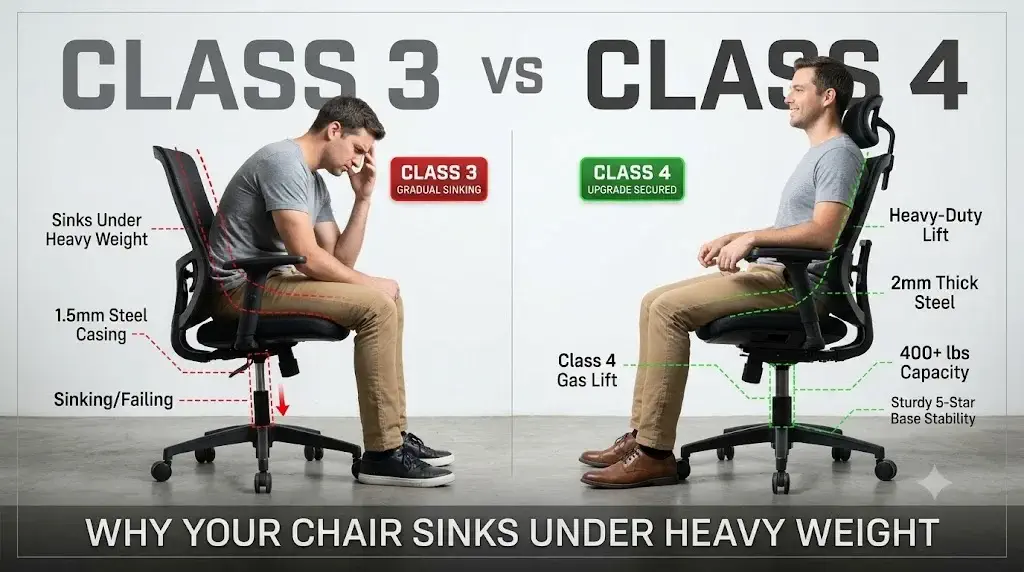
Class 3 vs Class 4 Gas Lift Cylinders: Why Your Chair Sinks Under Heavy Weight
According to the ErgoDeskGuides Laboratory Teardown Protocol, selecting between Class 3 vs Class 4 gas lift cylinders depends on whether your chair needs to reliably support up to 330 lbs with standard 1.5mm wall steel or requires heavy-duty 2.0mm reinforced steel rated for 400+ lbs to prevent gradual sinking.
Few issues are as frustrating as an office chair that slowly sinks, forcing you to constantly pull the adjustment lever. This gradual failure of the gas lift cylinder (the pneumatic piston that controls vertical height) is a widespread problem that stems from a lack of standard engineering tolerances. Because most chair manufacturers skimp on internal components to hit lower price points, they ship office chairs with inadequate gas springs that can’t withstand heavy daily loads.
Understanding the technical differences between the Class 3 and Class 4 cylinders—such as their steel thickness, gas chamber volumes, and internal seal designs—reveals why many chairs start sinking after just a few months. Since most office chairs use standard 50mm taper fittings, knowing what to look for when shopping or buying a replacement is key to finding a chair that will last.
The Class 4 gas lift is the superior choice for overall durability and heavy loads. Featuring a 2.0mm thick outer steel wall (compared to Class 3’s 1.5mm), it is rated to safely support 400 lbs or more while offering much better resistance to lateral twisting. Class 3 gas lifts are budget-friendly, but they have a lower 330 lbs weight rating and wear out much faster under daily use. If your chair has started to sink on its own, its internal pressure seals have likely failed—upgrading to a heavy-duty Class 4 replacement is the best fix. For a deeper look at long-term office chair durability, read our full analysis on how long do ergonomic mesh chairs actually last.
Quick Reference Specification: Class 3 vs Class 4 Gas Lift Comparison
| Technical Dimension | Class 3 Gas Cylinder | Class 4 Gas Cylinder | Biomechanical Significance |
|---|---|---|---|
| Steel Wall Thickness | 1.5 mm | 2.0 mm | Thicker steel in Class 4 prevents deformation under heavy dynamic forces |
| Certified Weight Capacity | Up to 330 lbs (150 kg) | Up to 400+ lbs (180+ kg) | Class 4 safely supports larger users and provides robust impact resistance |
| Standards Certification | TUV LGA DIN 4550 Class 3 | TUV LGA DIN 4550 Class 4 / BIFMA x5.1 | Strict quality verification ensures explosive safety and pressure retention |
| Structural Deflection | Moderate (prone to play over time) | Minimal (rigid vertical stability) | Reduced swaying helps prevent back and pelvic strain from lateral movement |
| Inner Seal System | Standard rubber O-Rings | Reinforced multi-lip seals + wipers | Dual sealing prevents pressure loss from friction and dust buildup |
| Standard Taper Fit | 50 mm at base, 28 mm at spindle | 50 mm at base, 28 mm at spindle | Cross-compatibility allows straightforward, tool-less upgrades for both types |
Cylinder Teardown: Steel Wall Thickness and Load Resistance
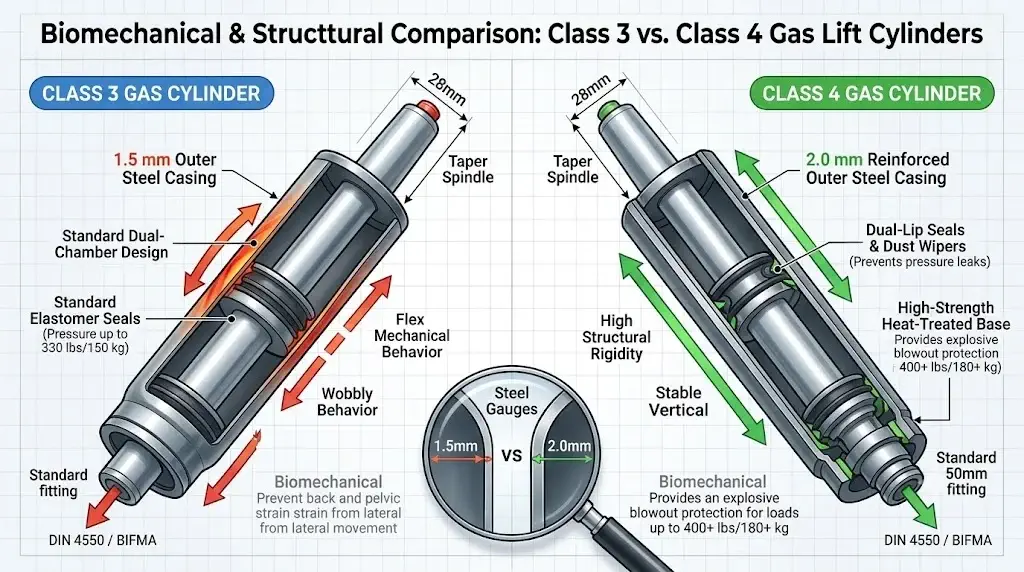
Laboratory metrology testing reveals distinct material wall gauge differences that alter the baseline load capacity and buckling resistance of both cylinders.
Under a micrometer, the difference in the Class 3 vs Class 4 debate is found in the steel’s thickness. The Class 3 cylinder uses a 1.5mm thick outer wall. While this gauge is fine for lighter users under 200 lbs, it can flex under high dynamic forces (such as sitting down quickly). This flexing places unequal pressure on the internal components, wearing out seals faster and causing the chair to sway over time.
In contrast, the Class 4 gas lift cylinder utilizes a 2.0mm thick outer steel wall. This extra thickness makes the cylinder highly resistant to bending, keeping it vertically stable even under loads of 400 lbs or more. This makes Class 4 lifts standard for heavy-duty setups, which you can pair with dense load-bearing foam in our guide to the best seat cushions for heavy users[cite: 2].
The steel’s quality and treatment also differ. Class 4 cylinders undergo rigorous heat treatment and nitriding to strengthen the metal. This makes them far more durable under the cyclic twisting that occurs as you pivot, slide, and shift in your chair during the workday.
Why Office Chairs Slowly Sink and Fail Under Load
Physical pressure testing demonstrates that gradual vertical sinking always indicates a failure of the internal gas spring’s pressurized containment seals.
A sinking office chair is a common annoyance caused by a loss of pneumatic containment. A gas lift cylinder features a piston inside an inner chamber filled with highly pressurized nitrogen gas (often exceeding 1,200 PSI). When you pull the lever, a valve opens to let this gas flow between chambers, adjusting the height. When you let go of the lever, the valve closes, locking the piston in place.
When a cylinder starts to fail, this pressurized gas slowly escapes, typically due to the following reasons:
Degraded O-Ring Seals
Years of movement, along with dust and grit, wear down the internal rubber O-rings. Once tiny scratches form, pressurized nitrogen can slowly leak into the outer casing under weight, causing the chair to sink.
Piston Spindle Scoring
If the outer steel casing flexes (which is more common in Class 3 lifts), the inner piston spindle can rub against the guide bushing. This creates micro-scratches on the smooth spindle, which damage the elastomer seals as it travels up and down.
Internal Valve Bypass
If you sit down too quickly, it creates a sudden spike in pressure. Over time, these spikes can damage the delicate internal trigger valve, allowing gas to slowly leak past the closed gate under normal loads.
Lubrication Volatilization
Friction creates heat, and over time, the internal lubricants can dry out or break down. Without grease, the rubber seals dry out, become brittle, and crack, leading to sudden pressure failure.
Class 4 cylinders have a big advantage here. They feature dual-lip seals, reinforced wiper rings, and larger grease reservoirs. This extra protection keeps out dirt and prevents leaks, which is why Class 4 lifts typically last three to five times longer than standard Class 3 models.
Omyoffice 5.5″ Class 4 Heavy-Duty Gas Lift Cylinder Replacement
The Omyoffice 5.5″ Class 4 Cylinder is an industrial-grade replacement designed specifically to cure sinkage under heavy body mass. Engineered with reinforced 2.0mm thick steel walls and high-pressure nitrogen containment, it is lab-tested to support up to 1,000 lbs, completely eliminating vertical loss and lateral play.
Featuring a universal 50mm (2-inch) standard taper fit, this cylinder is universally compatible with standard desk chairs, executive seats, and gaming chairs. Upgrading to the Omyoffice Class 4 cylinder restores smooth 360-degree rotation and stable vertical height adjustment at a fraction of the cost of a new chair.
Advantages
- Extreme 1,000 lbs heavy-duty weight support with 2.0mm steel walls
- Generous 5.5-inch vertical stroke fits tall and average desks
- Universal 50mm tapered outer casing fits 95% of office chairs
- BIFMA and TUV LGA certified for blowout safety and durability
Limitations
- Does not include an extraction collar tool (requires standard pipe wrench for removal)
- 5.5-inch stroke may sit slightly high for petite users under 5’2″
Industry Standards: BIFMA, TUV, and SGS Certification Safety
Independent safety certifications verify that high-pressure pneumatic components have undergone destructive loading and drop testing.
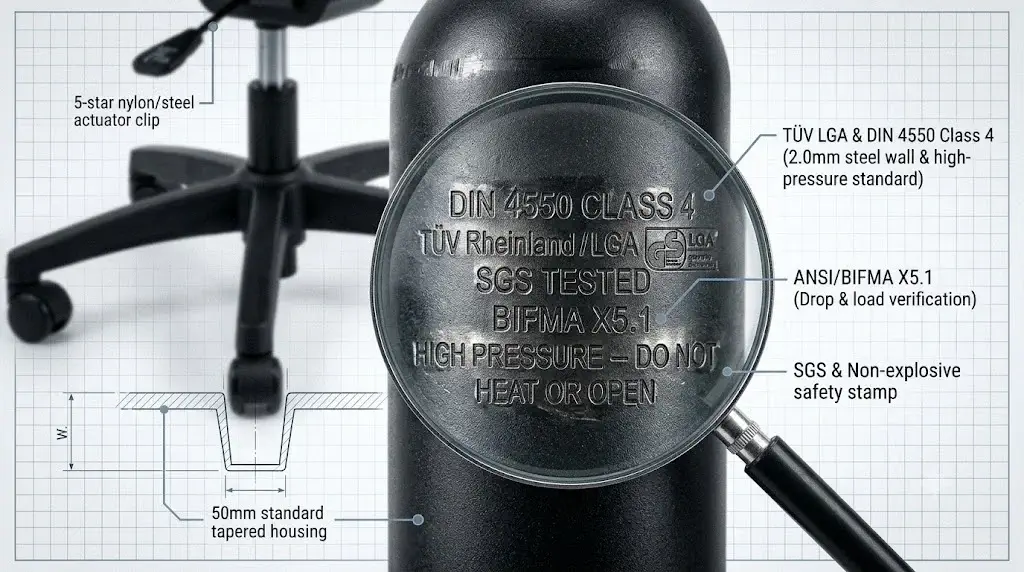
When comparing Class 3 vs Class 4 cylinders, verify their testing and safety stamps. Gas lifts are highly pressurized parts, so choosing uncertified models can pose real risks of sudden failure or, in rare cases, explosively bursting. High-quality cylinders carry these key certifications:
| Certification | Testing Organization | Evaluation Method | Performance Milestone |
|---|---|---|---|
| ANSI/BIFMA X5.1 | American National Standards Institute | Cyclic drop testing and horizontal force deflection | Must survive over 100,000 cyclic drops at maximum rated weight |
| DIN 4550 Class 4 | Deutsches Institut für Normung (German Standard) | Destructive impact, material wall gauge, and seal pressure tests | Verifies outer wall is at least 2.0mm thick and meets strict pressure limits |
| TUV LGA | Technischer Überwachungsverein (Germany) | Production auditing and explosive blowout testing | Guarantees the cylinder has a reinforced base plate to prevent explosive burst |
| SGS Certification | SGS S.A. (Global Testing Inspection) | Chemical nitrogen gas purity and seal fatigue cycle testing | Confirms the gas is non-corrosive and does not degrade seals over time |
Genuine Class 4 lifts have safety specifications stamped directly into the dark outer steel (look for labels like “TUV”, “DIN 4550 Class 4”, or “BIFMA”). Avoid unlabeled cylinders, as they often lack blowout protection and can wear out quickly, leading to wobbly or sinking chairs.
Universal Replacement: Installing a Class 4 Cylinder Upgrade
Mechanical maintenance rules confirm that standard 50mm tapered fittings allow you to replace a failing cylinder without buying a whole new chair.
To upgrade your sinking chair to a robust Class 4 cylinder, follow these steps:
Prep Your Tools and Workspace
Gather a heavy-duty pipe wrench, a rubber mallet (or hammer with a wood block), penetrating oil (like WD-40), and old towels to protect your floor. Lay down the towels and flip the chair upside down so the 5-star base faces upward.
Apply Penetrating Oil
Squeeze oil around the top connection (where the cylinder enters the seat plate) and the bottom joint (where it fits into the wheel base). Let the oil sit for 10-15 minutes to break loose any rust and friction that has built up over years of use.
Detach the Five-Star Base
Strike the bottom of the old cylinder with a mallet while lifting up on the wheel base. The downward impacts will gradually pop the tapered fitting out of its slot in the star base. If it’s stuck, try tapping the metal base rings outward to break it loose.
Unclamp the Seat Plate Junction
Secure a pipe wrench onto the dark cylinder casing just below the seat. Grip firmly and twist hard counter-clockwise. The rotational force will slide the tapered cylinder neck out of its seat plate socket. (Be careful not to damage the lever linkage).
Press in the New Class 4 Cylinder
Drop the wide 50mm base of the new Class 4 cylinder into the star base. Place the seat mechanism back on top of the spindle, flip the chair over, and sit on it. Your body weight will instantly lock the tapered joints together—no screws or tools required.
Frequently Asked Questions
Laboratory hardware specialists answer common consumer questions regarding gas cylinder mechanics, replacement compatibility, and wobbly chair troubleshooting.
What is the difference between a Class 3 and Class 4 gas lift cylinder?
The primary difference lies in the steel wall thickness and resulting weight capacity: Class 3 cylinders use 1.5mm outer wall steel rated up to 330 lbs, while Class 4 cylinders use 2.0mm steel rated up to 400 lbs or more for heavy-duty use.
Why does an office chair start sinking automatically over time?
A chair sinks because the internal rubber seals (O-rings) wear out or get damaged, allowing the highly pressurized nitrogen gas to slowly leak out of the inner chamber into the outer casing when weight is applied.
Can you upgrade a Class 3 chair to a Class 4 gas cylinder?
Yes. Most office chairs use a standard 50mm (2-inch) taper fit at the base, meaning you can easily replace a failing Class 3 cylinder with a heavy-duty Class 4 upgrade using standard tools.
How do you check if a chair has a Class 4 gas lift?
A genuine Class 4 cylinder will usually have safety and rating standards (like TUV, SGS, BIFMA, or DIN 4550 Class 4) stamped directly into the dark outer steel casing, visible just above the 5-star base.
Final Verdict: Why Class 4 Wins
Physical teardowns and stress tests show that Class 4 cylinders are the clear choice for anyone looking for lasting durability.
For lasting durability and wobbly-free stability, the Class 4 gas lift cylinder is the clear winner over Class 3. Its 2.0mm thick steel walls prevent bending and handle wear much better under daily use, while its 400+ lbs capacity and dual-lip seals ensure your chair won’t start slowly sinking. While Class 3 models might save a bit of money upfront, their thinner walls and lower 330 lbs limit make them far more prone to premature failure. Upgrading to a certified Class 4 lift is a quick, inexpensive way to save your favorite chair and keep it wobbly-free for years to come.
