
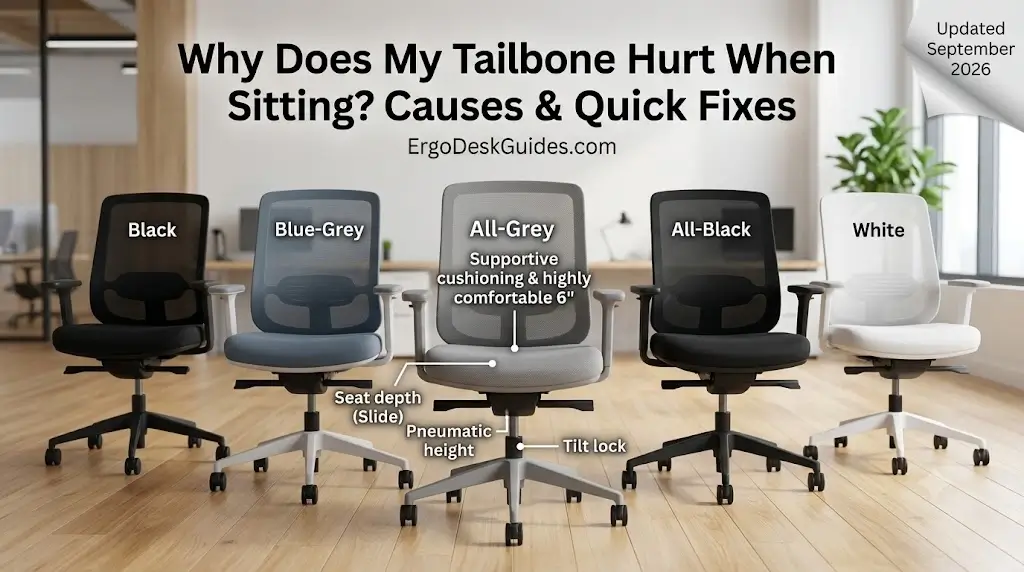
Why Does My Tailbone Hurt When Sitting? Causes & Ergonomic Fixes
Tailbone pain while sitting usually means the coccyx or surrounding tissues are being irritated by direct contact pressure, pelvic loading mechanics, acute impact, or persistent myofascial strain. Prolonged sitting, hard chair surfaces, direct falls, repetitive strain from athletic tasks, pregnancy, childbirth, and lumbar-pelvic misalignment represent the primary clinical and mechanical causes of seated coccyx discomfort.
The clinical term for this condition is coccydynia. Symptoms typically escalate during seated tasks, transitioning from sitting to standing, forward trunk flexion, or during bowel evacuation.
Quick AnswerIf your tailbone hurts when you sit, immediately minimize direct localized pressure against the coccyx and eliminate prolonged, uninterrupted seated sessions. Calibrate chair seat height so your feet remain grounded, engage the backrest to offload pelvic mass, adjust horizontal seat depth, and implement a dedicated U-shaped coccyx cushion or wedge pad. If symptoms follow an acute fall, worsen progressively, or fail to respond after several weeks, pursue professional clinical evaluation.
What Is the Tailbone?
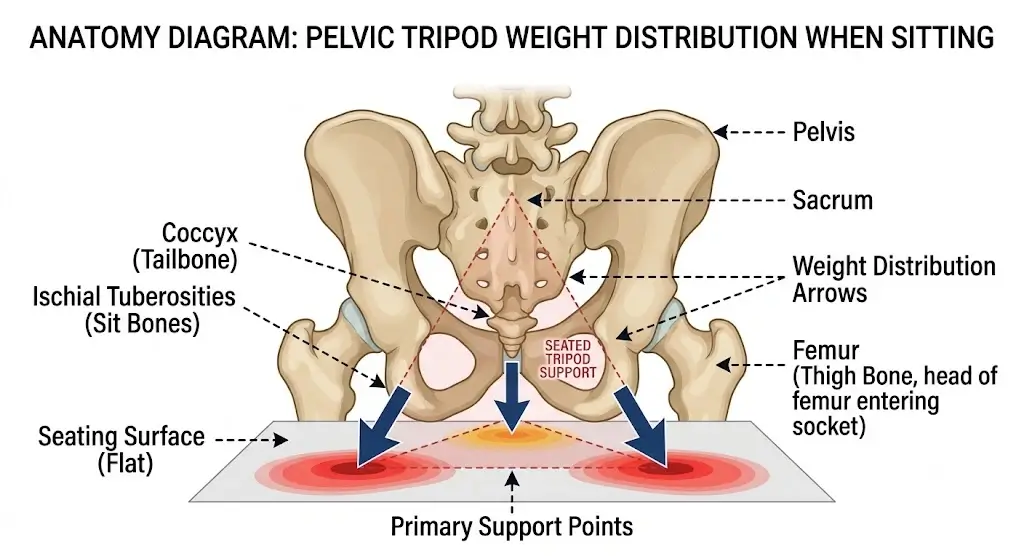
The coccyx, clinically designated as the tailbone, represents the terminal segment of the human vertebral axis. It comprises three to five fused or partially fused rudimentary vertebrae situated immediately inferior to the sacrum.
In a supported seated posture, the coccyx works dynamically with the bilateral ischial tuberosities (“sit bones”) to stabilize body weight. It serves as an attachment site for the gluteus maximus, the levator ani muscle group, the coccygeus muscle, and the anococcygeal ligament. Changing how your workstation distributes mass directly dictates the mechanical strain transferred through these coccygeal connections.
Why Does My Tailbone Hurt When I Sit?
Sitting concentrates upper-body mass directly across the pelvic floor and seating surface. When body weight is concentrated directly onto the coccyx—or when surrounding soft tissues are inflamed—axial compression triggers sharp or aching localized discomfort.
This discomfort is heavily multiplied by static posture duration. A workstation chair may feel benign for 20 minutes yet produce pronounced irritation after several hours as tissues experience prolonged ischemia and uninterrupted mechanical load.
An effective ergonomic strategy does not rely on holding a rigid “perfect posture.” Instead, it combines calibrated seat dimensions, balanced pelvic pressure redistribution, backrest support, and frequent micro-movement intervals.
Common Causes of Tailbone Pain When Sitting
Identifying the root source of coccyx discomfort requires evaluating recent mechanical exposures and the timeline of onset.
| Potential Contributor | Diagnostic Ergonomic Indicator | Primary Management Objective |
|---|---|---|
| Prolonged Static Sitting | Pain intensifies steadily after multi-hour desk sessions | Break up uninterrupted seated duration |
| Hard Seating Surfaces | Discomfort sharpens immediately on unyielding surfaces | Improve pelvic weight distribution with cushioning |
| Acute Impact / Falls | Symptoms initiated directly following a fall onto the buttocks | Obtain radiographic or medical assessment |
| Repetitive Microtrauma | Pain correlated with rowing, cycling, or seated friction | Modify aggravating physical activity patterns |
| Suboptimal Workstation Fit | Discomfort occurs predominantly during computer work | Calibrate seat depth, tilt, and lumbar support |
| Pregnancy or Childbirth | Symptoms arise postpartum or during late trimesters | Consult a specialized physical therapist or clinician |
| Sacrococcygeal Hypermobility | Pain persists despite ergonomic chair interventions | Targeted pelvic floor and clinical assessment |
| Idiopathic Coccydynia | No clear mechanical or traumatic precursor | Systematic professional diagnostic workup |
Standard health agency guidelines cite pregnancy, delivery, direct trauma, repetitive mechanical strain, postural slumping, body mass fluctuations, and ligamentous laxity as the leading factors in coccydynia development.
How Can an Office Chair Aggravate Tailbone Pain?
1. The Seat Surface Is Excessively Firm or Materials Mismatched
An overly rigid seat base fails to contour to the pelvic structure, shunting mass away from the muscular gluteal folds directly onto the bony coccyx. In entry-to-midrange office seating, upholstery construction dictates pressure mapping: our evaluation in the SIHOO M57 vs SIHOO M18 comparison illustrates how suspended elastomeric mesh distributes coccyx tension differently compared to contoured high-density polyurethane foam across an eight-hour working shift.
2. The Seat Pan Is Too Deep
When the horizontal depth of the seat pan exceeds the user’s thigh length, the front edge presses against the calf tendons (popliteal fossa). To relieve this knee pressure, users subconsciously slide their hips forward, causing posterior pelvic tilt that forces full torso weight onto the tailbone.
3. The Backrest Encourages Sacral Sitting (Slumping)
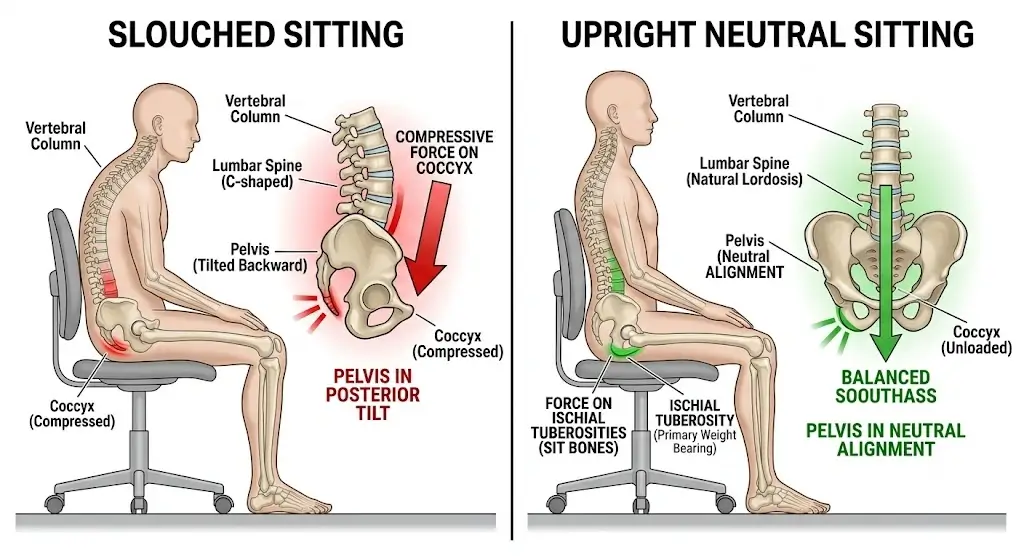
Inadequate lumbar support or an overly reclined, unsupportive backrest leads to slumping. This shifts weight bearing off the durable ischial tuberosities and directly onto the sacrum and coccygeal apex.
4. The Cushioning Is Excessively Soft
Deep, unrestricted cushion collapse allows the pelvis to sink below the supportive frame perimeter, rotating the pelvic bowl backward and increasing coccyx contact. Moderate, high-density resilience is ergonomically superior to ultra-soft plush foams.
5. Lower Extremities Are Unsupported
When seat elevation prevents the soles of the feet from resting completely flat on the floor, the thighs and feet cannot absorb their proportional 15–20% of torso load, forcing the entire weight burden onto the seat pan and coccyx.
Ergonomic PrincipleNever evaluate a chair based solely on cushion softness. The biomechanical objective is whether the unified seat-to-backrest assembly offloads the coccyx, stabilizes the pelvis, and allows continuous posture adjustments without fighting the workstation.
How Sitting Posture Affects Tailbone Pressure
Spinal alignment directly alters pelvic tilt angles, dictating whether weight rests on the ischial tuberosities or the coccyx. There is no static, permanent posture that guarantees zero coccyx strain over long intervals.
Supported Upright Posture
The standard baseline configuration aligns the pelvis neutrally with the backrest firmly supporting the lower thoracic and lumbar regions, feet fully grounded, and elbows level with the desk plane without reaching.
Controlled Anterior (Forward) Inclination
Leaning forward by approximately 5 to 10 degrees from the hips—rather than rounding the spine—transfers weight onto the anterior thighs and ischial bones, instantly unloading the posterior coccyx.
Eliminating Postural Rigidity
Holding any single position rigidly induces muscular fatigue and pelvic strain. Ergonomic stability requires active micro-adjustments and dynamic posture changes throughout the workday.
How to Adjust an Ergonomic Chair for Tailbone Pain
Calibrate one variable at a time in sequence to isolate which adjustment effectively resolves tailbone contact pressure.
Establish Full Foot Grounding
Adjust cylinder height until feet rest flat on the floor with knees flexed at approximately 90–100 degrees. If matching a fixed high desk surface causes feet to dangle, position a stable angled footrest beneath your feet immediately.
Eliminate Popliteal Compression
If your chair features horizontal seat sliding, adjust the pan until a 2- to 3-finger clearance exists between the front waterfall edge and the back of your knees while your back remains flush with the backrest.
Engage Spinal Offloading
Calibrate backrest recline between 100 and 110 degrees. This opens the trunk-to-thigh angle, reducing pelvic disc pressure while distributing torso mass against the backrest mesh or cushion.
Assess Contact Distribution
Sit attentively for 5 minutes. Check whether weight is carried by the muscular buttocks and lateral thighs, or if pressure continues concentrating over the posterior midline coccyx.
Test Anterior Angle Relief
If your chair features forward-tilt functionality, engage a slight 2–5 degree forward slope to confirm whether tilting the pelvis anteriorly mitigates coccyx tenderness.
Enforce Mandatory Micro-Breaks
Do not remain seated uninterrupted. Stand, walk, or perform brief hip-extension stretches every 30 to 45 minutes to restore capillary perfusion to compressed pelvic tissues.
What Cushion Is Best for Tailbone Pain?
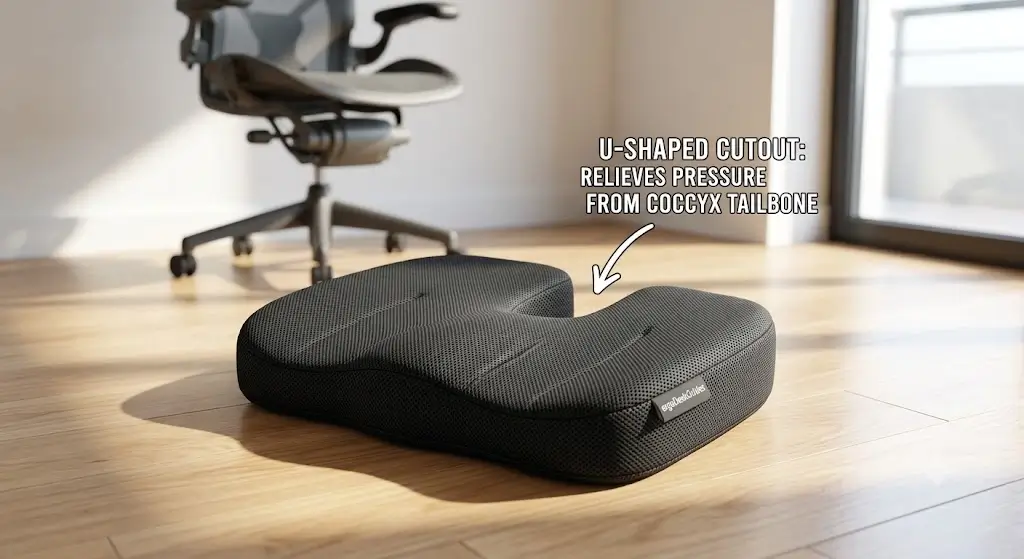
When default chair ergonomics cannot alleviate direct coccygeal contact, a specialized pressure-relieving seat cushion provides an immediate external modification.
| Cushion Design Feature | Functional Biomechanical Purpose | Evaluation Parameter |
|---|---|---|
| U/V-Shaped Rear Cutout | Suspends the coccyx in open air, eliminating direct contact | Ensure cutout is broad enough to prevent edge rubbing |
| Anterior Wedge Slope | Promotes forward pelvic rotation and lordotic curve retention | Verify angle does not push the body forward uncomfortably |
| High-Density Memory Foam | Contours to pelvic anatomy while resisting bottoming out | Check foam density to ensure it does not compress flat |
| Ultra-Soft Standard Foam | Offers initial soft cushioning | Prone to rapid collapse, restoring tailbone contact |
| Inflatable Donut Ring | Spreads weight across outer perimeter | Can increase venous pooling and pelvic floor pressure |
Can Your Desk Setup Make Tailbone Pain Worse?
While desks do not directly contact the coccyx, desk height and peripheral reach dictate how your torso and pelvis position themselves on the chair.
Keyboard and Mouse Positioning
Input devices positioned too far forward cause reach fatigue, prompting users to perch forward on the front edge of the seat pan and misalign pelvic stability.
Display Monitor Height
Monitors set too low trigger cervical flexion and upper thoracic rounding, which cascades downward into posterior pelvic tilting and increased sacrococcygeal pressure.
Fixed Desk Heights
If a fixed 29- to 30-inch desk forces you to elevate the chair beyond your anatomical knee height, lack of foot support immediately transfers excessive weight into the tailbone.
Movement-Capable Workstations
Workstations paired with height-adjustable sit-stand desks allow workers to alternate pelvic load bearing seamlessly without interrupting typing workflow.
Why Sitting Breaks Matter More Than Perfect Posture
Ergonomics distinguishes between postural alignment and postural duration.
Even the most biomechanically perfected, $1,500 office chair maintains a seated, loaded state. If coccygeal tissues or sacrococcygeal joint ligaments are inflamed, prolonged static pressure will inevitably exacerbate discomfort.
Practical RuleNever attempt to find a single static sitting position to hold all day. Establish an active desk workflow that rotates systematically between seated tasks, standing intervals, and short walking micro-breaks.
5-Minute Tailbone Pain Ergonomic Troubleshooting Checklist
Use this rapid diagnostic sequence whenever tailbone soreness surfaces during desk work:
- Grounding Check: Are both feet planted flat on the floor or on a stable footrest?
- Seat Density Check: Is the cushion fully bottomed out against the hard seat base?
- Pan Clearance Check: Is there a 2- to 3-finger gap between the seat edge and your calf creases?
- Contact Isolation: Is body weight resting on the sit bones or directly on the center tailbone?
- Backrest Engagement: Is the lumbar support actively stabilizing your spine without pushing you forward?
- Movement Reset: Stand up immediately and walk for 60 seconds rather than enduring acute localized pain.
- Calibration Rule: Modify only one ergonomic chair setting per session to identify what works.
If Pain Diminishes Following Adjustment
This confirms that seating mechanics were actively contributing to the irritation, though underlying ligament or joint vulnerability may still require attention.
If Pain Persists Unchanged
Cease repetitive mechanical adjustments. Persistent symptoms that fail to respond to zero-pressure setups indicate an internal or musculoskeletal issue requiring clinical evaluation.
Tailbone Pain Decision Tree
| Observed Scenario | Recommended Biomechanical / Clinical Step |
|---|---|
| Pain occurs only after prolonged uninterrupted desk work | Introduce 30-minute sit-stand intervals and calibrate seat pan depth. |
| Pain peaks on unpadded, rigid chair seats | Implement a contoured high-density cushion featuring a coccyx cutout. |
| Pain eases when angling the torso slightly forward | Adopt a gentle anterior pelvic tilt posture while keeping inputs within easy reach. |
| Pain followed an acute slip, fall, or blunt trauma | Consult a medical doctor for physical exam and X-ray/imaging assessment. |
| Pain remains unchanged after 2–3 weeks of ergonomic fixes | Schedule an evaluation with a physician, orthopedist, or physical therapist. |
| Pain disrupts basic sleep, walking, or daily tasks | Seek comprehensive medical evaluation immediately. |
| Pain is accompanied by fever, numbness, or bowel changes | Pursue urgent clinical medical assessment. |
Tailbone Pain vs. Lower-Back Pain
Precise anatomical localization provides vital diagnostic clues.
If tenderness resides strictly at the intergluteal cleft at the base of the spine, the coccyx or sacrococcygeal junction is directly involved. If discomfort is centered higher across the lumbar spine or radiates down the sciatica path into the legs, different spinal mechanics are at play. For instance, comparing posture mechanisms in our breakdown of the SIHOO M57 vs Ticova highlights how a chair’s backrest geometry may strongly isolate the lumbar vertebrae without directly relieving mechanical pressure on the coccyx beneath it.
Can an Ergonomic Chair Fix Tailbone Pain?
A properly fitted ergonomic chair eliminates mechanical sitting stressors, but it cannot cure underlying coccygeal pathology, fractures, or severe ligament sprains on its own.
Ergonomic chair adjustments prove most effective when discomfort is linked to poor weight distribution, incorrect seat dimensions, or poor desk alignment. Even premium ergonomic flagships approach this issue from completely different engineering philosophies: our detailed analysis of the Herman Miller Aeron vs Steelcase Leap v2 reveals how the rigid plastic perimeter rim of an all-mesh seat pan compares against a contoured flexible foam pan when dealing with tailbone and pelvic sensitivity.
Chairs cannot replace medical treatment when pain stems from trauma, progressive inflammatory disorders, or persistent coccydynia that fails to improve with self-care.
What Office Chair Features Matter Most?
- Adjustable Seat Depth: Essential for matching the seat to your thigh length. Investing in chairs with true sliding seat pans—as discussed in our review of the Branch Ergonomic Chair vs SIHOO M57—prevents the front edge from causing thigh compression while ensuring your pelvis sits back flush with the support frame.
- Independent Seat Height Travel: Ensures feet remain grounded to distribute lower-extremity load.
- High-Resilience Cushioning: Provides pressure dissipation without compressing flat against the base.
- Dynamic Backrest Recline: Permits smooth angle variations between 100° and 115° to offload pelvic mass.
- Forward Tilt Capability: Allows slight anterior pelvic tilt during typing to offload the coccyx.
- Adequate Sitting Width: Prevents hip compression from narrow armrest brackets or frame contours.
- Accessible Adjustment Controls: Enables frequent micro-adjustments during the workday.
Seating comfort for tailbone sensitivity is governed by precise dimensional fit and pressure redistribution rather than arbitrary feature counts or ultra-thick padding.
What Should You Avoid?
- Sitting continuously for multiple hours without standing intervals.
- Working on unpadded, flat surfaces that concentrate force on the tailbone.
- Using deep seat pans that prevent backrest contact and force sacral slumping.
- Overly soft memory foam cushions that collapse and trap the coccyx.
- Maintaining a single, rigid posture without natural movement.
- Endlessly adjusting chair levers when symptoms fail to improve over weeks.
- Ignoring acute pain that originated from a fall or direct physical impact.
When Should You See a Doctor for Tailbone Pain?
Clinical guidelines recommend consulting a qualified medical provider if tailbone pain shows no improvement after several weeks of conservative care, impairs daily walking or sleeping, or presents alongside fever, unexplained numbness, or radiating discomfort.
Seek Immediate Medical Advice If:
- Pain originated from an acute fall, hard impact, or physical trauma.
- Pain persists or worsens despite ergonomic adjustments and pressure relief.
- Symptoms prevent normal sitting, standing transitions, or basic mobility.
- You develop a fever, chills, or localized skin warmth/redness.
- Pain radiates down into the lower extremities, accompanied by numbness or tingling.
- You detect localized swelling, a palpable mass, or drainage near the coccyx.
- You experience new or worsening bowel or bladder dysfunction.
Tailbone Pain After a Fall
A direct fall onto the buttocks can produce severe coccygeal contusions, ligament tears, subluxation, or fractures. Seated pain is almost universally acute following this mechanism of injury.
If symptoms began after an impact, ergonomic chair tweaks are insufficient on their own. The underlying bone and joint architecture must be clinically diagnosed via physical examination and diagnostic imaging.
Why Does Tailbone Pain Keep Coming Back?
Recurrent coccyx pain typically stems from clear mechanical or physiological patterns:
Repetitive Static Loading
Returning to long, uninterrupted seated hours will quickly re-irritate sensitive coccygeal tissues.
Unresolved Ergonomic Mismatches
A chair pan that remains too deep or cushion foam that has completely degraded will continually reintroduce mechanical stress.
Absence of Postural Variation
Failing to incorporate sit-to-stand transitions leaves tissues in a chronic state of localized loading.
Unaddressed Clinical Pathology
Chronic joint instability, bone spurs, or pelvic floor muscle hypertonicity will cause symptoms to persist until treated by a physical therapist or physician.
How to Set Up Your Workstation Around Tailbone Comfort
An ergonomic workstation should support continuous, pain-free posture transitions throughout the workday.
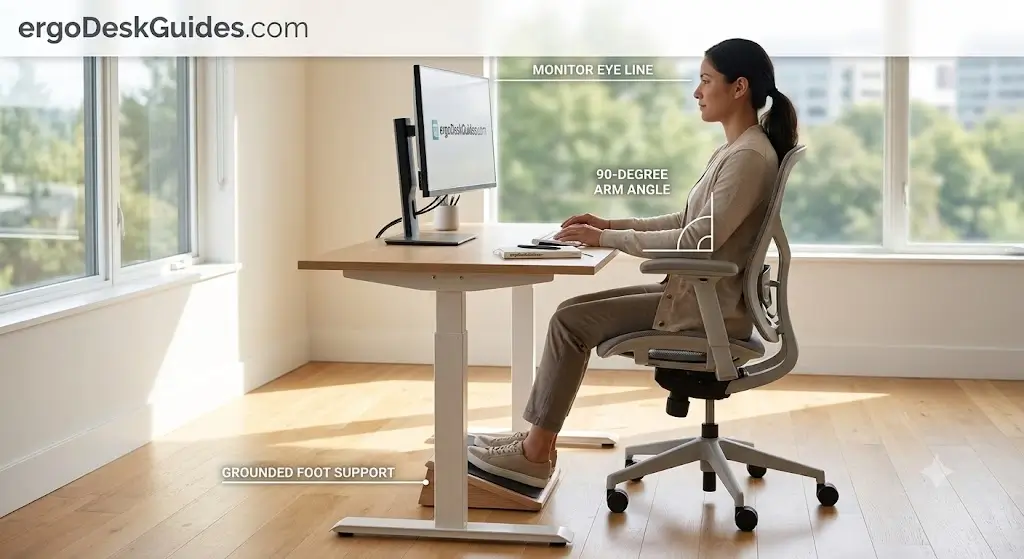
Office Chair
Calibrate cylinder height and pan depth so feet remain grounded and the backrest fully supports the spine without pushing you forward.
Desk Height
Maintain the desktop at relaxed resting elbow height so you never slide forward to reach input devices.
Monitor Alignment
Position screens at eye level to keep the neck upright, avoiding slumping that tilts the pelvis backward onto the coccyx.
Movement Routine
Incorporate standing desk intervals and scheduled 60-second walking breaks every 30–45 minutes.
Bottom Line: Why Does My Tailbone Hurt When Sitting?
Bottom LineTailbone pain when sitting is typically driven by concentrated mechanical pressure, prolonged static sitting, hard seat surfaces, prior fall trauma, repetitive strain, or pelvic floor tension.
For desk workers, primary relief starts with fundamentals: break up sitting duration, ensure feet are firmly grounded, adjust seat pan clearance, engage backrest lumbar support, and utilize a dedicated coccyx cutout cushion when needed.
Avoid searching for a mythical single sitting posture. Prioritize a well-supported, dynamic workstation setup that facilitates frequent posture changes.
If pain persists for weeks, escalates, follows an acute fall, or interferes with daily function, obtain a formal medical evaluation.
Frequently Asked Questions
Why does my tailbone hurt when I sit?
Tailbone pain can stem from prolonged sitting, firm or unsupportive seating, acute falls, repetitive strain, pregnancy, childbirth, or structural changes around the coccygeal vertebrae.
Why does my tailbone hurt only when sitting?
Sitting transfers body mass directly through the pelvic base. When coccygeal tissues or ligaments are inflamed, mechanical contact against a chair highlights and exacerbates the pain.
Can sitting too long cause tailbone pain?
Yes. Prolonged static sitting maintains sustained pressure on the coccyx and surrounding pelvic structures, particularly on firm or poorly contoured chairs.
Can an office chair cause tailbone pain?
An office chair can contribute if its seat depth is too deep, cushioning has collapsed, or backrest angles force the user into a slumped sacral-sitting posture.
What is the best sitting position for tailbone pain?
A supported posture with feet flat on the floor, lumbar spine stabilized by the backrest, and torso tilted slightly forward at the hips to shift mass onto the sit bones.
Should I lean forward if my tailbone hurts?
A slight forward lean from the hips can reduce direct tailbone pressure, provided it does not cause neck strain or force you to reach uncomfortably for your keyboard.
Is a coccyx cushion good for tailbone pain?
Yes. A cushion with a rear U- or V-shaped cutout suspends the tailbone over open space, directly eliminating contact pressure while seated.
Is a donut cushion good for tailbone pain?
Donut cushions distribute weight to the outer ring, but they can increase localized venous pressure and pelvic floor strain. U-shaped coccyx cushions or wedge designs are generally preferred.
Why does my tailbone hurt when I stand up after sitting?
The sit-to-stand transition causes pelvic muscles and ligaments to pull on the coccyx, aggravating inflamed joints or soft tissues.
Can tailbone pain happen without a fall?
Yes. Prolonged sitting, repetitive mechanical loading, pregnancy, postural slumping, and joint hypermobility frequently cause coccydynia without any acute traumatic injury.
How long does tailbone pain last?
Mild cases often improve within a few weeks of pressure relief, while chronic coccydynia can persist for months. Unresolving pain warrants a professional clinical assessment.
When should I see a doctor for tailbone pain?
Seek medical care if pain persists past several weeks, worsens progressively, follows a fall or impact, or presents with fever, numbness, or radiating pain.
Editorial Methodology
Who: ErgoDeskGuides provides evidence-based workstation ergonomics and seating education for individuals spending extensive hours working at desk setups.
How: We evaluate biomechanical seating mechanics separately from clinical medical diagnoses, referencing recognized ergonomic standards and verified clinical guidance.
Why: Our objective is to guide readers through practical, zero-cost workstation adjustments, identify effective equipment solutions, and recognize when pain requires medical diagnosis.
