
Mesh vs Leather Office Chairs: Which Keeps You Cooler?
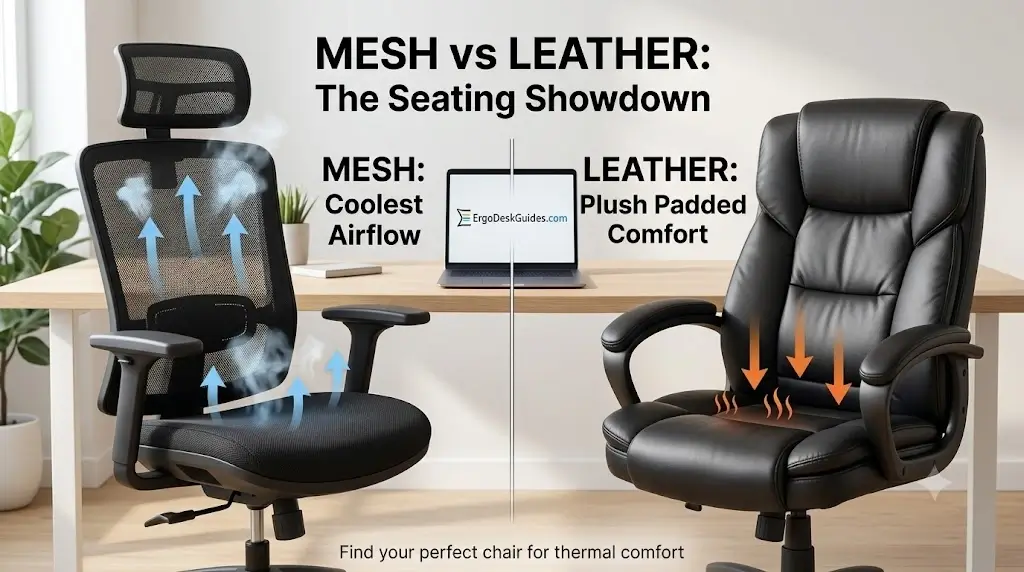
When comparing mesh vs leather office chairs, mesh office chairs consistently keep you cooler during sustained desk work because elastomeric mesh enables open convective airflow and rapid vapor dissipation, whereas non-porous leather traps conductive body heat and ambient moisture against dense polyurethane foam padding.
While natural top-grain hide and synthetic leather offer immediate tactile softness, high tensile durability, and rapid surface maintenance, their solid structural membranes block ambient air circulation. This mechanical divergence directly governs thermal regulation, sweat accumulation, and seated circulatory comfort across multi-hour work sessions.
Best Balance of Airflow and Pelvic Support: High-tension mesh backrest combined with a breathable woven fabric-covered seat cushion.
Best for Executive Aesthetics & Cool Climates: Top-grain leather or synthetic leather operated exclusively within climate-controlled, air-conditioned rooms.
Mesh vs Leather Office Chairs: Quick Comparison
Evaluating mesh vs leather office chairs shows that practical thermal performance is determined by the total thermodynamic barrier formed between the human body and the underlying chair frame, rather than superficial marketing designations.
| Performance Parameter | Suspended Mesh Chairs | Leather & Synthetic Chairs | Engineering Winner |
|---|---|---|---|
| Backrest Airflow | Continuous passive convective airflow | Impermeable membrane barrier | Mesh |
| Seat Pan Breathability | High vapor and air permeability | Zero direct vertical air transmission | Mesh |
| 4+ Hour Heat Accumulation | Negligible thermal retention | High heat storage in core foam | Mesh |
| Perspiration Evaporation | Accelerated convective moisture drying | Fluid pooling along contact zones | Mesh |
| Initial Contact Tactile Feel | Firm, elastic tensile resistance | Supple, plush immediate sink | Leather |
| Warm / Humid Environments | Maintains optimal body cooling | Induces localized sweating and sticking | Mesh |
| Cold Office Environments | Allows ambient drafts across the spine | Provides passive thermal insulation | Leather / Preference |
| Spill Resistance & Cleaning | Requires vacuuming or fabric extraction | Wipes clean instantly with microfiber cloth | Leather |
| Thermal Boundary Resistance | Minimal thermal barrier | High thermal boundary resistance | Mesh |
Why Does Mesh Keep You Cooler? The Biomechanics of Seated Heat Transfer
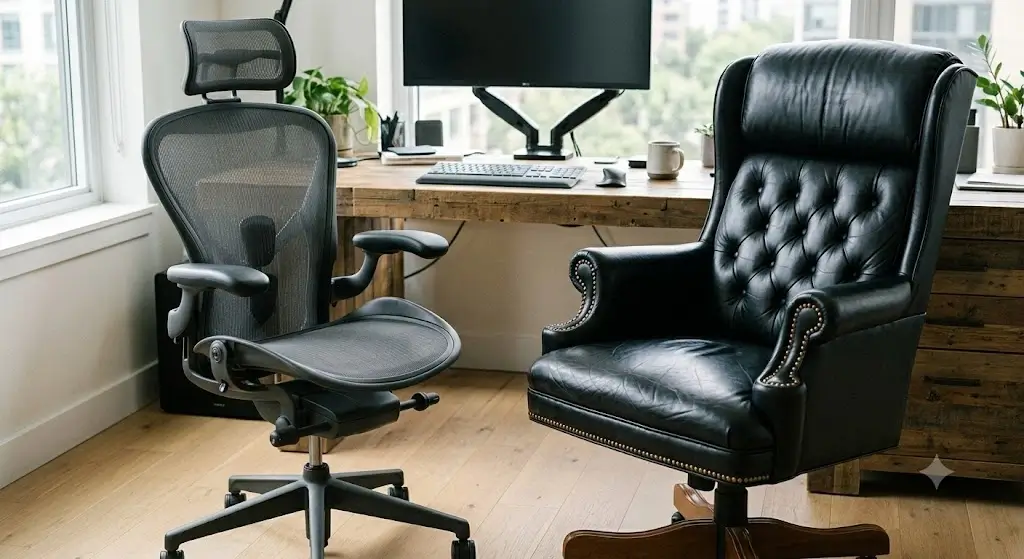
The thermal contrast in mesh vs leather office chairs is rooted in boundary-layer thermodynamics. When a person sits, the metabolic heat generated by the musculoskeletal system must radiate outward to maintain dermal equilibrium.
1. Convective Air Currents
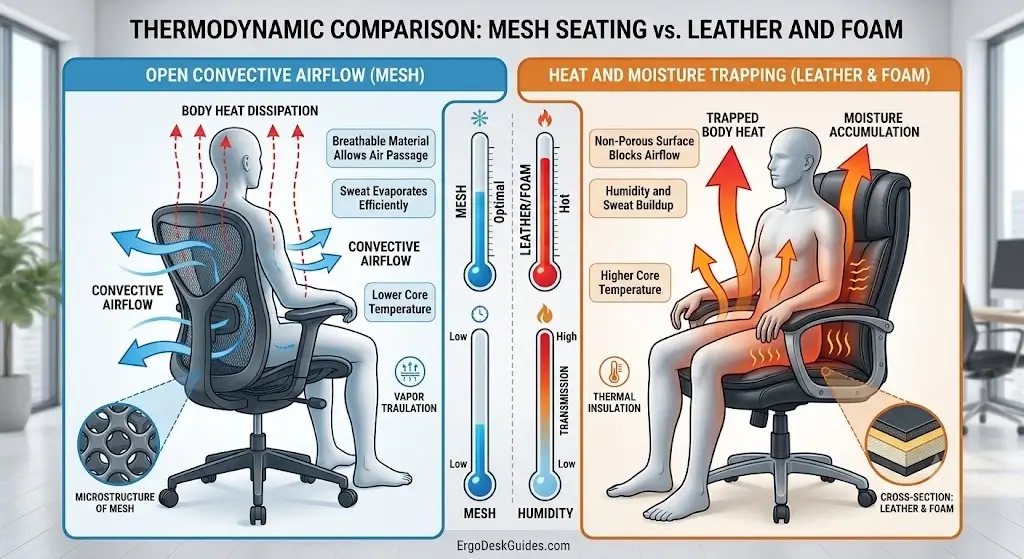
Open-weave filament mesh lacks continuous solid backing. Natural indoor convection currents flow freely through the open lattice, constantly clearing the boundary layer of hot air that normally gathers behind the thoracic spine.
2. Active Moisture Vapor Transfer
Perspiration cools the body exclusively through evaporation. Mesh allows moisture vapor emitted through clothing to evaporate directly into the room atmosphere. Non-porous leather traps this vapor, creating high relative humidity against clothing textiles.
3. Elimination of Insulating Polyurethane Cores
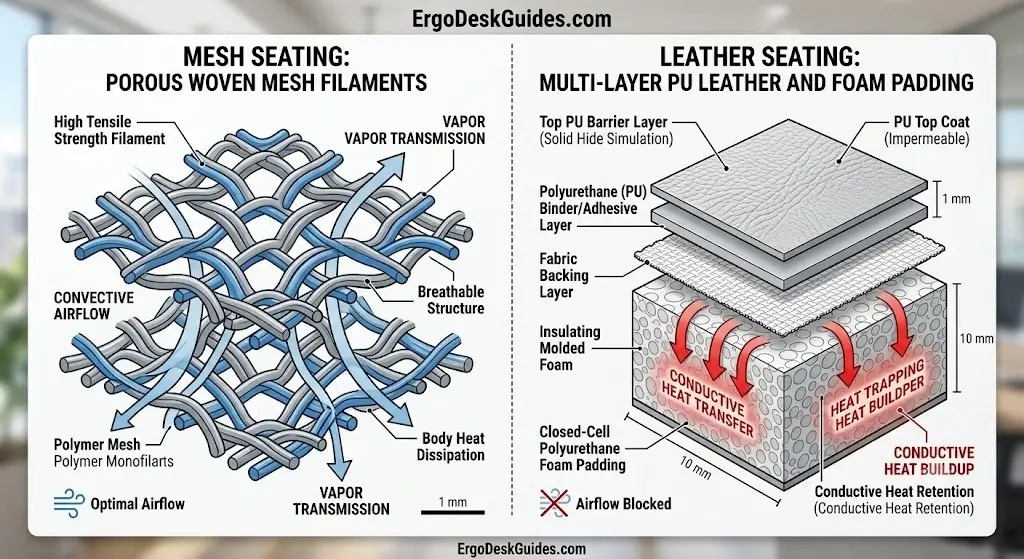
Traditional leather executive chairs rely on thick molded polyurethane foam pads. Polyurethane is an outstanding thermal insulator; it traps micro-pockets of air, rapidly absorbing torso heat and returning that thermal energy directly to the user.
4. Reduced Surface Contact Area
Fine tensile filaments support the body across thousands of micro-suspension points, leaving up to 70% of the surface area directly exposed to circulating ambient air.
Cooling Is Not the Same as Thermal Comfort
A common buying trap when weighing mesh vs leather office chairs is judging thermal properties solely during the first five minutes of showroom testing. Leather often feels cool initially because its high thermal mass conducts heat away from the skin upon first contact. However, once that surface reaches thermal equilibrium with the body, heat dissipation drops significantly.
| Seated Timeframe | Primary Thermal Determinant | Mesh Performance | Leather Performance |
|---|---|---|---|
| 0–10 Minutes | Initial contact temperature | Neutral, matches room air | Cold to the touch initially |
| 30–60 Minutes | Core thermal absorption | Continuous heat shedding | Heat saturates surface coating |
| 2–4+ Hours | Moisture vapor evaporation | Zero heat or sweat buildup | Traps moisture; creates hot spots |
Which Office Chair Material Is Coolest? Technical Hierarchy
When evaluating mesh vs leather office chairs strictly for convective airflow and breathability, workstation chair constructions rank in the following order:
1. Full Suspended Elastomer Mesh (Seat & Back): Maximum passive airflow; entirely eliminates insulating foam cores.
2. Mesh Backrest + Breathable Woven Fabric Seat: Delivers unrestricted spinal cooling while providing balanced pelvic cushion support.
3. Unpadded High-Porosity Woven Fabric: Moderate vapor permeability without the firm edge frames of suspended mesh.
4. Thick High-Density Foam with Fabric Covering: Good pressure redistribution, but dense foam retains heat over long shifts.
5. Perforated Genuine Top-Grain Leather: Surface perforations offer modest moisture venting, but the foam layer below remains insulated.
6. Solid PU Synthetic Leather & Vinyl: Non-permeable plastic coatings that produce zero airflow and induce perspiration rapidly.
Not All Mesh Office Chairs Are Equally Breathable
Treating every chair designated as “mesh” as an identical thermal solution is an ergonomic mistake. Mechanical design choices drastically impact air passage:
Weave Density & Filament Composition
Ultra-dense, tight mesh weaves restrict airflow more than open elastomer filament blends. Premium meshes balance structural elasticity with maximum void space.
Foam-Backed Mesh Traps
Budget chairs occasionally stretch thin mesh fabric over solid foam. This produces the visual appearance of a mesh chair while retaining the heat-trapping characteristics of conventional upholstered foam.
Perimeter Frame Interference
Suspended mesh requires a rigid perimeter ring to maintain fabric tension. When evaluating seating mechanics—such as the suspended mesh pan on the Herman Miller Aeron versus the flexible foam pan analyzed in our Herman Miller Aeron vs Steelcase Leap v2 comparison—the structural frame determines whether outer edges cause pelvic pressure during prolonged work sessions.
Leather vs PU vs Vinyl: Which Traps More Heat?
In technical reviews of mesh vs leather office chairs, the term “leather” encompasses multiple distinct upholstery categories with vastly different thermal properties:
| Upholstery Category | Chemical / Structural Composition | Air Permeability | Long-Shift Heat Retention |
|---|---|---|---|
| Top-Grain Natural Leather | Organic animal hide with natural pore channels | Low to moderate | Moderate to high |
| Polyurethane (PU) Faux Leather | Synthetic polymer film over fabric backing | Extremely low | Very high |
| PVC / Vinyl | Solid polyvinyl chloride membrane | Impermeable (0%) | Extreme heat trapping |
| Bonded Leather | Macerated leather fibers bound with polyurethane | Near zero | High |
| Elastomeric Mesh | Woven polyester and polymer monofilaments | Maximum (>75% open) | Lowest possible |
Seat Cooling vs Backrest Cooling: Targeting the Heat Zone
Different areas of the body interact with office seating in distinct ways:
- Thoracic & Lumbar Back: Forms the largest contiguous surface area. An open mesh backrest directly halts shirt sweat by promoting convective airflow.
- Thighs & Ischial Tuberosities: Bear concentrated downward compressive weight. When thigh perspiration is your chief complaint, examining the structural differences between mesh and foam—as explored in our SIHOO M57 vs SIHOO M18 comparison—helps balance cooling against pelvic contact pressure.
Which Office Chair Is Best If You Sweat Heavily?
If hyperhidrosis, high metabolic warmth, or humid climates cause regular desk discomfort, a full-mesh ergonomic office chair is the most dependable choice. In testing mesh vs leather office chairs under high thermal loads, eliminating heat-trapping foam cores and maximizing ventilation across the back and thighs prevents clothing from becoming damp and clinging to the chair.
Is Mesh More Comfortable Than Leather? Separating Support from Temperature
When analyzing mesh vs leather office chairs, thermal comfort and skeletal support represent two distinct ergonomic disciplines:
- Mesh Excels At: Convective ventilation, moisture evaporation, preventing fabric sticking, and providing adaptive, spring-like spinal tension.
- Leather Excels At: Immediate plush cushioning, pressure relief across bony pelvic points, executive board styling, and effortless surface cleaning.
For individuals sitting for more than 6 hours per day, managing thermal accumulation is just as critical as managing lumbar alignment, because localized heat buildup prompts unconscious fidgeting and slouching.
Cleaning & Maintenance Comparison
Practical maintenance differences between mesh vs leather office chairs include:
| Maintenance Category | Mesh Seating Architecture | Leather & Synthetic Upholstery |
|---|---|---|
| Surface Dust & Particulates | Fibers trap dust within weave; requires vacuuming | Quickly wiped clean with dry or damp cloth |
| Liquid Spills | Liquids pass through mesh directly to hardware below | Liquids bead on surface for immediate wiping |
| Sebum & Skin Oil Infiltration | Can accumulate deep within synthetic fibers | Degrades polyurethane coatings if not cleaned |
| Long-Term Surface Care | Mild detergent application with soft bristle brush | Requires periodic conditioning to prevent cracking |
Buyer Decision Framework: Mesh vs Leather Office Chairs
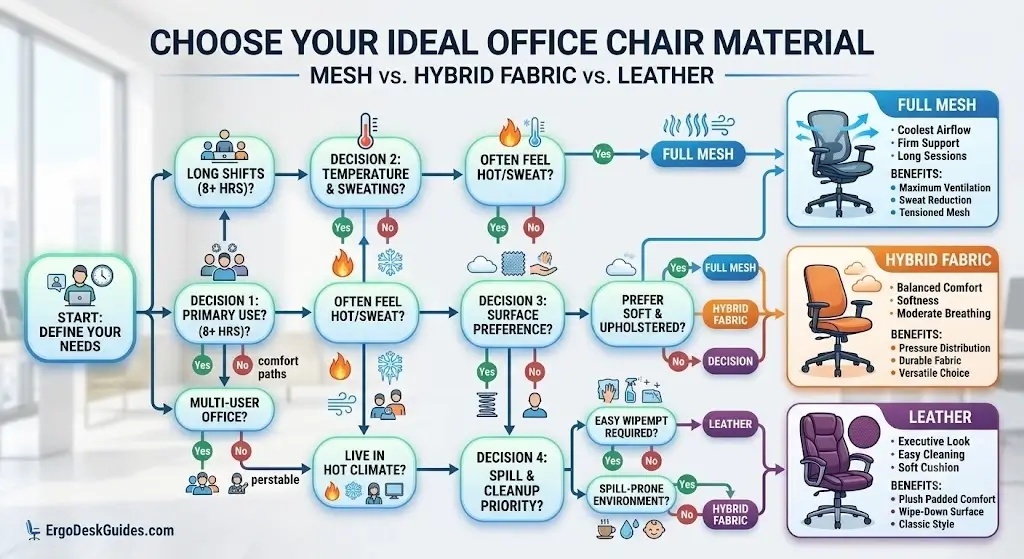
Assess Workspace Climate
If your room temperature regularly exceeds 75°F (24°C) or lacks air conditioning, full-mesh seating is the only material that prevents sustained heat trapping.
Pinpoint Localized Discomfort
If you experience an uncomfortably hot back but your legs feel fine on foam, choose a hybrid chair with a breathable mesh back and a cushioned fabric seat.
Factor in Shift Length
For 8+ hour knowledge workers comparing mesh vs leather office chairs, mesh chairs minimize thermal fatigue, helping you stay comfortable and focused throughout the day.
Final Verdict on Mesh vs Leather Office Chairs
Leather remains a viable alternative for cool, climate-controlled executive offices where plush surface cushioning, classic styling, and easy spill cleanup take priority over breathability.
Frequently Asked Questions
In mesh vs leather office chairs, which is better for staying cool?
Mesh is significantly better. In any comparison of mesh vs leather office chairs, the open structural weave of mesh allows continuous ambient air circulation around the body, whereas leather creates an impermeable barrier that traps heat and moisture against internal foam padding.
Do mesh office chairs make you sweat less than leather?
Yes. By promoting convective heat dissipation and rapid perspiration evaporation, breathable mesh seating reduces the skin temperature and humidity that trigger sweating during long work sessions.
Is leather hotter than mesh during long work sessions?
Yes. Over several hours, natural hide and synthetic leather absorb body heat, warming the underlying foam core and creating a persistent, warm contact zone.
What is the coolest office chair material overall?
High-tension open-weave elastomeric mesh across both the seat pan and the backrest provides the highest airflow and cooling potential among modern office chair materials.
Is PU synthetic leather hotter than real leather?
Generally yes. PU faux leather features a solid polyurethane membrane coating over fabric that completely blocks air passage, making it noticeably hotter than porous top-grain leather or open mesh.
Are mesh office chairs durable over years of daily use?
High-tensile elastomer mesh holds its structural elasticity and support for years. Low-quality mesh, however, can gradually loosen or sag, reducing both posture support and comfort.
Editorial Methodology
Who: ErgoDeskGuides is an independent technical resource focused on evidence-based workspace ergonomics, physical durability, and workstation health.
How: We evaluate chair materials through thermodynamic properties, material construction, and long-session use, looking past marketing buzzwords to deliver actionable ergonomic guidance.
Why: Our mission is to help users select office equipment that matches their body type, working habits, and room climate without compromising on healthy spinal alignment.
