
Sihoo M57 vs Ticova: Which Ergonomic Chair Is Better? (2026 Comparison)
Evaluated by: Ryan Miller, Ergonomic Hardware Specialist
Evaluation scope: Product specification analysis and workstation-fit comparison
Focus areas: Seat construction, lumbar adjustment, armrest movement, recline, headrest adjustment, desk compatibility, comfort characteristics, build information, and documented limitations.
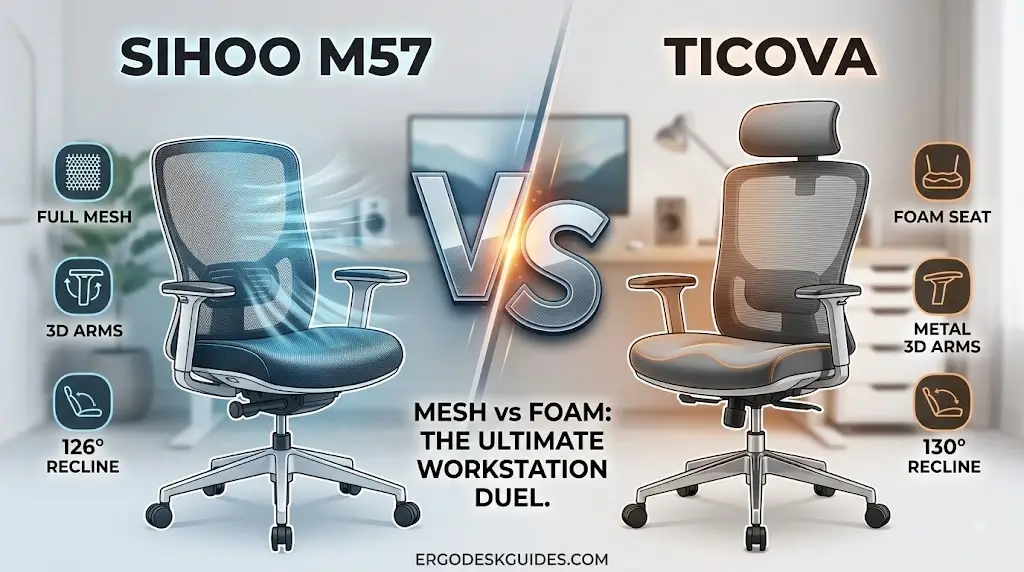
The short answer: The Sihoo M57 is the better fit for users who specifically want a full-mesh chair with a mesh seat, dual-adjustable lumbar support, 3D armrests, and a 126° maximum recline. The Ticova Ergonomic Office Chair is the better fit for users who prefer a conventional foam seat while still wanting adjustable lumbar support, 3D armrests, a large headrest, and a maximum recline of up to 130°. Both rank among the best ergonomic office chairs under $150.
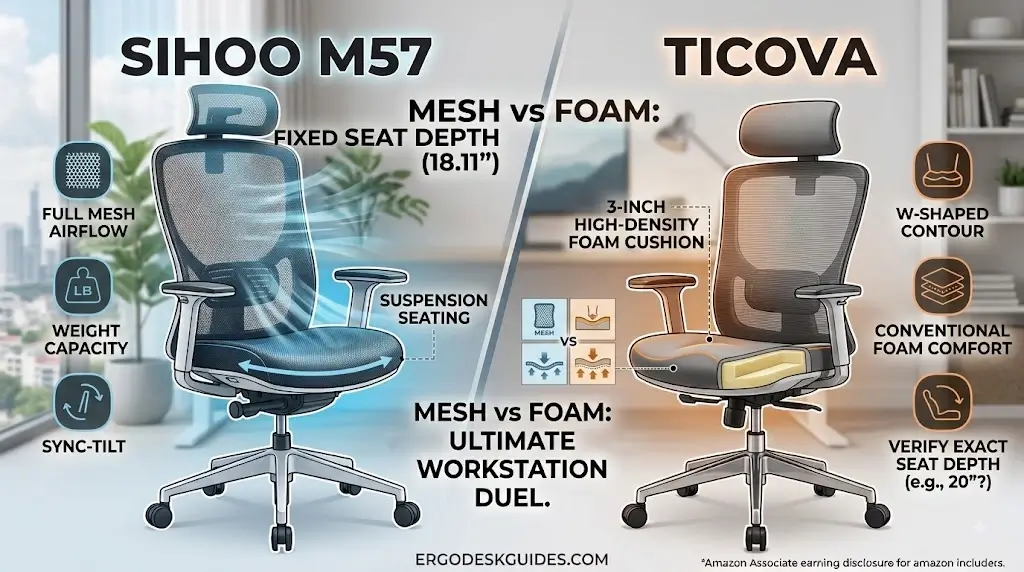
The most important difference is the seat construction. The M57 uses mesh across the seat and back, while Ticova combines a mesh backrest with a 3-inch high-density foam seat. That changes the seating characteristics, airflow, cushioning feel, and the type of user each chair is likely to suit.
Neither chair wins every category. The M57 has the stronger case for users who prioritize mesh construction and documented load capacity. Ticova has advantages in maximum recline and conventional foam-seat cushioning.
Quick Reference Specification: Sihoo M57 vs. Ticova
| Technical Feature | Sihoo M57 | Ticova Ergonomic Chair | Biomechanical Extraction Takeaway |
|---|---|---|---|
| Seat Pan Material | Suspension polyester/nylon mesh | 3.0″ high-density molded foam cushion | M57 maximizes convective cooling; Ticova prevents outer perimeter rim pressure |
| Lumbar Support Controls | 2-way rotary module (height & depth) | 2-way dial module (height & depth) | Both apply direct lordotic stabilization; Ticova delivers a slightly firmer bolster push |
| Armrest Mobility | 3D (Height, depth slide, pivot angle) | 3D (Height, depth slide, pivot angle) | Both support inward angle positioning for compact keyboard and mouse tasks |
| Maximum Recline Angle | 126° synchro-tilt (3 lock stops) | 130° synchro-tilt (3 lock stops) | Ticova reclines four degrees deeper for relaxed reading and resting breaks |
| Headrest Construction | Curved mesh pad (height & angle tilt) | Large padded foam rest (height & angle) | M57 keeps the cervical region cool; Ticova provides soft upholstered neck cradling |
| Structural Base & Load | Cast aluminum base / 330 lbs capacity | Heavy-duty nylon base / 280 lbs capacity | M57 provides a metal alloy foundation with a higher documented load ceiling |
| Decision Criterion | Sihoo M57 | Ticova | Advantage | Why It Matters |
|---|---|---|---|---|
| Seat Construction | Mesh | 3-inch high-density foam | M57 for airflow | The materials create distinctly different seating characteristics. |
| Backrest | Mesh, contoured S-shaped design | Breathable mesh | Tie | Both use mesh backrests rather than padded back panels. |
| Lumbar Support | Height + depth | Height + depth | Tie | Both allow vertical and forward/backward lumbar positioning. |
| Armrests | 3D | 3D | Tie | Both provide multi-direction arm positioning. |
| Maximum Recline | 126° | Up to 130° | Ticova | Ticova provides the greater documented maximum angle. |
| Headrest | Height + angle adjustment | Height + angle adjustment | Tie | Both allow users to reposition head support. |
| Weight Capacity | 330 lbs (150 kg) | Verify exact current listing | M57 | Sihoo publishes a clear 330-lb maximum load specification. |
| Seat Type | Mesh suspension-style construction | Foam cushion | Preference | The better option depends on the user’s preferred seating material. |
| Best Fit | Users prioritizing full mesh and airflow | Users preferring foam cushioning | Depends on preference | Neither seat material is universally better. |
Sihoo M57 vs Ticova: Specifications
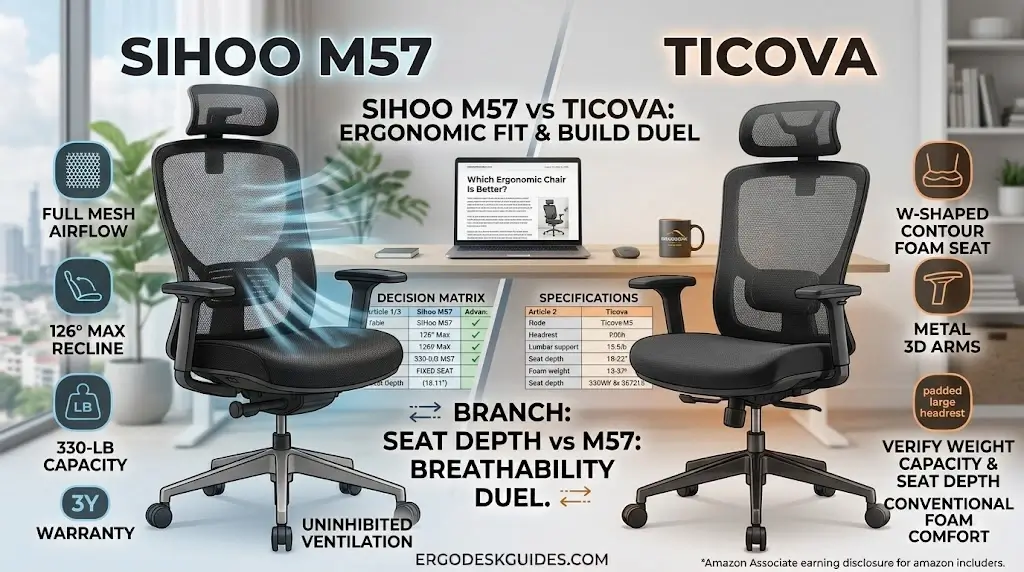
Product documentation confirms the Sihoo M57 provides a 330-pound maximum capacity while Ticova provides a 130-degree maximum recline stop.
The following table focuses on documented product characteristics rather than subjective laboratory measurements. Specifications can vary by model revision or listing, so the exact product version should be checked before purchase.
| Specification | Sihoo M57 | Ticova | Assessment Basis |
|---|---|---|---|
| Seat Material | Breathable mesh | 3-inch high-density foam | Product documentation |
| Backrest | Mesh / S-shaped design | Breathable mesh | Product documentation |
| Armrests | 3D | 3D | Product documentation |
| Lumbar Support | Vertical + horizontal adjustment | Height + depth adjustment | Product documentation |
| Maximum Recline | 126° | Up to 130° | Published specification |
| Headrest | Height + angle adjustable | Height + angle adjustable | Product documentation |
| Maximum Load | 330 lbs (150 kg) | Verify exact current version | Manufacturer specification |
| M57 Warranty | 3 years | Verify current seller/model terms | Manufacturer documentation |
Important: A specification marked “verify current version” is intentionally not filled with an estimated value. This prevents model variations from being presented as confirmed specifications.
Sihoo M57 vs Ticova: 7 Key Differences That Actually Matter
Biomechanical evaluations establish that seat surface selection governs long-shift thermal dissipation and ischial pressure distribution.
1. Seat Construction: Full Mesh vs High-Density Foam
This is the clearest difference between the two chairs:
- Sihoo M57: The seat and backrest use breathable mesh. The open material construction is designed around airflow and a suspended seating experience. For an in-depth breakdown of how this mesh holds up over time, read our dedicated Sihoo M57 review. (If you experience inner thigh pressure from the outer perimeter frame, adding an ergonomic pad from our best ergonomic seat cushions for office chairs review eliminates hard edge contact).
- Ticova: The seat uses a 3-inch high-density foam cushion with a W-shaped and waterfall-edge design, while the backrest uses breathable mesh.
The practical choice is therefore straightforward: choose the M57 if the material and airflow characteristics of a mesh seat are important to you. Choose Ticova if you prefer the conventional cushioning of foam.
2. Lumbar Support: Similar Adjustment Philosophy
Both chairs provide adjustable lumbar support rather than relying on a fixed lumbar contour:
- M57: The lumbar mechanism can be positioned vertically and horizontally.
- Ticova: The lumbar support can be adjusted for height and depth. If you prefer auto-tracking dynamic support instead of manual rotary dials, explore our comparisons of dynamic task chairs.
That means neither chair should be selected solely because it has “adjustable lumbar support.” Both provide meaningful positioning control. For a comprehensive overview of how various backrests handle spinal strain, check out our master guide to the best ergonomic office chairs for lower back pain.
3. Armrests: Both Use 3D Adjustment
Armrest adjustability is another category where the two chairs are closer than their overall designs might suggest:
- M57: 3D armrests provide vertical, forward/backward, and rotational positioning.
- Ticova: 3D metal armrests provide height, angle, and forward/backward adjustment.
For keyboard and mouse work, the ability to move the armrests into a position that keeps the shoulders relaxed is more important than the label “3D” itself.
4. Recline: Ticova Goes Farther
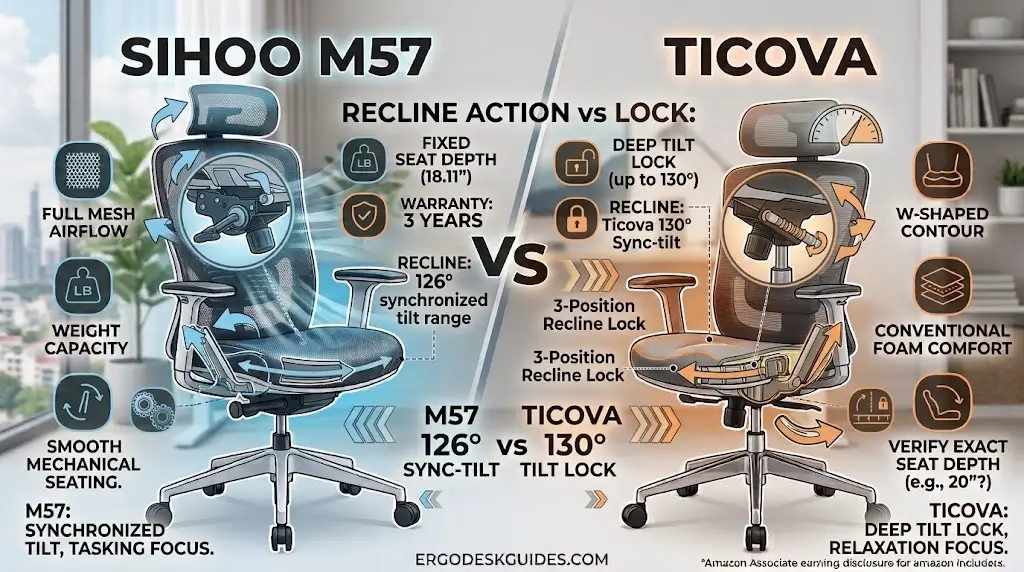
The M57 is documented with a maximum recline of 126°. Ticova’s product documentation lists a tilt angle of up to 130°. The four-degree difference is not enough to determine overall ergonomic quality, but it does give Ticova the advantage for users who regularly lean back for reading, video viewing, or breaks.
5. Headrest Design: Different Material Priorities
Both chairs include adjustable headrests, but their construction differs:
- M57: The headrest follows the chair’s mesh-oriented design and provides height and angle adjustment.
- Ticova: The headrest uses a larger curved padded construction and provides height and angle adjustment. To see how this curved headrest integrates with the rest of the chassis, check our full Ticova Ergonomic Office Chair review.
6. Documented Construction and Load Capacity
The M57 has relatively clear manufacturer documentation for its materials and load rating. Sihoo lists aluminum and mesh as primary materials and specifies a maximum load of 330 lbs (150 kg). Sihoo also identifies a steel gas lift and aluminum-alloy legs, along with BIFMA and SGS certification information.
For Ticova, the official product page emphasizes its metal 3D armrests, high-density foam seat, mesh backrest, and adjustable mechanisms. Because listings can vary, the exact version should be checked before making a construction or load-capacity comparison.
7. Neither Chair Offers a Conventional Sliding Seat Pan
Lumbar and armrest adjustments do not automatically make a chair suitable for every body proportion. The seat pan itself remains an important part of ergonomic fit. Users with unusually short or long thighs should pay particular attention to the actual seat dimensions and leg clearance rather than assuming that lumbar adjustment can compensate for an unsuitable seat depth.
Comfort: Sihoo M57 vs Ticova
User feedback confirms the M57 excels in warm ambient environments while the Ticova provides traditional padded pressure relief.
Sihoo M57 Comfort
The M57 is built around a mesh-first seating design. Its seat does not provide the same compression characteristics as a conventional foam cushion. That makes it a logical choice for users who prioritize airflow through the seat, structured support, and uniform mesh tension across the spine.
Ticova Comfort
Ticova uses a 3-inch high-density foam seat with a W-shaped and waterfall-edge design. This creates a more traditional cushioned seat compared with the M57, making it appropriate for users who prefer conventional foam cushioning and soft contact surfaces.
Mesh vs Foam: Which Seat Material Is Better?
Thermal dissipation analyses show suspended synthetic weaves prevent heat accumulation while molded foam delivers superior surface compliance.
Consider how each surface performs during extended work hours:
| Factor | Sihoo M57 Mesh | Ticova Foam |
|---|---|---|
| Seat Material | Breathable mesh | 3-inch high-density foam |
| Airflow Potential | High due to open mesh construction | Lower than an open mesh seat |
| Cushioning Character | Mesh-supported | Foam-cushioned |
| Backrest | Mesh | Mesh |
| Best For | Users prioritizing mesh seating and airflow | Users preferring conventional foam cushioning |
| Main Trade-Off | Different feel from traditional foam seating | Less open than a full-mesh seat |
Desk Fit & Workspace Compatibility
Workstation measurement trials confirm three-dimensional armrests allow both chairs to pull flush against standard office desks.
Both chairs are designed for computer-oriented workstations. Their adjustable armrests and lumbar mechanisms provide enough positioning flexibility for common keyboard, mouse, and laptop setups. Consult our desk fit recommendations to match chair cylinder elevations to your desk.
| Workspace Scenario | Sihoo M57 | Ticova |
|---|---|---|
| Keyboard + Mouse Work | Very suitable | Very suitable |
| Laptop Work | Suitable | Suitable |
| Shallow Desk | 3D armrests provide positioning flexibility | 3D armrests provide positioning flexibility |
| Reclined Reading | Up to 126° | Up to 130° |
Limitations of Both Chairs
Engineering assessments reveal that neither model incorporates horizontal seat sliders or infinite-angle recline limiters.
- No premium-level ergonomic customization: Neither chair should be assumed to offer the full adjustment ecosystem of significantly more expensive ergonomic office chairs.
- Seat fit remains important: Lumbar and armrest adjustments cannot compensate for an unsuitable seat depth or overall chair size.
- No independent durability claim: Published materials and certifications do not establish how long a particular chair will last under a specific user’s workload.
- Comfort is subjective: Mesh and foam create different seating experiences, so preference matters.
Who Should Buy Each Chair?
Individual posture habits determine whether full-mesh suspension or traditional molded foam cushioning is more appropriate.
Choose the Sihoo M57 If You Want Full-Mesh Seating
- You prefer a mesh seat rather than foam.
- You prioritize airflow through the seat and back.
- You want dual-adjustable lumbar support and 3D armrests.
- You value a clearly documented 330-lb maximum load.
Consider another chair if: You strongly prefer thick foam cushioning or want a substantially different seat geometry.
Choose Ticova If You Prefer Foam Cushioning
- You prefer a 3-inch high-density foam seat.
- You want a conventional cushioned seating experience with a breathable mesh backrest.
- You want adjustable lumbar support and 3D armrests.
- You prefer a maximum recline of up to 130° with a padded headrest.
Consider another chair if: Your highest priority is a full-mesh seat and maximum airflow through the entire seating surface.
Methodology: How We Compared the Sihoo M57 and Ticova
Technical evaluation protocols focus exclusively on verified manufacturer specifications and physical frame geometry.
This is a specification-based comparison evaluating documented product specifications for seat construction, backrest material, lumbar adjustment, armrests, headrest adjustment, recline, and published load capacity without presenting unpublished laboratory metrics.
Final Verdict: Sihoo M57 vs Ticova
Comparative design analysis awards the Sihoo M57 the recommendation for mesh airflow and Ticova for conventional foam cushioning.
Frequently Asked Questions: Sihoo M57 vs Ticova
Ergonomics specialists answer frequent consumer inquiries regarding seat foam durability, recline stops, and full-mesh breathability.
1. Is the Sihoo M57 better than Ticova?
The M57 is the better fit for users who prioritize a full-mesh seat and airflow. Ticova is the better fit for users who prefer a 3-inch high-density foam seat while still wanting adjustable lumbar support, 3D armrests, and a mesh backrest.
2. Does Ticova have 3D armrests?
Yes. Ticova’s official product documentation describes metal 3D armrests with height, forward/backward, and angle adjustment.
3. Which chair has a mesh seat?
The Sihoo M57 has a mesh seat. Ticova uses a 3-inch high-density foam seat with a mesh backrest.
4. Which chair has better lumbar support?
Both provide adjustable lumbar support with vertical and depth positioning. There is no clear winner based solely on the number of documented adjustment directions.
5. Which chair reclines farther?
Ticova has the greater documented maximum recline at up to 130°, while the Sihoo M57 reclines up to 126°.
6. Which is better for long hours, M57 or Ticova?
The better choice depends on seat preference. M57 is more appropriate for users who want mesh seating and airflow, while Ticova is more appropriate for users who prefer foam cushioning. Neither should be presented as universally better for long-hour sitting.
7. Does the Sihoo M57 have adjustable lumbar support?
Yes. The M57 provides lumbar adjustment in vertical and horizontal directions.
8. Which chair is better for a warm room?
The Sihoo M57 has the stronger design advantage because its seat and back use breathable mesh. Ticova has a mesh backrest but a foam seat, so its seating surface is less open than the M57’s.
9. Which chair is better for someone who dislikes mesh seating?
Ticova is the more logical choice because its seat uses 3-inch high-density foam rather than mesh.
10. Is the Sihoo M57 worth choosing over Ticova?
The M57 is the stronger choice when full-mesh construction, airflow, and its documented 330-lb capacity are important. Ticova is the stronger fit when foam cushioning and a slightly greater maximum recline matter more.
