
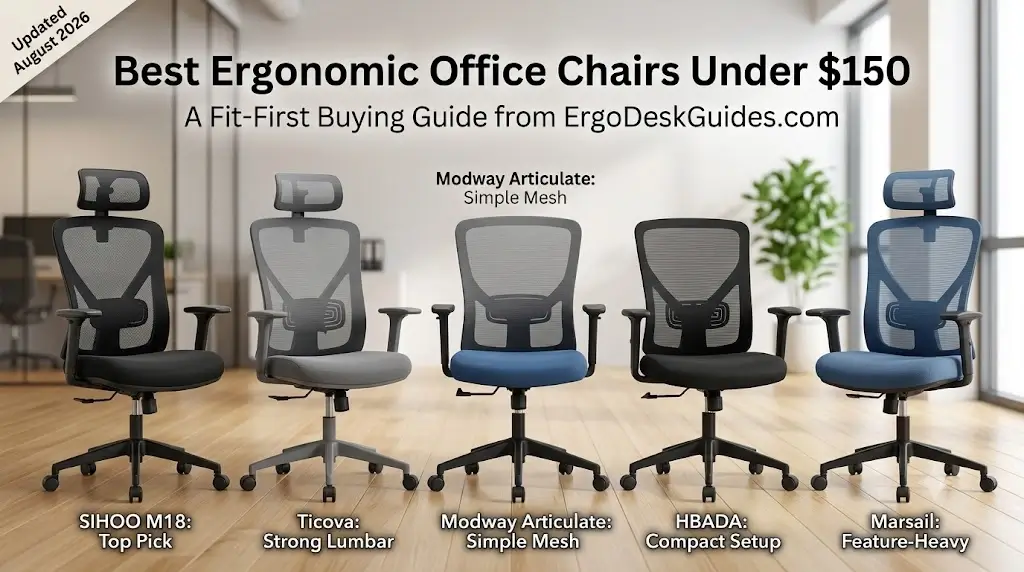
Best Ergonomic Office Chairs Under $150
A good ergonomic office chair under $150 is possible, but the buying decision is fundamentally different from shopping for iconic flagships like the Herman Miller Aeron vs Steelcase Leap v2. At this price, the most valuable features are not an endless list of premium patents. They are the essential adjustments that determine whether the seat, lumbar support, and armrests actually fit your physical body.
This guide compares affordable ergonomic chair designs using a fit-first evaluation framework: seat dimensions, lumbar adjustability, armrest positioning, backrest construction, recline behavior, weight capacity, breathability, price, and the mechanical compromises created by the budget.
Quick AnswerIf you find a genuinely sub-$150 deal on the SIHOO M18, it is one of the strongest options to consider because of its 2D lumbar adjustment, height-adjustable armrests, breathable mesh back, and 330-lb stated capacity.
However, the important price caveat is that SIHOO’s US store frequently lists the M18 at $169.99. It therefore should not be represented as a permanent under-$150 product; it qualifies only when a legitimate sale or promotional price brings it below the target budget.
Best Ergonomic Office Chairs Under $150: Quick Answer
There is no single chair that fits every person. A 5-foot-tall user and a 6-foot-3 user require completely different ergonomics, even when using identical desk setups.
| Chair Model | Best For | Key Strength | Primary Limitation | Budget Status |
|---|---|---|---|---|
| SIHOO M18 | Most buyers | 2D lumbar + adjustable arms | Current US list price is often above $150 | Qualifies only during sale/promotional pricing |
| Ticova | Pronounced lumbar support | Support-focused backrest geometry | 280-lb stated capacity | Verify current retailer price |
| Modway Articulate | Simple mesh workstation | Adjustable seat depth and back height | Passive lumbar support | Often lists above $150 depending on seller |
| HBADA | Compact setups | Multiple adjustment configurations | Specifications vary significantly across models | Verify exact model configuration |
| Marsail | Feature-heavy budget chair | Adjustable lumbar, headrest, and arms | Multiple distinct model families | Several configurations consistently list below $150 |
This table avoids treating fluctuating retail items as permanent under-$150 fixtures. A price-based buying guide becomes misleading when market rates no longer reflect headline claims.
Detailed Comparison: Specifications & Dimensions
| Model | Lumbar Adjustment | Seat & Back Adjustment | Armrest Type | Back Material | Stated Capacity |
|---|---|---|---|---|---|
| SIHOO M18 | 2D (Height & Depth) | Seat depth 17.91 in; recline up to 126° | Height adjustable (1D) | Breathable Mesh | 330 lb |
| Ticova | Adjustable system (Height & Depth) | Tilt mechanism with lock | Height & angle adjustable | Breathable Mesh | 280 lb |
| Modway Articulate | Passive (Built-in curve) | Seat depth slider & backrest height adjustment | Height adjustable (1D) | Mesh | 330 lb (Model-dependent) |
| HBADA P2 | Adaptive / Dual-support mechanism | Multiple adjustments per configuration | Model-specific (Flip-up or 2D) | Breathable Mesh | 300–330 lb (Configuration-dependent) |
| Marsail MSOC24B-US | Integrated adjustable lumbar | 90°–120° recline range | Flip-up padded armrests | Breathable Mesh | 300 lb |
How We Evaluate Ergonomic Chairs Under $150
A budget ergonomic chair should be evaluated by the structural issues it solves, not by the number of buzzwords packed into its marketing copy.
Seat Fit
We prioritize seat height, usable width, and seat depth because these determine whether the user can sit back against the backrest while keeping stable foot support on the floor.
Lumbar Positioning
A useful lumbar system allows support to contact the lower lumbar spine naturally without forcing unnatural spinal curvature or excessive forward pressure.
Armrest Geometry
Armrests must allow relaxed shoulder alignment and level forearm support, rather than merely offering arbitrary adjustment directions.
Backrest Behavior
We distinguish upright task support from recline capability. A deep maximum recline angle does not compensate for poor upright posture mechanics.
Thermal Comfort
Mesh backrests provide a significant advantage in unconditioned or warm environments by facilitating active convective airflow behind the torso.
Mechanical Value
Pneumatic cylinder certification, base structural integrity, casters, and stable tilt-lock mechanisms outweigh cosmetic features like decorative headrests.
Price Integrity
A product is not permanently “under $150” just because an old sale price appeared in a review. Current pricing must be checked regularly.
Evidence Quality
Manufacturer technical specifications are strictly separated from editorial analysis. We do not invent test measurements, simulate lab durability cycles, or fake wear data.
What “Tested” Means on This Page
This article does not claim that every chair listed was physically tested inside a commercial materials-testing laboratory. Where a chair has not been independently measured in-house, all figures are attributed directly to manufacturer-published technical data sheets.
This distinction protects editorial integrity. Legitimate consumer guidance requires transparency regarding data origin, separating verified manufacturer parameters from synthetic performance claims.
SIHOO M18 Ergonomic Office Chair
The SIHOO M18 remains one of the benchmark chairs in this entry category because its functional value relies on mechanical adjustments rather than decorative add-ons. If you are comparing it against full-mesh seating from the same brand, exploring the differences in our SIHOO M57 vs SIHOO M18 comparison breaks down how the foam cushion on the M18 differs in long-term pelvic support from an all-mesh seat pan.
Manufacturer US specifications detail a 330-lb maximum load, 17.91-inch seat depth, height-adjustable armrests, dual-adjustable lumbar support, mesh back, and recline up to 126°, backed by a published 3-year warranty and a 30-day return policy.
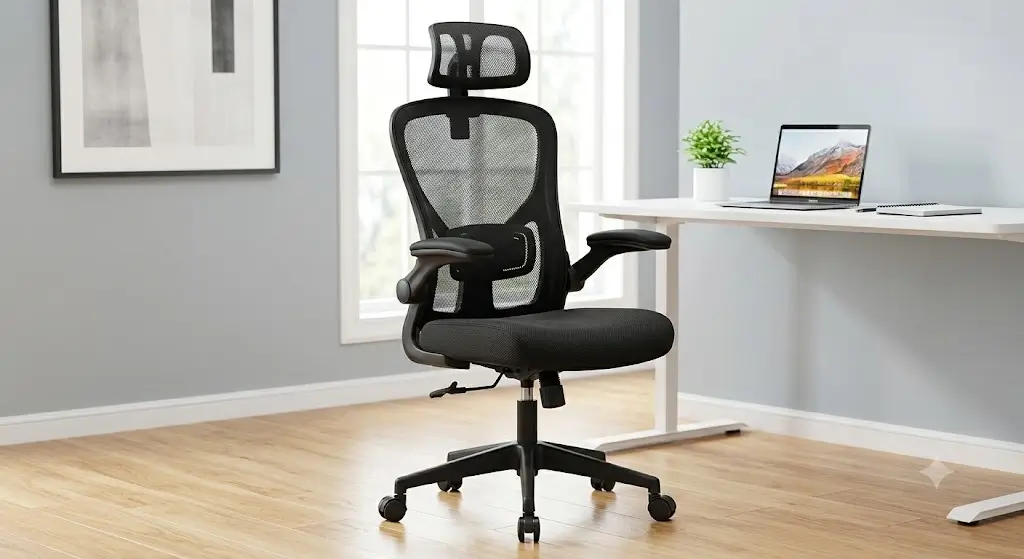
Check current pricing and availability on Amazon US:
Why the M18 Ranks First When Discounted Below $150
- 2D lumbar adjustment provides both vertical travel and depth positioning.
- Height-adjustable armrests align with standard desk working heights.
- Porous mesh back panel maximizes airflow compared to synthetic polyurethane padding.
- 330-lb stated weight capacity offers higher headroom than average entry models.
- 17.91-inch seat depth provides a stable baseline fit for average-height adults.
The Important Price Problem
The SIHOO M18 is not permanently priced below $150 on the official US store, frequently listing at $169.99. It must be treated as a sale-dependent recommendation rather than an unconditional under-$150 staple.
Who Should Buy It?
Choose the M18 if your active retailer price falls under $150, you need precise lower-back positioning, and your leg length matches its fixed 17.91-inch seat depth.
Who Should Skip It?
Skip it if current retail exceeds $150 or if your stature requires an active seat-depth slider. Shorter individuals under 5’2″ may experience excessive seat-edge pressure behind the knees.
Advantages
- 2D adjustable lumbar support (height and depth)
- Height-adjustable armrests
- Breathable, high-elasticity mesh back
- 330-lb manufacturer load rating
- 30-day return window listed by manufacturer
- 3-year limited warranty support
Limitations
- Standard retail list price frequently exceeds $150
- Fixed seat pan depth (no horizontal sliding adjustment)
- Basic entry-level recline tension control
- Fit suitability strictly dependent on user limb proportions
Ticova Ergonomic Office Chair
The Ticova ergonomic chair prioritizes aggressive lumbar contact, integrated steel recline mechanics, breathable open-weave mesh, and a contoured W-shaped high-density foam seat. Official specifications state a 280-lb maximum user capacity.
The core differentiator is backrest feel: Ticova utilizes a dedicated mechanical pad that projects further forward into the lordotic curve than the M18. If you are debating between Ticova’s aggressive support geometry and other popular budget mesh contenders, our in-depth analysis of the SIHOO M57 vs Ticova examines backrest firmness and posture alignment in greater detail.
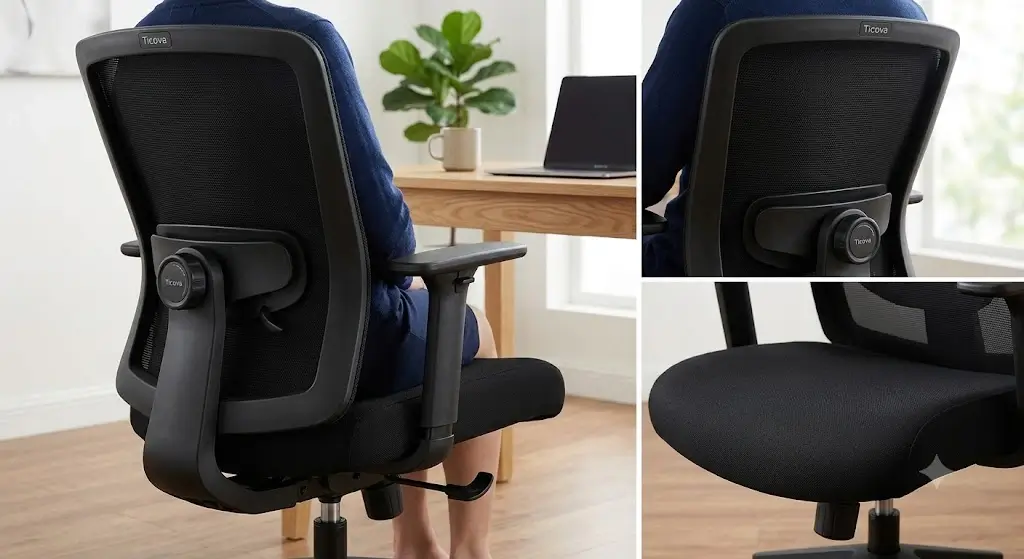
Check current pricing and availability on Amazon US:
Why It Can Outperform the M18 for Select Users
If your spinal alignment requires noticeable lumbar projection to prevent slouching, the Ticova’s forward-positioned pad can provide superior engagement compared to the flatter curve of the M18.
Key Trade-offs to Consider
Its 280-lb load ceiling falls below the SIHOO’s 330-lb rating. Furthermore, pricing fluctuates near the $130–$160 margin, requiring verification prior to purchase.
Best Buyer
Select the Ticova if you want defined lower-back pressure, prioritize a shaped waterfall foam cushion, and find current pricing within the $150 boundary.
Advantages
- Pronounced forward lumbar pad projection
- Contoured W-shaped foam cushion distributes pressure
- Height and angle adjustable arm pads
- Curved headrest with angle and height travel
Limitations
- 280-lb lower rated capacity compared to 330-lb rivals
- Lumbar pad can feel overly aggressive for flat-backed sitters
- Foam density may feel firm during initial break-in period
Modway Articulate Ergonomic Mesh Chair
The Modway Articulate focuses on utilitarian workspace flexibility. Published parameters include breathable mesh, independent backrest height adjustment, a dedicated seat-depth pan adjustment, height-adjustable armrests, pneumatic lift, and dual-action tilt locking. Its lumbar structure is passive.
Standard list pricing regularly settles around $169.05, meaning this chair enters the sub-$150 category only via recurring promotional discounts.
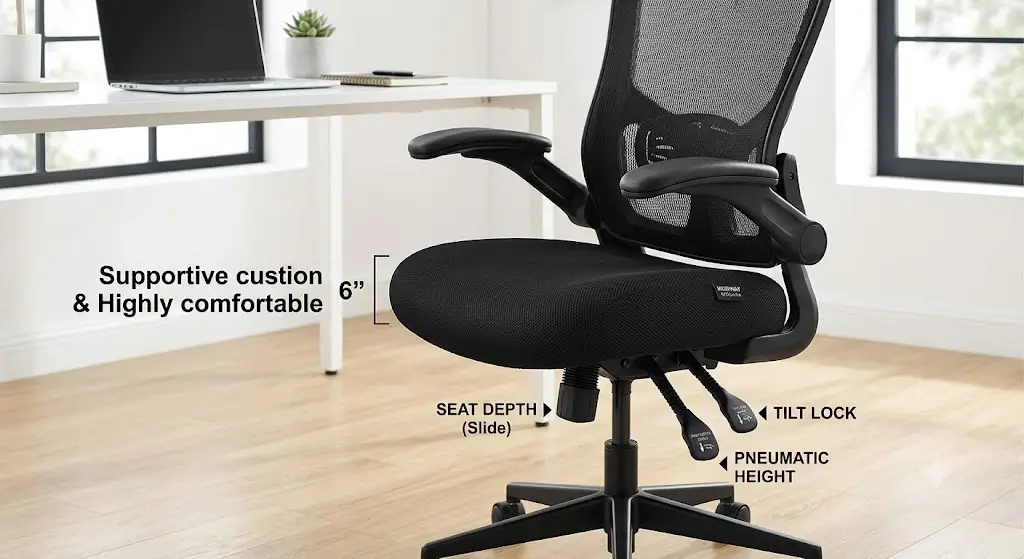
Check current pricing and availability on Amazon US:
Why the Articulate Ranks for Workspace Versatility
- Dedicated seat-depth pan adjustment accommodates different femur lengths.
- Independent backrest height adjustment helps align the passive curve with your spine.
- Height-adjustable armrests offer basic workstation alignment.
- Thick, contoured 6-inch mesh-covered cushion provides generous padding.
- Solid 331-lb stated weight capacity across most retail configurations.
The Important Price & Design Caveats
List prices regularly hover above $150, making it a deal-dependent selection. More importantly, its lumbar support relies on a fixed molded curve rather than an independently adjustable depth dial.
Who Should Buy It?
Choose the Modway Articulate if you struggle with standard seat depths, need to shift the seat pan forward or backward, and prefer a thick foam cushion over an all-mesh base.
Who Should Skip It?
Skip it if you require targeted, adjustable lower-back pressure or if you work in an unconditioned hot space where a thick foam cushion tends to trap body heat.
Advantages
- True seat-depth slider adjustment
- Independent backrest height positioning
- Generous 6-inch padded seat pan
- Sturdy 331-lb published load rating
- Durable two-tone nylon base construction
Limitations
- Passive lumbar support without independent depth/height dials
- Retail list price frequently hovers above $150
- Seat cushion retains more heat than an all-mesh seat
- Multi-lever mechanism requires manual trial-and-error setup
HBADA Ergonomic Office Chairs
HBADA manufactures a wide spectrum of chairs across multiple pricing tiers; treating “HBADA” as a singular ergonomic unit is technically inaccurate.
For example, the HBADA P2 documents a recommended height accommodation range of 4’11” to 6’3″ alongside a 300-lb capacity rating in its technical documentation, while adjacent marketing sections note a 330-lb maximum threshold. This variance illustrates why buyers must audit the specific serial configuration.
Check current pricing and availability on Amazon US:
Why HBADA Is Worth Tracking
- Extensive catalog spanning sub-$100 to mid-tier ergonomic brackets.
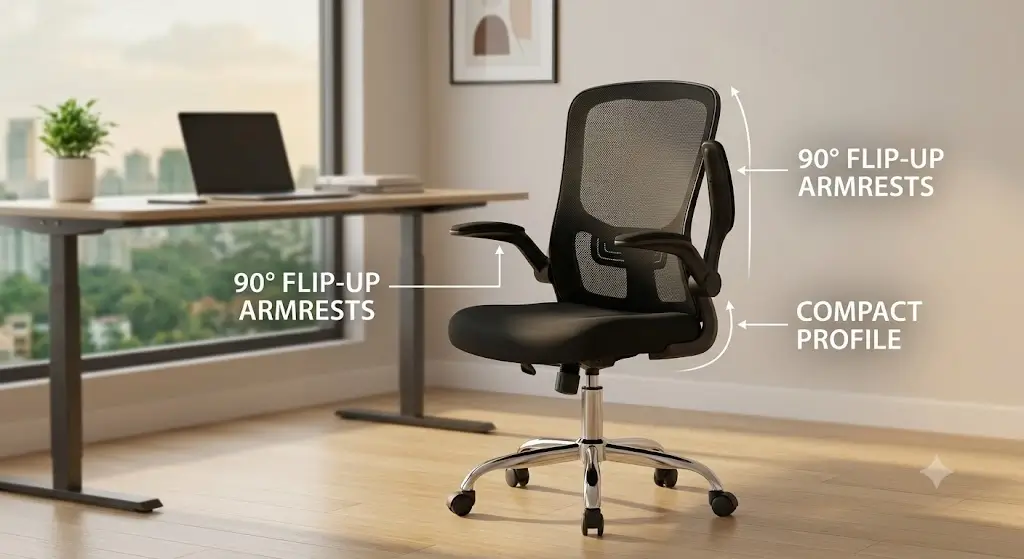
- Widely implemented flip-up armrest mechanisms suited for shallow desks.
- Adaptive dynamic lumbar wings available on specific P-series revisions.
- Engineered to accommodate smaller room footprints.
The Critical Buying Rule
Never base a purchase on universal brand claims. Verify whether your target model features a fixed lumbar ridge, a 2D dial, or passive mesh tension before committing.
Advantages
- Space-saving 90° flip-up armrests on most compact models
- Clean, minimalist aesthetic suitable for modern home setups
- Multiple models natively sold below the $130 threshold
Limitations
- Conflicting technical specs across SKU variations
- Flip-up armrests generally lack height adjustment
- Plastic base on entry-level models limits long-term rigidity
Marsail Ergonomic Office Chairs
Marsail directly targets the sub-$150 price ceiling with catalog options such as the MSOC12B-N1-US (around $99.96), MSOC10B-US (from $89.99), and MSOC24B-US (around $99.98).
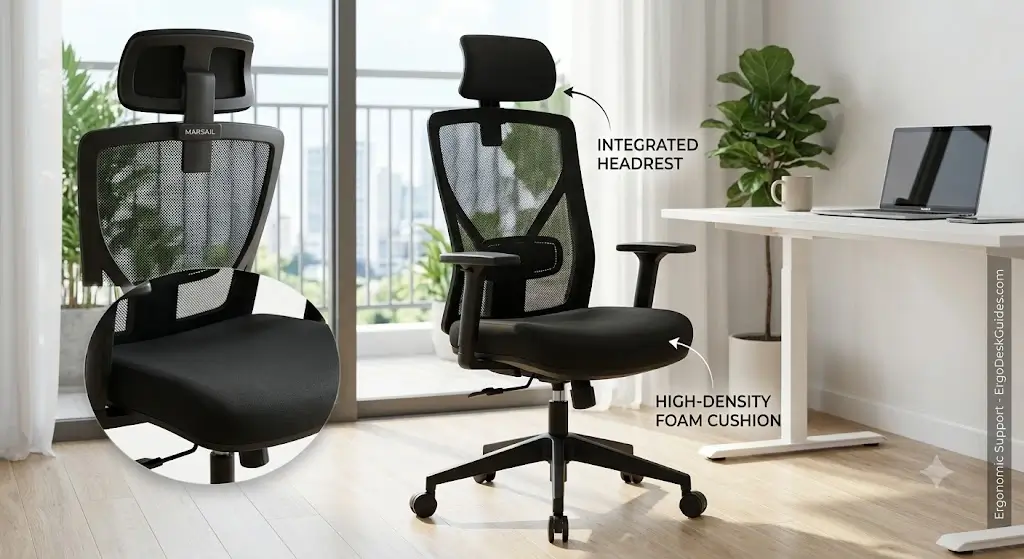
Specifications on models like the MSOC24B-US include adjustable lumbar mechanics, a 2D articulated headrest, 90° flip-up padded armrests, a 90°–120° tilt-lock range, and a 3.14-inch thick high-density molded seat base.
Check current pricing and availability on Amazon US:
Why Marsail Matters in This Price Tier
It represents the contemporary commoditization of ergonomic hardware, supplying full-body adjustment packages at price points substantially lower than traditional office supply brands.
The Mechanical Caveat
Feature density does not guarantee ergonomic precision. Secondary adjustments like rudimentary headrests provide no value if the primary seat height and lumbar apex fail to align with your spine.
Advantages
- Consistently priced below $120 without relying on rare sales
- Comprehensive adjustments (lumbar, headrest, and flip-up arms)
- High-density molded foam seat cushion resists initial sagging
Limitations
- Flip-up armrests cannot be calibrated for height
- Recline range is limited to 120 degrees
- Lighter overall frame construction compared to heavier steel models
Which Ergonomic Chair Under $150 Should You Choose?
Choose SIHOO M18 when:You locate a legitimate sub-$150 promotional offer and require independent 2D lumbar travel, reliable airflow, height-adjustable arm pads, and a certified 330-lb load frame.
Choose Ticova when:You prefer rigid, pronounced lower-back curvature support and your body weight falls well within its 280-lb rating envelope.
Choose Modway Articulate when:Your proportions require dedicated seat-depth pan travel and independent backrest height tuning over active lumbar mechanisms.
Choose HBADA when:You have verified an exact model configuration whose dimensions fit your workspace constraints, especially when flip-up arms are required.
Choose Marsail when:You must adhere strictly to a sub-$100 or sub-$120 spending limit while obtaining an all-in-one feature setup including head and armrest adjustments.
Best Ergonomic Chair Under $150 by Body Size
| User Profile | Critical Dimension Requirement | Primary Pitfall to Avoid |
|---|---|---|
| Shorter Users (< 5’4″) | Low minimum seat height (≤ 17 in) + seat depth < 18 in | Excessive seat pan depth restricting knee flexion |
| Average Users (5’4″ – 5’11”) | Balanced seat depth (17.5–19 in) + 2D lumbar | Armrests lacking height adjustment relative to desk surface |
| Taller Users (≥ 6’0″) | Seat depth ≥ 19 in + extended cylinder lift | Short seat pans causing insufficient distal thigh support |
| Broad Frame Users | Usable sitting width (distance between arm brackets) | Rigid inward-sloping armrest mounting brackets |
| Higher-Weight Users | Certified 300+ lb base + steel mechanism plate | Equating static maximum capacity with sustained cushion resilience |
Total published outer width is distinct from usable sitting width. Inward-angled armrest brackets and contoured plastic side rails frequently reduce functional hip space by 2 to 3 inches.
How Much Lumbar Adjustment Do You Really Need?
The functional purpose of lumbar support is not to exert maximum focal pressure on the spine. It is to provide steady anterior support to preserve the natural lordotic curve without causing muscular guarding or hyperlordosis.
Vertical Adjustment
Vertical adjustment ensures that the apex of the lumbar curve aligns directly with the L1–L5 vertebrae rather than pressing into the sacrum or lower thoracic spine.
Depth Adjustment
Depth adjustment calibrates contact firmness. This allows users with varying degrees of spinal curvature to dial in support without feeling displaced forward on the seat pan.
Dynamic Support Mechanisms
Self-adjusting dynamic systems flex under shifting body postures. While convenient, complex spring-loaded units in budget price bands often lack long-term tension consistency compared to manual locking mechanisms.
Why Seat Depth Is a Critical Fit Factor
Seat depth dictates the distribution of pelvic pressure and vascular circulation through the lower extremities.
A seat pan that is too deep prevents the pelvis from reaching the backrest, forcing the user to slouch. Conversely, a shallow seat leaves thighs unsupported, concentrating body weight across a reduced surface area of the ischial tuberosities.
Quick Fit TestSit back until your lumbar spine contacts the chair. Maintain feet flat on the floor. There should be approximately a 2- to 3-finger gap between the front edge of the seat cushion and the back of your calves. If the seat presses against your calf tendons, the chair is too deep for your frame.
Armrests: Evaluating Adjustability in Budget Chairs
Armrests are designed to offload load from the trapezius and cervical spine without forcing shoulder elevation or wrist extension.
Height Adjustment Is Primary
Vertical height adjustment is the single most critical armrest movement. It ensures your forearms rest parallel to your desk surface, keeping elbows bent near 90 degrees.
The Utility of Flip-Up Armrests
Flip-up arm designs lack vertical height calibration, but they allow chairs to tuck fully under compact desks, making them optimal for shallow home-office setups.
Multidirectional (3D/4D) Adjustments
Lateral and rotational movements offer additional fine-tuning, but inexpensive multi-axis armrests frequently suffer from loose tolerances and rattling. A firm 1D height-adjustable arm is mechanically superior to an unstable 3D unit at this price point.
Mesh vs. Padded Office Chairs Under $150
| Evaluation Metric | All-Mesh Backrest | High-Density Foam Padded Seat |
|---|---|---|
| Airflow & Heat Dissipation | High passive ventilation | Retains body heat across extended sessions |
| Warm Climate Performance | Superior comfort in unconditioned rooms | Susceptible to thermal accumulation |
| Initial Surface Feel | Firm, suspended tension | Immediate cushioned pressure distribution |
| Long-Term Durability | Depends on elastomer tensile retention | Subject to foam compression and bottoming out |
| Maintenance & Hygiene | Easy to wipe down; does not trap odors | Fabric covers collect dust and spills |
Upholstery selection is an ergonomic variable. If your work environment lacks climate control, mesh prevents perspiration buildup that causes unconscious shifting and posture degradation.
Can a $150 Ergonomic Chair Handle an 8-Hour Workday?
Yes, provided the chair’s physical dimensions correctly match your stature and desk height. However, manufacturing concessions are distributed differently at $150 compared to commercial-grade units.
What $150 Ergonomic Chairs Deliver Effectively
- Functional seat-height calibration matching standard desk heights.
- Dedicated lumbar contact points that support the lumbar spine.
- Ventilated mesh textiles to prevent heat retention.
- Standard tilt-lock configurations for posture variation.
- Independent arm support to reduce upper trapezius strain.
Where Budget Concessions Appear
- Coarser tilt mechanism tolerances and spring tension control.
- Harder synthetic armrest plastics with minimal cushioning.
- Basic nylon caster wheels with higher rolling friction.
- Foam cushions with lower density ratings prone to flattening after 12–18 months.
- Gradual mesh tension relaxation under sustained loads.
A mechanically aligned $120 chair configured to your proportions will support spinal health far better than an improperly fitted $500 chair. Ergonomic success is determined by alignment, not brand pedigree.
Budget Ergonomic Chair Red Flags
| Observed Red Flag | Functional & Safety Risk |
|---|---|
| Excessive Marketing Buzzwords | Overemphasis on cosmetic claims often hides absent mechanical adjustments. |
| Missing Dimensional Schematics | Inability to verify seat pan depth, height range, and usable sitting width. |
| Vague “Ergonomic” Labels | Use of the term without published adjustment specs or ANSI/BIFMA certification notes. |
| Omitted Model SKUs | Obscures component alterations across different factory production runs. |
| Stale Promotional Pricing as MSRP | Misleadingly labels temporary sales prices as everyday retail costs. |
| Extreme Recline Angles as a Feature | Deep recline (135°–155°) does not substitute for stable 90°–100° upright typing support. |
| Absent or Restrictive Return Terms | High return freight fees prevent zero-cost testing if physical fit fails. |
| Conflicting Load Ratings | Contradictory weight capacities indicate poor quality assurance documentation. |
How to Adjust an Ergonomic Chair After Unboxing
Set Seat Height
Adjust the pneumatic cylinder until your feet rest flat on the floor with your knees positioned at approximately a 90-degree angle. Your thighs should sit parallel to the floor surface.
Set Seat Depth
If equipped with a seat slider, establish a 2- to 3-finger clearance between the front waterfall edge and the back of your knees while resting against the backrest.
Position Lumbar Support
Adjust the vertical lumbar slider until the cushion aligns directly with the inward curve of your lower back (L1–L5 region). Set depth tension so it supports without forcing you forward.
Calibrate Armrest Height
Adjust armrests upward until your forearms rest comfortably while your shoulders remain completely relaxed. The pads should align flush with the top surface of your desk.
Adjust Recline Tension
Rotate the tension knob beneath the seat mechanism until the backrest allows controlled recline resistance without requiring excessive core effort to lean back.
Harmonize Chair and Desk Height
If reaching your desk requires raising your chair so that your feet dangle, implement a dedicated footrest immediately to avoid compromising femoral circulation.
When Should You Spend More Than $150?
Upgrading to the $250–$500 tier is warranted when your daily sitting schedule consistently exceeds 8 hours, when your weight approaches standard mechanical thresholds, or when you require multi-axis fine-tuning (such as 4D arms and synchronized seat-slider mechanisms). For instance, comparing the Branch Ergonomic Chair vs SIHOO M57 illustrates how moving into the next pricing bracket brings significant gains in frame stability, fabric longevity, and refined tilt mechanics.
Higher investment brackets purchase enhanced foam density retention, certified Class-4 gas cylinders, polished aluminum bases, and advanced multi-year component warranties. If your hard ceiling is $150, focus on core biomechanical dimensions rather than cosmetic accessories.
Final Verdict
Bottom LineThe SIHOO M18 remains the most capable overall ergonomic contender whenever verified retail pricing brings it below $150.
Its structural combination of 2D lumbar adjustability, height-adjustable armrests, mesh back ventilation, 17.91-inch seat depth, and 330-lb maximum load provides high functional utility. However, because standard US list pricing sits near $169.99, it must be acquired during active sales events to qualify.
The Ticova stands as the primary alternative for users needing pronounced lower back support. The Modway Articulate is suited for individuals prioritizing seat-pan depth adjustment, HBADA serves space-constrained areas, and Marsail provides an accessible feature package natively under $100–$120.
The foundational rule remains: select the chair that matches your physical body measurements, not the chair that advertises the most components.
Frequently Asked Questions
What is the best ergonomic office chair under $150?
The SIHOO M18 is the leading option when priced under $150 via discounts. Key specifications include 2D lumbar support, height-adjustable armrests, a 17.91-inch seat depth, and a 330-lb maximum load rating. Note that standard US retail pricing regularly fluctuates above this threshold.
Is $150 enough for a good ergonomic office chair?
Yes. A $150 budget provides fundamental ergonomic adjustments including pneumatic height adjustment, active or contoured lumbar support, breathable mesh, and adjustable armrests. Mechanical refinements and material longevity are the primary trade-offs.
What should I look for in an office chair under $150?
Prioritize verified seat pan dimensions, lumbar adjustability range, armrest height compatibility with your desk, stated load ratings, and merchant return policies over secondary add-ons like footrests or headrests.
Is the SIHOO M18 worth buying?
Yes, particularly when acquired within a $130–$150 promotional range. Its combination of 2D lumbar regulation, adjustable arms, breathable backrest, and 330-lb structural frame delivers solid performance in this category.
Is Ticova better than the SIHOO M18?
Neither is universally superior. Ticova provides firmer, more pronounced lumbar contact, making it suitable for users wanting aggressive back support. The SIHOO M18 offers a slightly higher weight rating and a broader, less intrusive lumbar contour.
Are mesh office chairs better than padded chairs?
Mesh offers superior thermal regulation and airflow, preventing heat retention during long work sessions. Padded high-density foam cushions provide immediate pressure relief across the pelvic base. The choice depends on room temperature and personal support preference.
Can a $100 office chair be comfortable for eight hours?
Yes, provided the chair’s fixed dimensions match the user’s leg length and desk height. Budget chairs lack long-term adjustment versatility, so initial dimensional compatibility is critical for all-day posture support.
What is the most important ergonomic chair adjustment?
Seat height is the primary foundation: it determines foot grounding and pelvic tilt relative to your working plane. Secondary priorities include lumbar positioning and armrest elevation.
Do I need a headrest on an ergonomic office chair?
No. A headrest is functional only while leaning back to rest or read. During upright task-oriented typing, proper head and neck alignment should be maintained naturally by the spine without touching a headrest.
Should lumbar support feel strong against your back?
Lumbar support should feel gently supportive rather than forcefully intrusive. If a lumbar pad forces your torso forward or creates localized pressure spots, it is improperly positioned or too aggressive for your spine.
How long should a $150 office chair last?
A typical entry-level ergonomic chair lasts between 2 and 4 years depending on user weight, usage duration, and mechanical stress. Foam cushion compression and caster degradation are typical early points of wear.
Is an ergonomic chair under $150 worth buying?
Yes, provided you focus on mechanical fundamentals—proper seat sizing, functional lumbar support, and armrest height—rather than uncertified marketing novelties.
Editorial Method & Transparency
How Product Specifications Are Verified
Manufacturer-published specification sheets, user guides, and certified retail listings are cataloged as factual specifications rather than claimed as proprietary measurements. When model families diverge, individual product SKUs are audited separately.
What Qualifies as Hands-On Testing
A rigorous physical review requires controlled testing across multiple user heights, continuous multi-hour posture mapping, pressure sensor tracking on seat cushions, and mechanical deflection checks. Where these specific tests are not performed, data is explicitly attributed to manufacturer baseline ratings.
Why We Do Not Fabricate Lab Test Data
Publishing unverified test data damages user trust. We deliver clear value by separating verified technical specifications, dimensional fit constraints, and ergonomic trade-offs so consumers make informed decisions.
