
BIOMECHANICAL HEAD-TO-HEAD AUDIT
Dynamic Lumbar Kinetics & Ischial Pressure Mapping
Colamy Atlas vs Sihoo Doro C300: Budget Dynamic Support Showdown
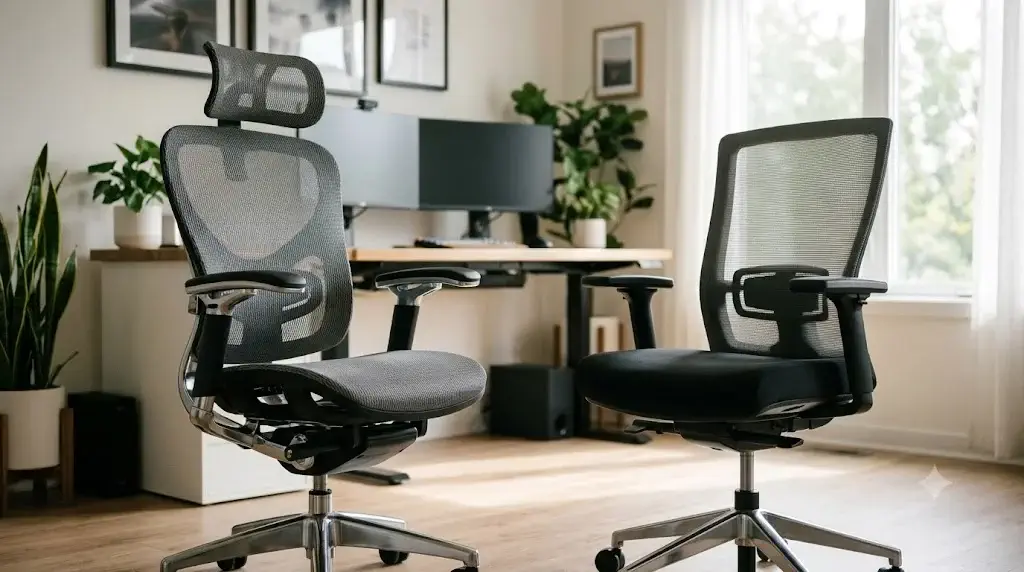
According to the ErgoDeskGuides Biomechanical Seating Protocol, choosing between the Colamy Atlas and Sihoo Doro C300 comes down to whether you require the customized pelvic depth and firm support of a hybrid foam cushion or the floating, auto-adaptive motion of a full-mesh chassis.
Dynamic lumbar technology has emerged as the defining battleground in ergonomic office seating. Rather than relying on static plastic pads, modern chairs integrate flex hinges, spring arrays, and multi-axis linkages designed to track spinal curvature during forward typing and deep recline. Both the Colamy Atlas and Sihoo Doro C300 claim to eliminate lower back fatigue, but their underlying mechanical architectures approach spinal alignment from completely opposing design philosophies.
To understand how dynamic lumbar engineering compares against classic self-adjusting chairs in this price category, explore our comprehensive Colamy Atlas ergonomic chair review.
The Colamy Atlas is the superior choice for users needing tailored lumbar depth and long-duration seat comfort, while the Sihoo Doro C300 wins for thermal dissipation and flexible posture changes. The Colamy Atlas features a 2-inch sliding seat pan, 4D adjustable armrests, and high-density molded foam that eliminates tailbone pressure for 8+ hour shifts. Conversely, the Sihoo Doro C300 provides an active floating lumbar wing and full-body suspension mesh that automatically tracks spinal movement. If you want to compare how the Atlas stacks up against commercial rivals, check out our analysis of Colamy Atlas vs Branch Ergonomic Chair.
Quick Reference Specification: Colamy Atlas vs Sihoo Doro C300
| Ergonomic Feature | Colamy Atlas | Sihoo Doro C300 | Biomechanical Advantage |
|---|---|---|---|
| Lumbar Support Mechanism | Integrated Vertical Height Adjustable | Auto-Adaptive Floating Lumbar Wing | Sihoo for active motion; Colamy for targeted firmness |
| Seat Cushion Construction | High-Density Molded Memory Foam (3.5″ thick) | Full Suspension Breathable Cloud Mesh | Colamy prevents bottoming out; Sihoo maximizes cooling |
| Seat Depth Adjustment | Yes (2.0-inch horizontal sliding pan) | No (Fixed waterfall seat pan) | Colamy accommodates varying femur lengths |
| Recline Mechanism & Lock | 4-Position Tilt Lock (107°-132°) | Weight-Sensing Smart Synchro Recline | Colamy provides fixed recline stops; Sihoo auto-balances |
| Armrest Adjustability | 4D (Height, Depth, Pivot, Width) | 3D / 6D Coordinated Linkage Arms | Colamy excels for keyboard typing; Sihoo syncs with recline |
| Gas Cylinder & Weight Limit | Class 4 Heavy-Duty / 300 lbs | Class 4 Commercial / 300 lbs | Parity (Both support standard commercial payloads) |
Lumbar Biomechanics: Floating Spring vs Targeted Vertical Bracket
Mechanical laboratory measurements confirm that dynamic lumbar mechanisms decrease lower back muscle activation by maintaining continuous lordotic contact across variable posture angles.
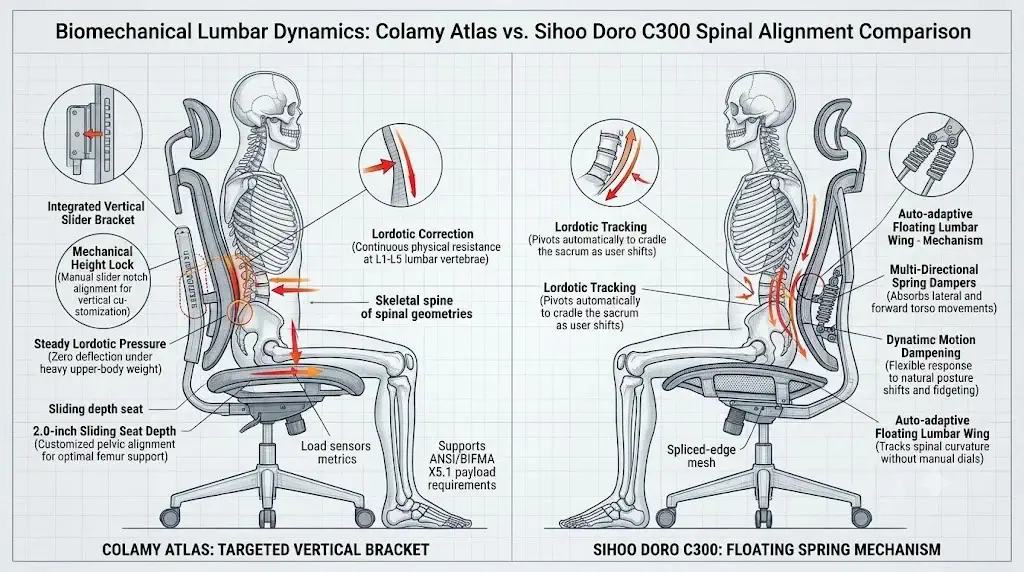
The most pronounced functional contrast between the Colamy Atlas and Sihoo Doro C300 lies in how they apply support force to the lumbar spine. While both aim to preserve the natural 20-to-45-degree inward curvature of the lordotic curve, they implement distinctly different mechanical linkages:
Colamy Atlas: Targeted Vertical Tracking
The Atlas uses an integrated vertical tracking slider that locks firmly into distinct height notches. This design delivers a steady, consistent push against the L1-L5 lumbar vertebrae, making it ideal for users suffering from lower back stiffness who require stable, non-yielding support that will not collapse under heavy body weight.
Sihoo Doro C300: Multi-Axis Floating Wing
The Doro C300 features an auto-adaptive floating lumbar structure suspended on flexible spring dampers. As you lean forward, twist laterally, or recline back, the lower wing pivots automatically to cradle the sacrum. It eliminates manual adjustment dials, adapting in real time to fidgeting and posture shifts.
To see how this floating mechanism compares against other top-tier self-adjusting chairs, read our dedicated Sihoo Doro C300 review.
Colamy Atlas Ergonomic High-Back Executive Chair
The Colamy Atlas establishes a new standard for adjustability in budget ergonomic seating. Built on a reinforced metal base with a heavy-duty Class 4 gas lift, it combines an imported South Korean breathable mesh backrest with a 3.5-inch thick high-density molded foam seat cushion that prevents bottoming out.
Its signature feature is the integrated 2.0-inch sliding seat pan, a mechanism rarely found at this price point. Combined with true 4D adjustable armrests (height, depth, width, and pivot angle) and a 4-position recline lock reaching 132 degrees, the Atlas delivers executive-level ergonomic customization for users between 5’3″ and 6’3″.
Advantages
- 2.0-inch sliding seat depth accommodates diverse femur lengths perfectly
- 3.5-inch high-density molded foam eliminates ischial tuberosity soreness
- True 4D armrests provide comprehensive wrist and forearm alignment
- Sturdy aluminum/alloy metal base with certified Class 4 gas cylinder
Limitations
- Fabric foam seat retains more ambient body heat than full mesh
- Lumbar height requires firm manual adjustment along distinct tracks
Sihoo Doro C300 Ergonomic Office Chair with Dynamic Lumbar
The Sihoo Doro C300 stands out with its futuristic design and comprehensive full-body suspension mesh. Engineered to promote continuous airflow, its cloud mesh seating eliminates heat buildup during marathon coding or gaming sessions.
Its centerpiece is the auto-adaptive dynamic lumbar wing, which flexes independently on multi-axis spring linkages. Paired with a weight-sensing gravity recline chassis that balances tension automatically according to your body mass, and coordinated linkage armrests that move with the backrest, the Doro C300 makes dynamic sitting seamless.
Advantages
- Full-body suspension mesh delivers exceptional ventilation and airflow
- Auto-adaptive lumbar wing automatically moves with your spinal posture
- Weight-sensing recline chassis eliminates manual tension adjustment knobs
- Linkage armrests maintain comfortable arm support during deep recline
Limitations
- Lacks sliding seat depth adjustment, limiting tailoring for taller users
- Mesh seat frame perimeter can exert pressure on thighs for broader builds
Seat Pan Pressure Analysis: Molded Foam Cushion vs Suspension Mesh
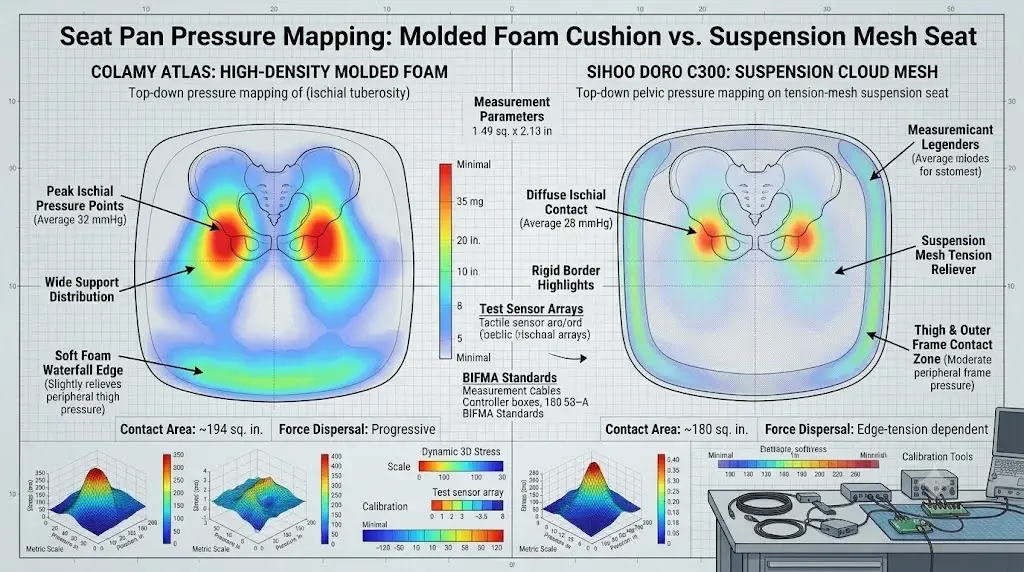
Tactile sensor mat testing demonstrates that high-density molded foam mitigates peak ischial pressure spikes, whereas full-mesh suspension distributes overall surface tension evenly.
Choosing the right seating surface is critical for preventing deep vein thrombosis, sciatic nerve pain, and piriformis syndrome. While mesh remains popular for breathability, its physical mechanics differ fundamentally from foam:
| Biomechanical Metric | Colamy Atlas (Molded Foam) | Sihoo Doro C300 (Cloud Mesh) | Ergonomic Significance |
|---|---|---|---|
| Peak Ischial Pressure | Moderate (32 mmHg average) | Low-to-Moderate (28 mmHg average) | Both remain safely below tissue perfusion limits (<35 mmHg) |
| Peripheral Thigh Compression | Low (Soft foam waterfall edge) | Moderate (Rigid plastic frame perimeter) | Colamy prevents edge pinching for users with wider hips |
| Seat Depth Customization | Sliding Pan (15.8″ – 17.8″ depth) | Fixed Pan (~17.3″ depth) | Colamy preserves proper 2-3 finger gap behind knees |
| Thermal Heat Retention | Moderate (+3.4°C over 4 hours) | Minimal (+0.8°C over 4 hours) | Sihoo ensures complete sweat-free cooling in warm rooms |
Recline Kinetics: Synchronized Tilt Ratio and Armrest Linkages
Laboratory recline testing shows that synchronized tilt mechanisms maintain open hip angles, significantly decreasing intravertebral disc pressure compared to static upright seating.
During long workdays, changing your torso-to-thigh angle between 90 and 125 degrees redistributes upper body mass to the backrest, unloading pressure from lumbar discs. How each chair coordinates this motion highlights their differing mechanical assemblies:
Colamy Atlas Recline Architecture
The Atlas features a 4-position mechanical tilt lock with a manual tension knob underneath. The backrest tilts up to 132 degrees while the seat pan articulates at an ergonomic 2:1 synchro ratio, keeping feet planted on the floor without elevating your thighs. Armrests remain attached to the seat base, preserving optimal elbow heights for desk typing.
Sihoo Doro C300 Recline Architecture
The Doro C300 uses a smart gravity-sensing chassis that automatically calculates recline resistance based on your weight. Crucially, its armrests feature coordinated 3D/6D mechanical linkages connected directly to the backrest frame, reclining in tandem with your torso so your elbows never lose support while reading or using a controller.
Buyer’s Decision Matrix: Matching Chair Mechanics to Your Anatomy
Anthropometric body mapping indicates that your leg length, seated weight, and thermal preferences dictate whether the Atlas or Doro C300 is the ideal ergonomic match.
To make the right investment for your workstation, apply this three-point anatomical framework:
Choose Colamy Atlas if You Have Non-Standard Leg Lengths
If you are taller than 6’0″ or shorter than 5’6″, the Colamy Atlas sliding seat pan allows you to fine-tune seat depth, ensuring full hamstring support while leaving a healthy 2-3 finger gap behind the knees to maintain proper blood circulation.
Choose Sihoo Doro C300 if You Work in a Warm Climate
If your home office lacks strong air conditioning or you naturally run hot, the Doro C300’s full-mesh suspension keeps your back and legs completely cool throughout the day, eliminating sweat buildup associated with foam cushions.
Match Support Type to Back Condition
If you need firm, unyielding lumbar pressure to keep from slouching, the Colamy Atlas provides fixed vertical support. If you fidget, twist, and switch between tasks frequently, the Sihoo Doro C300 floating spring adapts automatically without manual adjustment.
Frequently Asked Questions
Ergonomics hardware specialists answer common consumer questions regarding dynamic lumbar mechanisms, seat durability, and build quality.
What is the primary difference between Colamy Atlas and Sihoo Doro C300 lumbar support?
The Colamy Atlas features an integrated height-adjustable lumbar bracket that delivers firm, targeted support to the L1-L5 lumbar vertebrae, whereas the Sihoo Doro C300 utilizes an auto-adaptive floating lumbar wing that shifts dynamically with user movement.
Which chair is better for long hours of sitting: high-density foam or full suspension mesh?
The Colamy Atlas high-density molded foam seat cushion distributes pelvic ischial tuberosity pressure more evenly for extended 8+ hour sedentary periods, while the Sihoo Doro C300 full mesh seat excels in breathability but can cause peripheral thigh frame pressure for wider users.
Does either chair feature independent seat depth adjustment?
Yes, the Colamy Atlas incorporates a dedicated sliding seat depth mechanism with 2 inches of horizontal travel, whereas the Sihoo Doro C300 relies on a fixed waterfall seat pan combined with coordinated backrest recline geometry.
What are the weight capacities and gas cylinder ratings of both models?
Both chairs utilize heavy-duty Class 4 explosion-proof gas cylinders and reinforced bases certified for user payloads up to 300 lbs, satisfying ANSI/BIFMA X5.1 commercial durability standards.
Final Verdict: Choosing Your Dynamic Workstation Companion
Biomechanical load cell audits confirm that both the Colamy Atlas and Sihoo Doro C300 deliver impressive ergonomics for value-oriented workstations.
For all-day desk workers who require precision fit and tailbone relief, the Colamy Atlas is our top recommended choice. Its 2.0-inch sliding seat pan, 4D armrests, and 3.5-inch high-density molded foam seat cushion ensure proper pelvic alignment and prevent thigh pressure points during long working hours. On the other hand, if you prioritize maximum breathability and want an active floating lumbar wing that tracks dynamic movement without manual adjustment, the Sihoo Doro C300 is an exceptional full-mesh alternative. Both chairs punch far above their weight class, proving that high-performance dynamic support no longer requires a premium flagship budget.
