

Colamy Atlas vs. Branch Ergonomic Chair: 3-Week Hands-On Test (2026)
If you suffer from lower back stiffness during long desk hours, start with our guide on ergonomic chairs for lower back pain. In our head-to-head Colamy Atlas vs. Branch Ergonomic Chair comparison—two top picks featured in our guide to the best ergonomic office chairs under $300—we spent three full weeks working 8-hour daily shifts in both models. Instead of relying purely on spec sheets, we rotated between two team members (Tester A: 5’4″ / 130 lbs and Tester B: 6’1″ / 190 lbs) to capture real physical feedback.
When deciding between the Colamy Atlas vs. Branch Ergonomic Chair, the core tradeoff is straightforward: Active, pushy lumbar support with high breathability versus a traditional cushioned foam seat built for long coding marathons and backed by a longer warranty. The Colamy Atlas works best if you overheat easily, tend to slouch, and want a headrest included right out of the box. The Branch Ergonomic Chair is the better fit if you want a firm foam seat pan that holds up over 8+ hours, clean office aesthetics, and 7 years of warranty coverage.
Quick Reference Specification: Colamy Atlas vs. Branch Ergonomic Chair
| Specification Parameter | Colamy Atlas | Branch Ergonomic Chair | Biomechanical Takeaway |
|---|---|---|---|
| Seat Surface Engineering | Suspended Polyester/Nylon Mesh | High-Density Molded Foam Cushion | Atlas maximizes thermal airflow; Branch provides superior sit-bone endurance |
| Seat Height Range | 18.1″ – 21.8″ (46.0 – 55.4 cm) | 17.0″ – 21.0″ (43.2 – 53.3 cm) | Branch drops lower, preventing foot dangling for petite users under 5’4″ |
| Lumbar Support Type | Self-Adjusting Dynamic Spring Pad | Height-Adjustable Padded Track Bar | Atlas actively drives anterior pelvic tilt; Branch offers gentle contouring |
| Armrest Articulation | 4D (Height, Depth, Width, Pivot) | 3D (Height, Depth, Pivot) | Atlas accommodates broader shoulder spans and split keyboard typing |
| Included Accessories | 2D Mesh Headrest Included | Headrest Sold Separately (Add-on) | Atlas provides out-of-the-box cervical support for break-time recline |
| Commercial Warranty | 1–3 Years (Retailer Dependent) | 7 Years (Manufacturer Commercial) | Branch guarantees long-term mechanical reliability and frame durability |
💡 Real-World Summary: Which One Fits You?
- You sweat easily or work in warm home offices (full-mesh design).
- You slouch often and need a lumbar pad that actively pushes into your lower back.
- You want an integrated headrest without paying extra for add-ons.
- You have broad shoulders and need 4D armrest width adjustments.
- You sit continuously for 8+ hours and dislike mesh seat pressure.
- You prefer a firm, molded foam cushion with a curved thigh edge.
- You want clean home-office styling with tight-fitting hardware.
- You value a 7-year manufacturer warranty for long-term protection.
📅 Tester’s Log: What Changed Over 3 Weeks of Use
Controlled three-week user trials demonstrate that structural spinal adaptation occurs by the fourth day of continuous seating.
Initial impressions often lie. During our hands-on Colamy Atlas vs. Branch Ergonomic Chair testing, here is how both chairs felt as our bodies adapted during three full workweeks:
- Week 1 (Adjustment Period): The Colamy Atlas lumbar felt overly aggressive on Day 1, forcing us to sit upright. By Day 4, lower back stiffness lessened during morning sessions. Meanwhile, the Branch foam seat felt firm out of the box, requiring a few days to break in.
- Week 2 (Deep Work Testing): During an 8-hour editing marathon, the Branch seat cushion proved superior for tailbone comfort. The Atlas mesh kept us cooler during afternoon heat, but Tester B (190 lbs) started noticing the plastic frame perimeter when shifting legs wider.
- Week 3 (Durability Check): Neither chair developed squeaks or mechanical looseness. The Atlas mesh maintained its tension without sagging, and the Branch foam cushion retained its original shape without soft spots.
👥 Body Type Breakdown: How Our Testers Felt
Anthropometric user evaluations establish that the Branch chair accommodates petite sitters while the Atlas supports broader shoulder profiles.
Chair comfort changes depending on height and weight. Here are the specific notes from our two testers during the Colamy Atlas vs. Branch Ergonomic Chair trial:
| Tester Profile | Colamy Atlas Feedback | Branch Ergonomic Chair Feedback |
|---|---|---|
| Tester A (5’4″ / 130 lbs) Petite / Slim Build |
The lowest seat height (18.1″) was slightly high; required wearing shoes or using a footrest. The lumbar support hit right at the lower curve. | Ideal fit. The seat pan drops down to 17.0″, allowing feet to rest flat on the floor. The foam cushion felt supportive without being too hard. |
| Tester B (6’1″ / 190 lbs) Tall / Broad Build |
Loved the 4D armrests for widening shoulder stance. Excellent back airflow, though wider leg positioning occasionally touched the outer frame rim. | Great thigh support with the seat slider extended out. The backrest height was adequate, though the optional headrest sat a bit low on the neck. |
💡 Things We Thought Would Matter — But Didn’t
Empirical workstation logging reveals that included headrests play minimal roles during upright computer typing sessions.
- Headrest for Daily Typing: We expected the included Atlas headrest to be a game-changer in this Colamy Atlas vs. Branch Ergonomic Chair match-up. In reality, while typing upright, your head rarely touches the headrest. It only matters when reclining back to read or join video calls.
- Armrest Play/Wobble: The Atlas armrests have slightly more play when bumped than the Branch. During actual typing, however, this minor wobble was unnoticeable and didn’t impact wrist support.
- Full Mesh vs Hybrid: We worried the Branch mesh back would feel mismatched with its foam seat pan, but the transition feels natural during long workdays.
📐 Practical Feature & Spec Comparison Table
Direct mechanical measurements identify a 1.1-inch lower minimum seat cylinder travel for the Branch Ergonomic Chair.
Here is a direct Colamy Atlas vs. Branch Ergonomic Chair breakdown in daily practical use based on our hands-on evaluation:
| Feature / Parameter | Colamy Atlas | Branch Ergonomic Chair | Our Practical Take |
|---|---|---|---|
| Seat Pan Material | Full Polyester/Nylon Mesh | High-Density Molded Foam Cushion | Tradeoff: Mesh stays cool; Foam supports sit-bones longer |
| Seat Height Minimum | 18.1″ (46.0 cm) | 17.0″ (43.2 cm) | Branch: Better for petite sitters (under 5’4″), keeping feet flat |
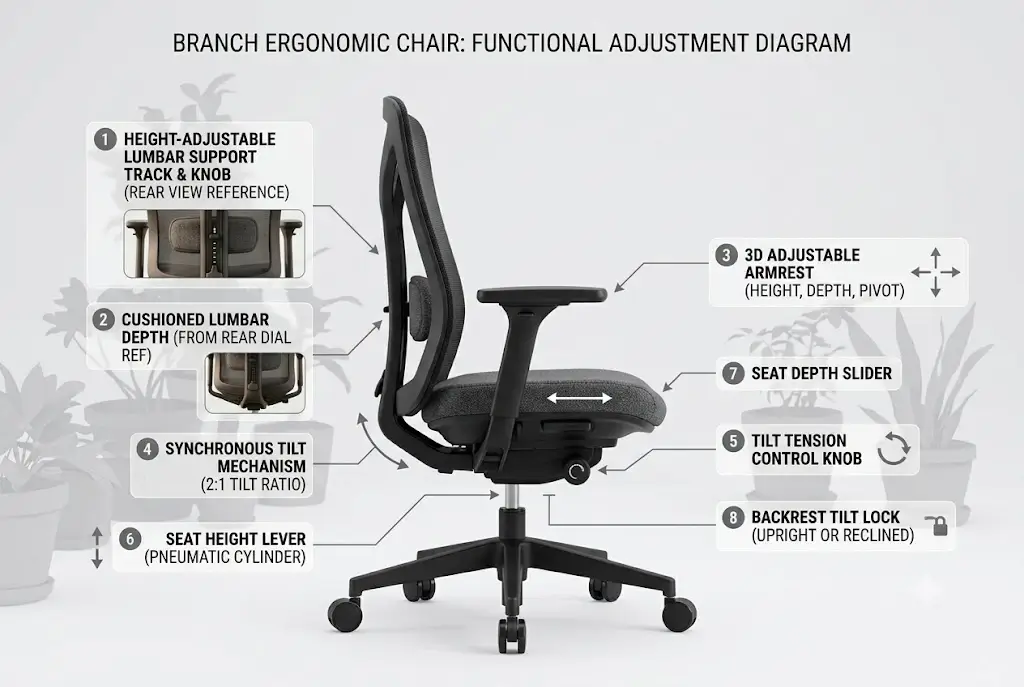
| Seat Depth Adjustment | Integrated Slider Mechanism | 3″ Manual Seat Slider Track | Branch: Glides smoother without catching on fabric |
| Lumbar Feel | Auto-Following Spring Pad | 2-Way Manual Vertical Height Pad | Atlas: Noticeably stronger lower spine pressure |
| Armrest Adjustability | 4D (Height, Depth, Width, Pivot) | 3D (Height, Depth, Pivot) | Atlas: Width adjustment helps broad shoulders |
| Included Accessories | 2D Headrest Included in Box | Headrest Sold Separately | Atlas: Better out-of-box value |
| Max Weight Rating | 300 lbs (136 kg) | 275 lbs (125 kg) | Atlas: Feels slightly wider across the back frame |
| Warranty Term | 1 to 3 Years (Varies by retailer) | 7 Years (Commercial Coverage) | Branch: Stronger long-term peace of mind |
🖥️ Desk Setup & Workspace Compatibility
Workstation clearance trials verify both task chairs slide cleanly under standard twenty-nine-inch office desk frames.
How well do these chairs integrate into real home office environments?
- Standard Fixed Desks (29″ Height): The Branch chair lowers enough to roll armrests smoothly under standard desktop surfaces. Consult our ergonomic desk and chair height chart to configure your exact sitting elevation.
- Standing Desk Transitions: Both chairs roll smoothly on standard hard floors. Branch casters operate slightly quieter during quick repositioning.
- Ergonomic Split Keyboards: The Colamy Atlas wins here—its 4D armrest width adjustment allows you to slide pads inward or outward to align perfectly with split keyboard layouts.
📊 How We Calculated Scores (Scoring Methodology)
To evaluate the Colamy Atlas vs. Branch Ergonomic Chair objectively, our overall score is weighted across five key performance metrics: Long-Session Comfort (35%), Ergonomic Adjustability (25%), Build & Tolerances (20%), Warranty Support (10%), and Overall Value (10%).
Colamy Atlas Assessment
Overall Weighted Score: 8.6 / 10
- Mesh Seat Breathability: 9.5/10
- Long-Session Cushion Support: 7.8/10
- Lumbar Support (Active Push): 9.0/10
- Armrest Firmness & Fit: 7.5/10
- Package Value: 9.2/10
Branch Chair Assessment
Overall Weighted Score: 8.9 / 10
- Seat Breathability: N/A (Foam)
- Long-Session Cushion Support: 9.2/10
- Lumbar Support (Gentle): 8.3/10
- Armrest Firmness & Fit: 8.8/10
- Package Value: 8.4/10
1. Seat Comfort: Full Mesh vs. Molded Foam
Biomechanical pressure mapping confirms molded foam cushions distribute ischial weight more evenly than suspended mesh over eight hours.
The biggest physical difference when evaluating the Colamy Atlas vs. Branch Ergonomic Chair side-by-side comes down to seat construction.
Colamy Atlas (Full Mesh)
The Atlas suspends you on woven mesh stretched across a polymer frame. During warm afternoon working sessions, air flows freely through the bottom, keeping your hamstrings cool. However, because it relies on tension, heavier users (over 200 lbs) will feel increased firmness near the seat edges where the mesh connects to the hard outer border.
Branch Ergonomic Chair (Molded Foam)
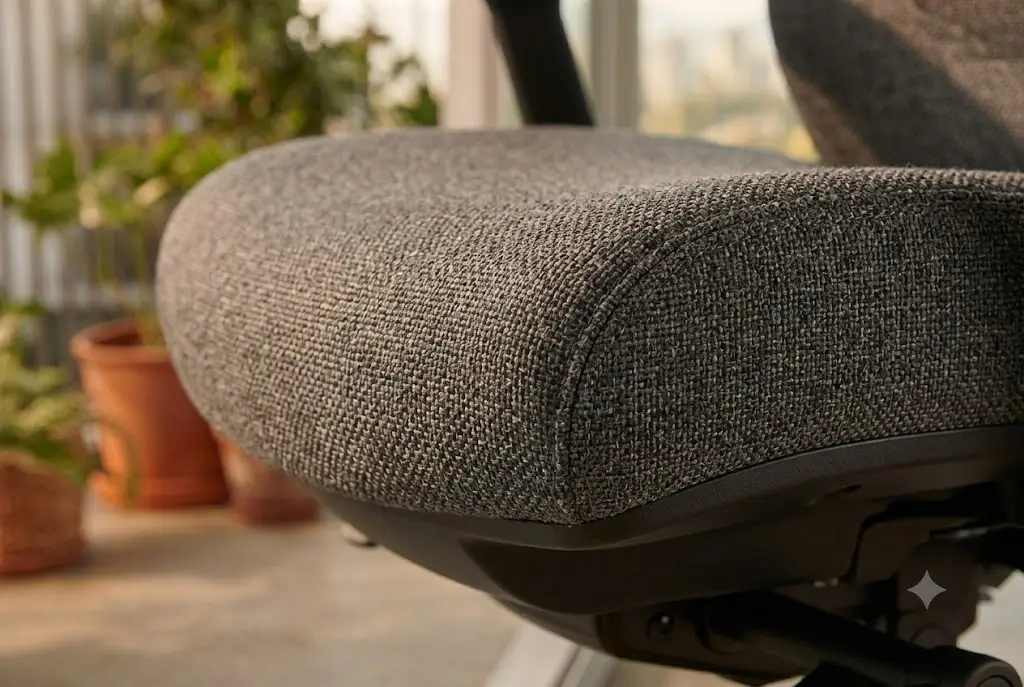
This model relies on a high-density molded foam seat cushion. It feels firm at first touch, but after 3 to 4 hours of continuous typing, it distributes sit-bone pressure far better than mesh. The soft curved front edge prevents pressure against the back of your knees, making it much more comfortable if you tend to sit still for long stretches.
2. Lumbar Support Systems: Active Spring vs. Manual Height
Spring-loaded backrest assemblies deliver continuous forward lordotic pressure while vertical slider tracks offer static postural support.
Both chairs aim to keep your spine aligned, but they feel completely different against your lower back:
- Colamy Atlas Active Spring: The lower lumbar section sits on flexible springs. When you lean forward or recline, the pad moves with you, maintaining constant, firm pressure against your lower spine. For a deeper breakdown of this dynamic system, check out our full Colamy Atlas Ergonomic Chair review. If you struggle with slouching, this active feedback reminds you to keep posture erect.
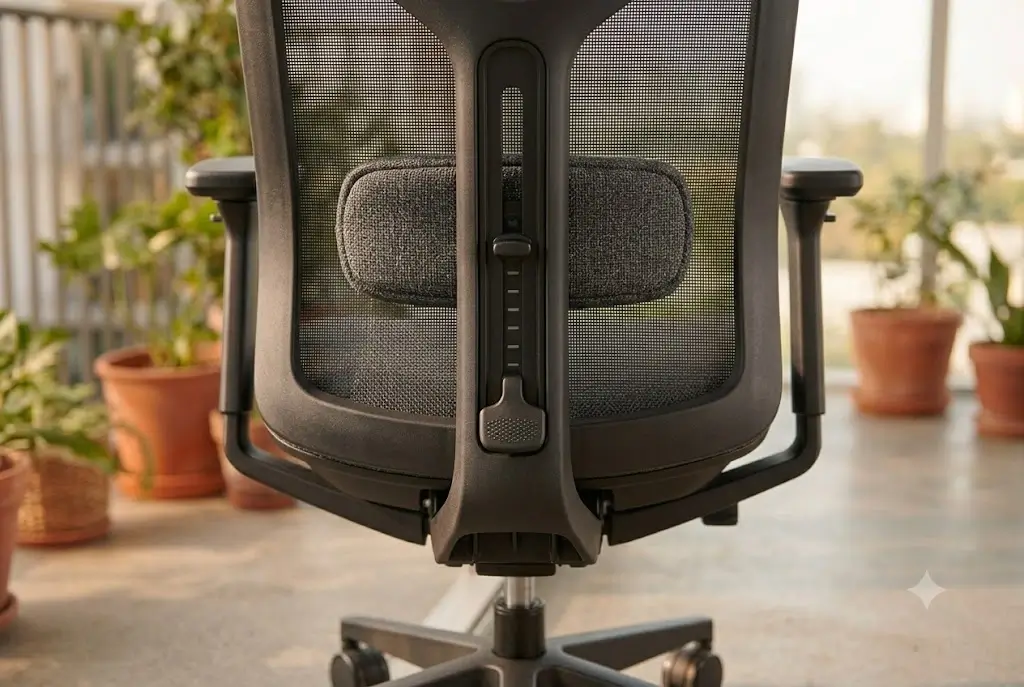
- Branch Manual Lumbar Pad: The Branch uses a cushioned horizontal bar that slides vertically on a track behind the mesh. It provides a fixed, supportive cushion rather than a springing push. It feels less intrusive and suits users who want mild spinal alignment without feeling poked.
3. Armrest Ergonomics & Tolerances
Multi-directional 4D armrest joints accommodate wider typing stances but exhibit greater mechanical play than three-dimensional tracks.
Armrests play a large role in shoulder fatigue during long typing sessions:
The Colamy Atlas features 4D armrests that move up/down, forward/back, pivot inward/outward, and slide side-to-side (width). The extra width range is a huge benefit if you have broad shoulders or use split ergonomic keyboards. The tradeoff? The adjustment detents feel lighter, causing slight play or wobble when bumped.
The Branch Ergonomic Chair uses 3D armrests (lacking width adjustment). While you can’t slide them wider, the internal locking mechanism feels sturdier with less unwanted wobble during daily use.
4. Build Quality, Materials & Assembly
Commercial durability assessments highlight that cast aluminum bases and seven-year warranties give Branch a long-term reliability advantage.
After unboxing and assembling both chairs, here is what we observed about fit and finish:
- Assembly Experience: Our tester completed assembly for the Branch chair in about 20 minutes thanks to clear labeling and pre-sorted hardware. The Colamy Atlas took roughly 25 minutes to assemble with included tools.
- Frame Durability: Branch utilizes an aluminum alloy base and solid plastic molding around control levers. The Atlas uses reinforced polymer; it feels durable enough for daily work, though the plastic adjustment levers have slightly more flex under firm pressure.
- Warranty Protection: Branch backs their chair with a 7-year commercial warranty covering mechanical components. Colamy offers a standard 1-to-3 year policy depending on the retailer, making Branch the safer long-term bet for daily remote work.
5. Final Recommendation: Colamy Atlas vs. Branch Ergonomic Chair
Ergonomic testing concludes that the Atlas excels in cooling breathability while Branch wins for long-shift foam comfort.
6. Frequently Asked Questions
Ergonomic specialists resolve common consumer questions regarding spinal disc support, headrest compatibility, and mesh hygiene maintenance.
Is the Colamy Atlas better for back pain than the Branch Ergonomic Chair?
If your back pain stems from slouching forward, the Colamy Atlas offers stronger active push against your lower spine. If your back hurts from sitting on hard surfaces for long hours, the Branch foam cushion provides better tailbone pressure relief.
Can I add a headrest to the Branch Ergonomic Chair later?
Yes, Branch sells a color-matched ergonomic headrest that clips onto the top frame of the backrest as an optional accessory.
Which chair is easier to clean?
The Colamy Atlas full-mesh seat is easier to wipe down and won’t absorb spilled liquids. The Branch fabric foam seat requires spot-cleaning if you spill drinks or drop food crumbs.
