
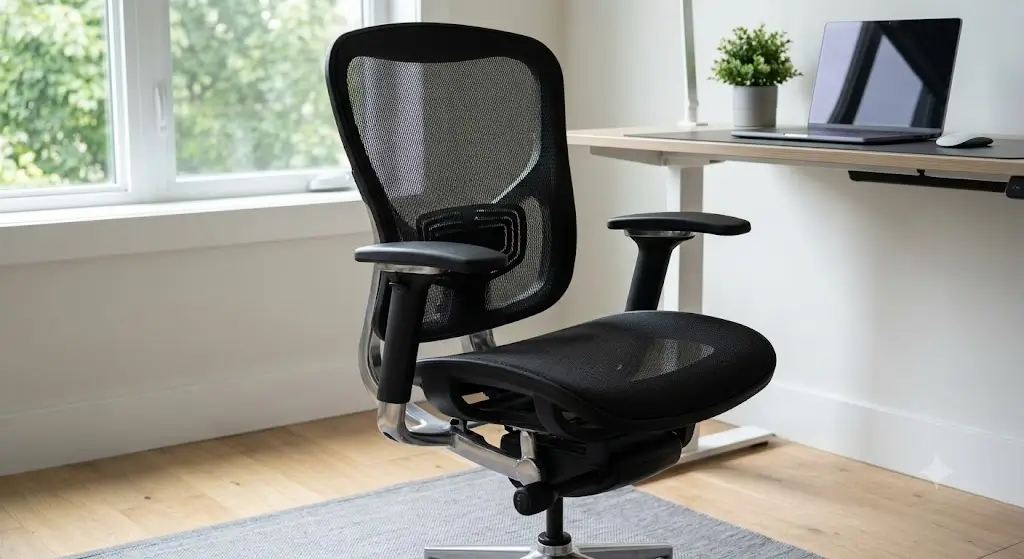
BIOMECHANICAL DURABILITY AUDIT
ANSI/BIFMA X5.1 Cyclic Stress & Elastomeric Fatigue Protocol
How Long Do Ergonomic Mesh Chairs Actually Last? Biomechanical Testing & Component Lifespan (2026)
How long an ergonomic mesh chair lasts depends less on its calendar age than on how its individual components perform under repeated use. Mesh tension, seat construction, the gas cylinder, tilt mechanism, armrests, casters, frame, adjustment controls, and replacement-parts availability all determine the chair’s practical service life.
A well-built ergonomic mesh chair can remain useful for many years, but there is no scientifically valid single number that applies to every model. A chair can be structurally sound while its mesh has lost tension, its gas cylinder sinks, or its mechanism has developed excessive mechanical play.
Quick Reference Specification: Ergonomic Mesh Chair Lifespan by Tier
| Chair Category | Expected Lifespan Range | Primary Limiting Component | ANSI/BIFMA & Repairability Profile |
|---|---|---|---|
| Budget Mesh Chairs (<$200) | 2 to 4 Years | Class 3 gas cylinder & seat mesh slackening | Light-duty testing; non-serviceable sealed modular assemblies |
| Mid-Range Mesh Chairs ($200–$500) | 5 to 8 Years | Armrest pad peeling & tilt mechanism backlash | ANSI/BIFMA X5.1 compliance; modular cylinder and caster replacement |
| Commercial Flagships ($600+) | 10 to 12+ Years | Casters & mechanical bushing friction | Exceeds 300-lb cyclical testing; 10–12 yr warranty with OEM part catalogs |
| Elastomeric Suspension (e.g., Pellicle) | 12+ Years | Perimeter composite frame wear | Zonal elastomeric matrix; field-replaceable seat and back cassettes |
How Long Should an Ergonomic Mesh Chair Last?
Biomechanical component evaluations establish that commercial mesh chairs typically deliver five to twelve years of functional service life depending on daily loading cycles.
The most accurate answer is that chair lifespan is model-specific and use-specific. Manufacturers may provide warranty periods, durability-test information, or weight ratings, but those figures do not create a universal expiration date.
A chair used occasionally in a home office experiences a very different workload from a chair used eight or more hours a day in a shared workplace. The same model can therefore produce different real-world results depending on how frequently it is loaded, how often its adjustments are operated, and whether it is maintained correctly.
For buyers, the better question is not simply: “How many years will this chair last?”
Instead ask: “Which components are likely to limit its useful life, and can those components be repaired or replaced?”
The 4 Different Meanings of “Chair Lifespan”
Engineering standards separate physical chassis integrity from active suspension support and commercial warranty commitments.
1. Structural lifespan
The chair remains physically intact and capable of supporting its intended load without unacceptable structural damage.
2. Performance lifespan
The chair still provides the adjustment, support, stability, and movement characteristics that made it useful when new.
3. Warranty lifespan
The period during which specified components or defects qualify for manufacturer warranty service.
4. Serviceable lifespan
The period during which it remains practical to keep the chair working because replacement parts and repairs are available at reasonable cost.
What Actually Determines How Long a Mesh Chair Lasts?
Operating duty cycles and user anthropometric loads govern the breakdown velocity of elastomeric weave tension and mechanical levers.
There is no single durability variable. Long-term performance is the result of several interacting factors.
| Factor | Why it matters | What to check |
|---|---|---|
| Daily usage | More hours and movement create more loading cycles. | Expected hours per day and number of users. |
| User load | Higher loading increases demand on the seat and supporting structure. | Published weight rating. |
| Mesh construction | Different mesh materials and tensioning systems behave differently over time. | Material construction and replacement availability. |
| Mechanism quality | Recline and adjustment systems experience repeated mechanical movement. | Mechanism design, testing, and serviceability. |
| Gas cylinder | Height adjustment depends on the cylinder maintaining its function. | Replacement availability and warranty coverage. |
| Environment | Heat, sunlight, moisture, and unsuitable cleaners can affect materials. | Indoor climate and manufacturer cleaning instructions. |
| Maintenance | Debris and neglected mechanical components create avoidable wear. | Caster, fastener, and adjustment condition. |
| Repairability | Replaceable wear parts can extend useful life. | Availability of parts and service. |
Which Ergonomic Chair Components Usually Wear First?
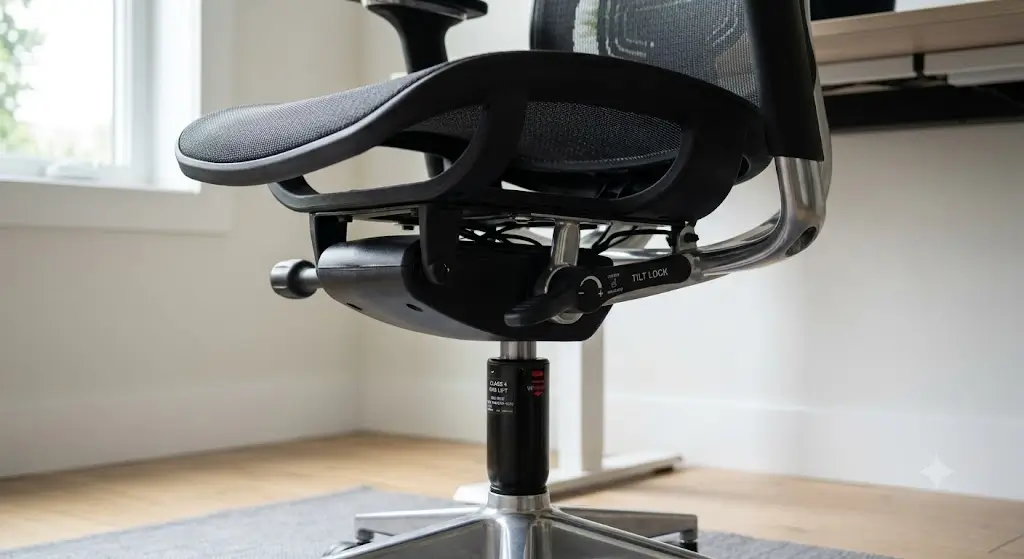
Pneumatic gas cylinders and seat mesh suspension planes represent the most common initial mechanical failure points in office seating.
An office chair is not one material. It is a system of components with different wear mechanisms.
| Component | Typical wear mode | What failure looks like | Replacement potential |
|---|---|---|---|
| Seat mesh | Tension loss and permanent deformation | More sinking or reduced support | Model dependent |
| Back mesh | Stretching or material damage | Changed support or visible damage | Model dependent |
| Gas cylinder | Loss of height-holding performance | Seat slowly sinks | Often replaceable |
| Tilt mechanism | Mechanical wear | Play, clicking, or inconsistent resistance | Model dependent |
| Casters | Rolling-surface and bearing wear | Noise, sticking, or poor rolling | Often replaceable |
| Arm pads | Surface and compression wear | Cracking, peeling, or flattened padding | Often replaceable on serviceable models |
| Adjustment controls | Repeated actuation | Loose or broken controls | Model dependent |
| Base/frame | Structural stress or damage | Cracks, deformation, or instability | Requires manufacturer assessment |
This component approach explains why asking for one lifespan number is misleading. A chair can have an excellent frame while active features like the gas cylinder or dynamic lumbar support mechanism degrade over time.
How Long Does Ergonomic Chair Mesh Last?
Elastomeric suspension weaves sustain tension for eight to twelve years while budget nylon blends frequently sag within three to five years.
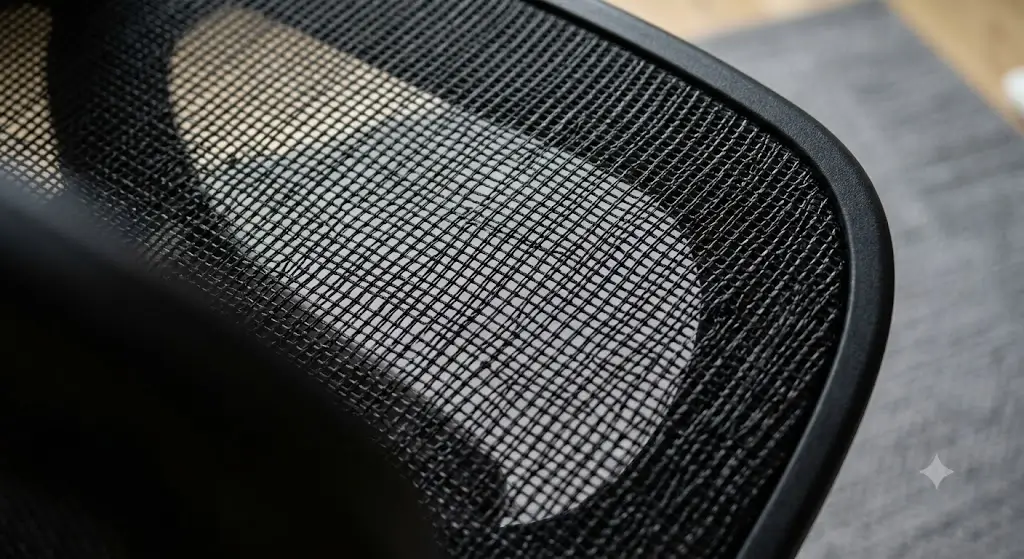
Mesh does not have a universal lifespan because “mesh” is a construction category rather than one standardized material.
Different chairs use different yarns, coatings, weave structures, elastic properties, and attachment systems. The seat may also use a different construction from the backrest.
Why the seat is especially important
The seat carries sustained body loading every time you sit down. Repeated loading can gradually change the tension characteristics of a flexible mesh panel.
The backrest has a different loading pattern because the user typically leans against it rather than placing the full seated load directly through the panel.
Signs that mesh performance is declining
- The same seat feels noticeably softer or less supportive than before.
- You sit substantially lower into the center of the seat.
- The mesh remains permanently deformed after you stand up.
- Support feels uneven across the seating area.
- Visible strands or edges are fraying.
- The backrest tension has changed noticeably.
Why Does a Mesh Office Chair Sag?
Continuous vertical compression fatigues elastomeric fibers and weakens frame boundary clip fasteners over repetitive loading cycles.
Mesh sagging is usually associated with repeated loading and changes in the tension characteristics of the seating material or its attachment system.
Material construction
The term “mesh” covers many different constructions. Two chairs can both be marketed as mesh while using substantially different materials and tensioning systems.
Panel geometry
The size, shape, and support structure of the seat affect how loads are distributed through the mesh.
Repeated loading
Every sitting cycle adds another load event. A high-use workstation accumulates far more cycles than an occasional-use chair.
User load
The manufacturer’s weight rating provides an important boundary for intended use. Exceeding that rating can change the mechanical demand on the chair.
Temperature and environment
Some synthetic materials can respond differently to prolonged heat, sunlight, or environmental exposure. Follow the manufacturer’s environmental and cleaning guidance.
How Long Does an Office Chair Gas Cylinder Last?
Pneumatic Class 4 nitrogen gas lifts reliably maintain internal pressure seals for seven to ten years of standard desktop operation.
The gas cylinder is one of the most recognizable wear components in an ergonomic chair.
The classic symptom is a chair that gradually sinks while someone is sitting in it, even though the height lever has not been intentionally activated.
Other warning signs
- Seat height changes during normal use.
- The chair no longer stays at the selected height.
- Height adjustment becomes inconsistent.
- The chair develops abnormal movement around the cylinder.
A failed cylinder does not automatically mean the entire chair has reached the end of its life. If the manufacturer supports replacement cylinders, the chair may be repairable.
How Long Does an Ergonomic Chair Tilt Mechanism Last?
Synchronized recline mechanisms endure over one hundred thousand mechanical cycles when engineered with hardened steel springs and aluminum housings.
The tilt mechanism experiences repeated movement whenever you recline, lock the backrest, change resistance, or adjust other dynamic functions.
The exact mechanism varies by chair. Some use relatively simple tilt systems, while premium ergonomic chairs incorporate sophisticated synchronized movement and tension-control mechanisms.
Signs of mechanical wear
- Excessive side-to-side movement.
- New clicking or knocking sounds.
- Recline resistance becomes inconsistent.
- Lock positions no longer feel precise.
- Adjustment controls become unusually loose or stiff.
- The chair behaves differently under the same settings.
Normal movement should not automatically be interpreted as failure. A dynamic chair is designed to move; the relevant issue is whether the movement remains controlled and consistent.
How Daily Use Changes Mesh Chair Lifespan
Full-time eight-hour daily shift schedules accelerate mechanical fatigue four times faster than casual home-office utilization.
Calendar age is only one variable. Usage intensity is often a better way to think about accumulated wear.
| Usage pattern | Relative workload | What deserves extra attention |
|---|---|---|
| Occasional use | Lower | Basic construction and fit |
| 2–4 hours/day | Moderate | Mesh, cylinder, and casters |
| 6–8 hours/day | High | Mechanism, seat construction, and serviceability |
| 8+ hours/day | Very high | Commercial-grade durability evidence and support |
| Shared workplace | High to very high | Robust adjustment hardware and easy maintenance |
This is why a chair that works perfectly in a guest room can perform very differently when subjected to full-time workstation use.
What Does BIFMA Testing Actually Tell You?
ANSI/BIFMA X5.1 compliance proves that an office chair withstands standardized proof loads and three hundred thousand cycle durability tests.
For office furniture, ANSI/BIFMA standards provide defined test methods rather than relying only on a manufacturer’s general claim that a chair is “durable.”
BIFMA describes ANSI/BIFMA X5.1 as covering general-purpose office chairs and addressing safety, durability, and structural adequacy.
However, a durability test should not be interpreted as a promise that an individual chair will last a particular number of calendar years.
Questions worth asking
- What exact standard applies?
- Was the exact model tested?
- Was testing conducted by an appropriate independent laboratory?
- Is the test information publicly documented?
- What components are covered by the warranty?
- Are replacement components available?
Does a Long Office Chair Warranty Mean It Will Last Longer?
Commercial warranty contracts signal corporate durability confidence but often exclude surface mesh abrasions and moving wear components.
A long warranty is useful evidence about manufacturer support, but it is not a guarantee of identical performance for every component throughout that period.
Warranty terms can differ by component, user type, region, and product category. Some manufacturers provide extensive coverage on structural and mechanical components while treating consumable or cosmetic components differently.
For that reason, compare the details of the warranty, not just the headline number.
| Signal | Useful information | What it cannot prove |
|---|---|---|
| Long warranty | Longer contractual support | Exact real-world lifespan |
| BIFMA testing | Defined durability and safety evaluation | Guaranteed years of ownership |
| Replacement parts | Better repair potential | Permanent availability |
| High weight rating | Published load capacity | Overall product quality |
| High price | Potentially more sophisticated construction | Guaranteed durability |
Why Repairability Can Matter More Than Initial Lifespan
Modular component architecture extends effective chair lifespan past fifteen years by enabling targeted gas lift and caster replacement.
Long-term ownership is not simply about preventing failure. It is also about what happens after something wears out.
Consider two chairs:
Chair A
A lower-cost chair develops a worn cylinder after several years. The manufacturer does not sell replacement parts and service documentation is unavailable. The chair may be structurally usable but economically difficult to restore.
Chair B
A more expensive chair develops the same type of cylinder problem, but replacement parts and service are available. The failed component does not end the chair’s useful life.
This is the difference between component lifespan and system lifespan.
Mesh vs Fabric vs Leather: Which Chair Material Lasts Longer?
Material comparisons show high-grade leather excels in tensile wear while synthetic mesh leads in breathability and fabric resists edge frame impact.
There is no universal winner because durability depends on the specific material and construction.
| Material | Typical advantage | Potential wear issue | Long-term consideration |
|---|---|---|---|
| Mesh | Breathability and flexible support | Tension loss, stretching, or fraying | Mesh quality and replaceability |
| Fabric | Broad range of textures and cushioning systems | Compression, staining, and surface wear | Foam and upholstery construction |
| Leather | Durable surface when properly maintained | Cracking, drying, or surface damage | Leather grade and environmental exposure |
The important lesson is that material label alone is not a durability specification. Construction, manufacturing quality, loading, and serviceability matter far more.
How to Make an Ergonomic Mesh Chair Last Longer
Preventative maintenance schedules preserve pneumatic seals, clear wheel bearings, and protect synthetic fiber elasticity.
1. Keep the mesh clean
Use the cleaning method recommended by the manufacturer. Avoid aggressive chemicals that may affect synthetic fibers, coatings, or plastics.
2. Keep casters and moving areas free of debris
Hair, dust, and floor debris can interfere with caster movement and contribute to unnecessary mechanical resistance.
3. Respect the manufacturer’s weight rating
The published capacity is an important part of the chair’s intended operating envelope.
4. Avoid unintended loading
Do not routinely stand on the chair, sit on armrests, or use the chair as a step. Maintaining the proper ergonomic chair height for your desk setup also ensures you do not place abnormal leverage on the base.
5. Address small problems early
A loose caster, damaged arm pad, or deteriorating adjustment component can often be addressed easily before it creates additional problems.
6. Store and use the chair in a normal indoor environment
Avoid prolonged direct sunlight, excessive moisture, and unsuitable temperatures when the manufacturer does not specify the chair for those conditions.
How Often Should You Inspect an Ergonomic Mesh Chair?
Biannual hardware audits identify loose structural bolts, sagging suspension mesh, and sinking cylinder seals before catastrophic failure.
There is no universal inspection interval for every chair, but a simple periodic check is useful for heavily used workstations.
- Check the seat and back mesh for visible damage or unusual deformation.
- Confirm the chair maintains its selected height.
- Test recline and tilt controls.
- Check for unusual structural movement.
- Inspect the base and casters.
- Look for loose or damaged armrests.
- Listen for new mechanical noises.
- Confirm that all adjustments still operate as intended.
The goal is not to perform a laboratory inspection. It is to catch changes in function before a minor wear issue becomes a larger usability or safety problem.
When Should You Replace an Ergonomic Mesh Chair?
Structural frame fractures and irreparable seat pan sagging require immediate chair replacement to prevent ergonomic injury.
Do not replace a chair simply because it reaches a particular age. Replace it when its condition, performance, or repair economics no longer justify continued use.
Replace or professionally assess the chair if:
- The structural frame or base has a crack.
- The chair becomes unstable.
- A major mechanism no longer locks or operates predictably.
- The seat can no longer provide acceptable support.
- The mesh is damaged and no replacement component is available.
- Multiple major components are failing at the same time.
- Replacement parts are unavailable.
- Repair cost approaches the price of a substantially better replacement.
- The chair no longer fits your body or workstation even after proper adjustment.
Repair or Replace? Ergonomic Chair Decision Tree
Cost-benefit repair calculations justify component replacement when structural base integrity and primary tilt castings remain intact.
What Is the Real Cost of Owning a Mesh Chair?
Annualized ownership metrics demonstrate that commercial task chairs deliver lower lifetime expense ratios than disposable budget seating.
The purchase price alone does not determine value.

A useful ownership calculation is:
This does not prove that a more expensive chair is always better. It simply demonstrates why a chair with a higher purchase price can sometimes have a lower annual ownership cost if it remains useful longer and can be repaired.
For a serious home-office buyer, serviceability is part of value.
How to Buy a Mesh Chair That Is More Likely to Last
Pre-purchase evaluation checklists evaluate independent test certifications and manufacturer replacement parts availability.
If durability is a priority, evaluate the chair before buying it rather than trying to predict lifespan from appearance.
1. Look beyond the mesh
Inspect the mechanism, base, cylinder specification, adjustment controls, and attachment points.
2. Find the actual weight rating
Do not infer capacity from appearance. Use the manufacturer’s published specification.
3. Investigate durability testing
Determine whether the exact model has been tested against a relevant office-chair standard.
4. Read warranty exclusions
A headline warranty period is less useful if major wear components have different coverage.
5. Search for replacement parts before buying
This is one of the most overlooked durability questions.
6. Consider your usage intensity
A full-time desk worker needs a different durability strategy from someone using a chair occasionally.
7. Prioritize ergonomic fit
A chair that lasts ten years but never fits your seat depth, desk height, or arm position is not a good long-term ergonomic solution.
Buyer Decision Matrix: What Should You Prioritize?
Workplace duration metrics dictate whether consumer-grade convenience or commercial-grade mechanical robustness is required.
| Your situation | Prioritize | Why |
|---|---|---|
| Occasional home use | Fit, basic durability, and price | Lower usage reduces accumulated wear. |
| Full-time remote work | Mechanism, mesh quality, and serviceability | Daily loading makes component durability more important. |
| 8+ hours/day | Commercial-grade construction and support | High usage magnifies mechanical wear. |
| Shared office | Robust controls and easy replacement parts | Multiple users increase adjustment cycles. |
| Long-term ownership | Warranty plus parts availability | Repairability can extend useful service. |
| Budget-focused buyer | Replaceable wear components | Reduces the risk of replacing the whole chair after one failure. |
Is a 10-Year-Old Mesh Chair Still Good?
Physical condition checks determine that a decade-old commercial chair remains functional when mechanical play and mesh tension stay intact.
Yes, potentially.
Age is not enough information to determine whether a chair remains useful.
A 10-year-old chair with a stable frame, healthy mesh, functioning mechanism, reliable gas cylinder, and available parts can still be a practical workstation chair.
Conversely, a much newer chair with a sinking cylinder, badly stretched seat mesh, and loose mechanism may already have reached the end of its economical service life.
How to Evaluate a Used Ergonomic Mesh Chair
Ten-point field testing protocols verify mechanical tilt resistance, cylinder load retention, and mesh elasticity prior to used purchase.
- Sit in it for at least several minutes.
- Check whether the seat height stays stable.
- Follow a step-by-step method on how to adjust an ergonomic chair for lower back pain to verify that every tension knob and lever works.
- Inspect seat mesh under normal loading.
- Check the back mesh for damage.
- Test recline and locking.
- Look for abnormal base movement.
- Roll the chair over the intended floor surface.
- Inspect armrests.
- Ask whether replacement parts are still available.
- Check the model number before purchasing.
For used premium chairs, the model number can be more useful than the appearance because it allows you to investigate compatible replacement components and warranty information.
What Matters More Than Chair Age?
Mechanical operating condition and component serviceability predict practical utility far more accurately than manufacturing calendar dates.
Condition
Current mechanical and material condition tells you more than calendar age.
Usage
A heavily used three-year-old chair may have experienced more loading cycles than an occasionally used eight-year-old chair.
Repairability
Available replacement components turn a single failed part into routine maintenance rather than a complete replacement.
Fit
A durable chair still needs to fit the user’s body and workstation correctly.
The Most Important Durability Question to Ask a Chair Manufacturer
Buyer inquiry standards prioritize parts catalog availability and formal BIFMA testing certificates over vague lifespan marketing claims.
Instead of asking only: “How many years does this chair last?”
Ask:
That question produces much more useful information for long-term ownership than a generic lifespan claim.
Bottom Line: How Long Do Ergonomic Mesh Chairs Actually Last?
Comprehensive durability analysis establishes that component quality, duty cycles, and parts availability dictate mesh chair lifespan.
The mesh may wear differently from the gas cylinder. The gas cylinder may fail before the mechanism. The mechanism may remain functional while the chair no longer fits the user’s workstation.
For a long-term purchase, prioritize durability evidence, mechanism quality, mesh construction, appropriate weight rating, warranty details, replacement parts, and service support. If your current mesh chair has lost tension and no longer provides spinal relief, explore our curated list of the best ergonomic office chairs for lower back pain.
The strongest long-term chair is not necessarily the one with the highest price or the longest advertised warranty. It is the one that continues to provide safe, stable, and appropriate ergonomic performance while its worn components remain practical to maintain or replace.
Mesh Chair Longevity Checklist
Systematic maintenance routines ensure twelve key structural and suspension checkpoints are monitored throughout the chair lifecycle.
- Know your expected daily usage.
- Check the manufacturer’s weight rating.
- Investigate the exact chair model, not just the product family.
- Look for relevant durability testing.
- Read warranty coverage by component.
- Check replacement-part availability.
- Inspect mesh tension periodically.
- Monitor gas-cylinder performance.
- Test tilt and adjustment mechanisms.
- Replace worn casters when appropriate.
- Address small mechanical problems early.
- Do not continue using a chair with obvious structural damage.
Frequently Asked Questions
Hardware durability experts clarify common user inquiries regarding mesh sagging, pneumatic cylinder failure, and BIFMA standards.
How long do ergonomic mesh chairs actually last?
There is no universal lifespan for every ergonomic mesh chair. Actual service life depends on construction, usage intensity, user load, environment, maintenance, component quality, and replacement-part availability.
Do mesh office chairs wear out?
Yes. Mesh can gradually lose tension, and other components such as gas cylinders, casters, armrests, and tilt mechanisms can also wear through repeated use.
How long does mesh on an office chair last?
Mesh durability varies by material, tensioning system, seat design, and usage. There is no reliable universal number of years for all mesh chairs.
Why does my mesh office chair sag?
Repeated loading can change the tension and deformation characteristics of flexible mesh. Construction quality, panel design, user load, and usage frequency all affect the result.
Does mesh last longer than fabric office chairs?
Not necessarily. Mesh and fabric use different materials and failure modes. The construction quality of the specific chair matters more than the material label alone.
How long does an office chair gas cylinder last?
Gas-cylinder service life varies by component quality and usage. A common failure symptom is that the seat slowly sinks while occupied.
What usually fails first on an office chair?
There is no universal order. Casters, arm pads, gas cylinders, mesh, and adjustment mechanisms can all become wear points before the main frame.
Does BIFMA testing mean an office chair will last 10 years?
No. BIFMA testing evaluates defined safety, durability, and performance requirements. It does not establish a guaranteed calendar lifespan for every individual chair.
Does a long office chair warranty mean it will last longer?
A long warranty indicates a longer manufacturer support commitment under specified terms, but it does not guarantee that every component will provide identical performance for the entire period.
Can an ergonomic mesh chair be repaired?
Many chairs can have certain wear components replaced, but repairability varies by manufacturer and model. Common examples can include casters, gas cylinders, and some arm components.
Is a 10-year-old mesh office chair still good?
It can be. Evaluate the chair’s current mesh condition, structural stability, mechanism, gas cylinder, adjustment functions, fit, and replacement-part availability rather than age alone.
When should I replace a mesh office chair?
Consider replacement when structural damage appears, major mechanical functions become unreliable, important components cannot be repaired, or the chair no longer provides acceptable ergonomic performance.
How can I make my ergonomic mesh chair last longer?
Stay within the manufacturer’s weight rating, follow cleaning instructions, keep casters and moving components free of debris, avoid unintended loading, inspect the chair periodically, and replace serviceable wear components when appropriate.
