
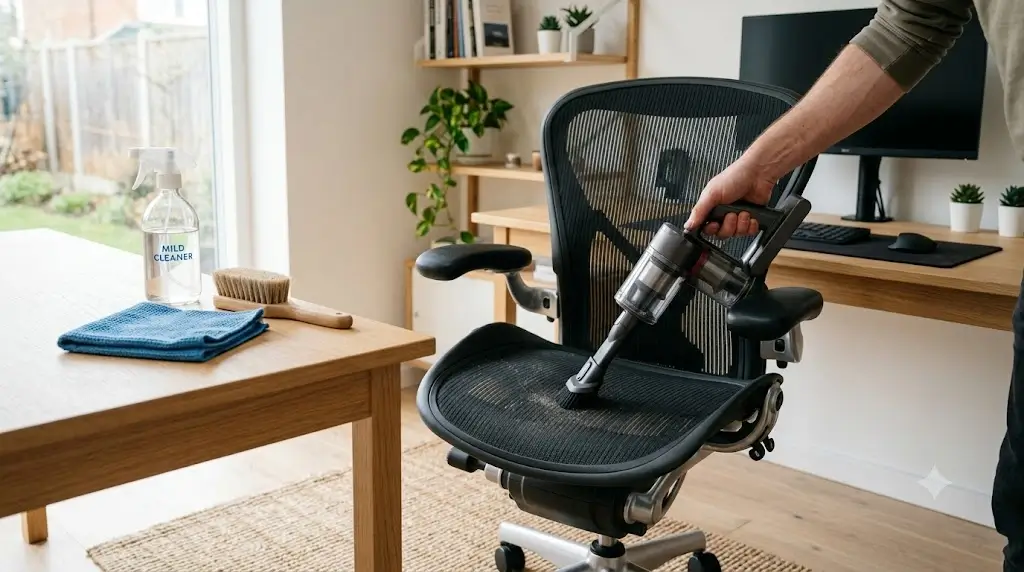
HARDWARE MAINTENANCE PROTOCOL
Elastomeric Fiber Preservation & Mechanical Decontamination Guide
How to Clean and Maintain a Mesh Office Chair: Complete Technical Maintenance Guide (2026)
The safest general method is to remove dry debris first, spot-clean the mesh with minimal moisture, use only a manufacturer-compatible mild cleaner when necessary, remove residue, and let the chair dry completely.
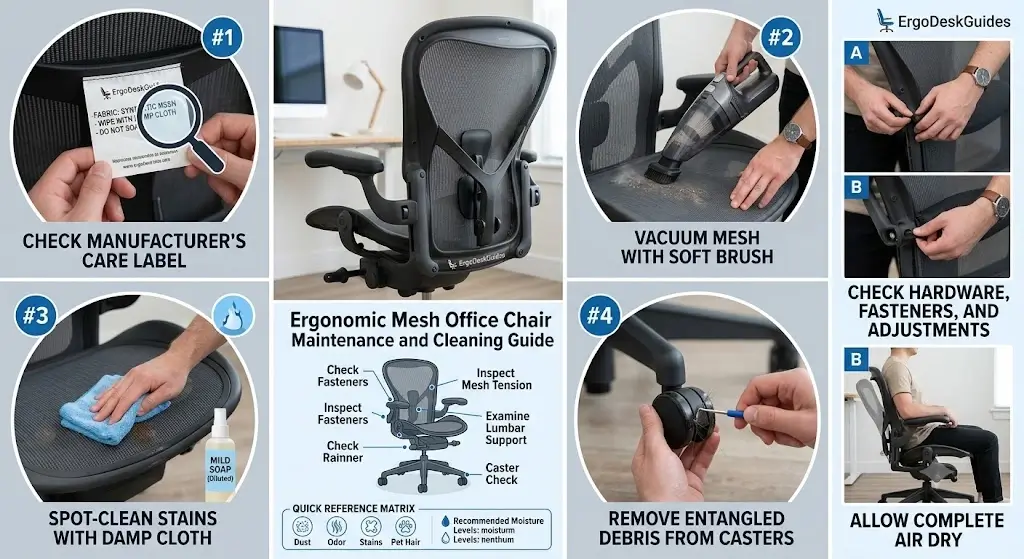
Learning how to clean and maintain a mesh office chair properly protects your ergonomic investment and ensures long-lasting comfort. Unlike traditional upholstered furniture, mesh chairs rely on open-weave synthetic support that can trap dust, hair, crumbs, and body oils while housing sensitive mechanical levers, tension springs, and gas cylinders that must remain free of excess moisture.
A good maintenance routine does more than make the chair look clean. It reduces contamination, protects the mesh from unnecessary mechanical stress, keeps casters moving properly, and gives you an opportunity to identify wear before a small problem becomes a structural one.
Quick Reference Specification: Mesh Office Chair Maintenance Parameters
| Component Focus | Recommended Cleaning Tool | Permissible Chemistry | Critical Maintenance Limit |
|---|---|---|---|
| Elastomeric Seat & Back Mesh | Soft brush vacuum attachment + microfiber cloth | Warm water or diluted mild neutral dish soap (<2% dilution) | Zero aggressive solvent degreasers, bleach, or high-heat steam cleaners |
| Structural Chassis & Base | Dry or lightly damp microfiber towel | Neutral surface cleaner on cloth only | Zero liquid spray entering enclosed mechanical tilt housings |
| Dual-Wheel Casters | Fine pick tool, tweezers, and dry microfiber wipe | Isopropyl alcohol (axle wipe only if dried grease attracts grit) | Remove wrapped hair fibers; avoid unapproved liquid oils that attract dust |
| Class 4 Pneumatic Cylinder | Dry lint-free cloth wipe | Clean dry rag only (no degreasing solvent on factory column seal) | Never disassemble pressurized chamber; wipe column to remove abrasive grit |
How to Clean and Maintain a Mesh Office Chair: The Safest Method
Standard cleaning protocols dictate that dry debris extraction must precede any damp spot cleaning to prevent grit slurry formation inside mesh pores.
This sequence is preferable to immediately spraying the chair with cleaner because it uses the least amount of moisture and chemical exposure needed for the job.
Mesh Office Chair Cleaning Decision Matrix
Diagnostic cleaning matrices align specific contaminant types with targeted moisture limits and verified chemical agents.
When mastering how to clean and maintain a mesh office chair, matching the method to the contamination type is critical. A dusty chair does not need the same treatment as a chair with dried body-oil residue or a fresh liquid spill.
| Problem | First method | Moisture | Cleaner | Avoid | Escalate when |
|---|---|---|---|---|---|
| Dust | Soft vacuum | None | None | Wetting the entire mesh | Debris is embedded or contamination remains |
| Crumbs | Vacuum / soft brush | None | None | Grinding debris into mesh | Crumbs are trapped inside inaccessible areas |
| Pet hair | Vacuum / soft brush | None | None | Sharp tools | Hair is wrapped around casters |
| Fresh liquid spill | Blot | Low | Usually unnecessary initially | Rubbing aggressively | Staining remains after approved spot cleaning |
| Body-oil buildup | Light damp wipe | Low | Diluted mild soap if approved | Strong degreasers | Surface remains contaminated after approved cleaning |
| Odor | Clean source of contamination | Low | Approved cleaner | Masking odor with fragrance | Odor persists after cleaning and drying |
| Torn mesh | Do not scrub | None | None | DIY structural repair | Consult manufacturer / replace component |
What Is a Mesh Office Chair Made From?
Commercial ergonomic chairs combine synthetic polymer textiles with extruded aluminum chassis and polyurethane contact pads.
“Mesh” is a construction category rather than one universal material. Office chairs can use different synthetic fibers, weave structures, and coatings, and the mesh is usually combined with several other materials.
| Component | Typical material | Main maintenance concern |
|---|---|---|
| Seat mesh | Synthetic textile mesh | Dust, oils, stains, and stretching |
| Backrest mesh | Synthetic textile mesh | Dust, hair, and body oils |
| Frame | Plastic, polymer, or metal | Dust, residue, and surface wear |
| Arm pads | Polyurethane, rubberized, or other materials | Skin oils, sweat, and chemical sensitivity |
| Casters | Plastic, rubber/polymer, and metal | Hair, fibers, and floor debris |
| Adjustment mechanism | Metal, plastic, and mechanical components | Moisture, contamination, and wear |
This mixed construction is why treating the entire chair as if it were washable fabric is a poor maintenance strategy.
What Cleaning Supplies Do You Actually Need?
Routine workstation maintenance requires non-abrasive microfiber cloths, soft-bristle vacuum nozzles, and pH-neutral surfactants.
Most routine mesh-chair cleaning can be handled with a small set of basic supplies.
Microfiber cloth
Use a clean, soft microfiber cloth for controlled wiping. Keep separate cloths for the dirty cleaning stage and final wipe-down.
Vacuum with soft attachment
This is the most useful tool for dry dust, crumbs, and hair because it removes contamination without adding moisture.
Mild soap
A mild soap diluted in water may be appropriate for some materials when the manufacturer’s instructions permit it.
Soft brush
A soft brush helps loosen dry debris around seams, edges, and caster areas without using sharp objects.
You generally do not need a collection of aggressive upholstery chemicals. In fact, using unnecessary chemicals increases the number of ways the chair can be damaged.
How to Clean and Maintain a Mesh Office Chair Step by Step
Stepwise decontamination sequences isolate dry particulates and targeted spot treatment before hardware inspection.
Step 1 — Read the care instructions
Before cleaning, identify the manufacturer’s recommended care method. Look for the chair manual, care label, or official maintenance documentation.
Step 2 — Clear the chair
Take off removable cushions, headrest covers, or other accessories so you can inspect the underlying mesh.
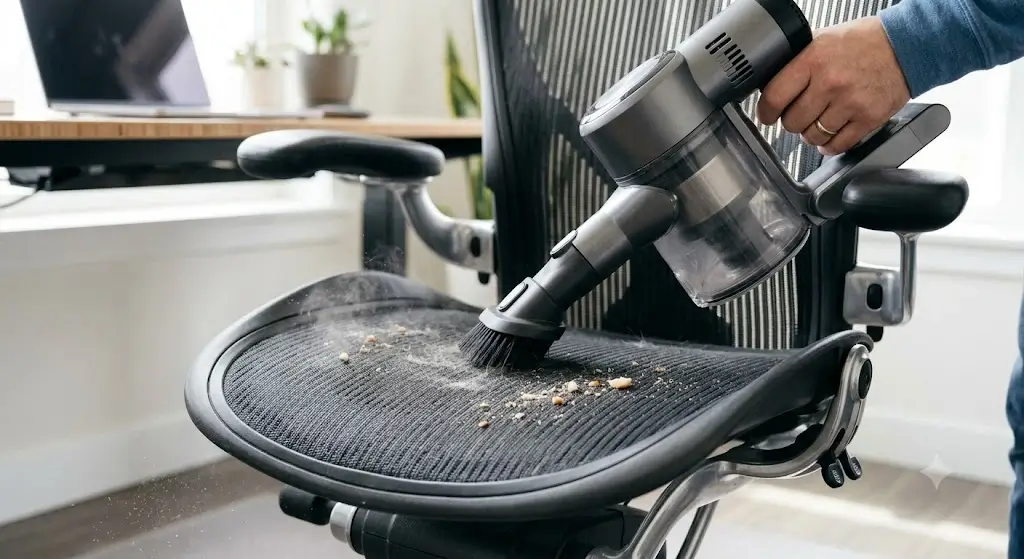
Step 3 — Vacuum
Vacuum the seat, backrest, edges, and accessible underside. Use a soft attachment and avoid catching the mesh in a narrow, aggressive nozzle.
Step 4 — Inspect
Look for stains, body-oil buildup, hair, spills, and areas of residue. Do not wet areas that are already clean.
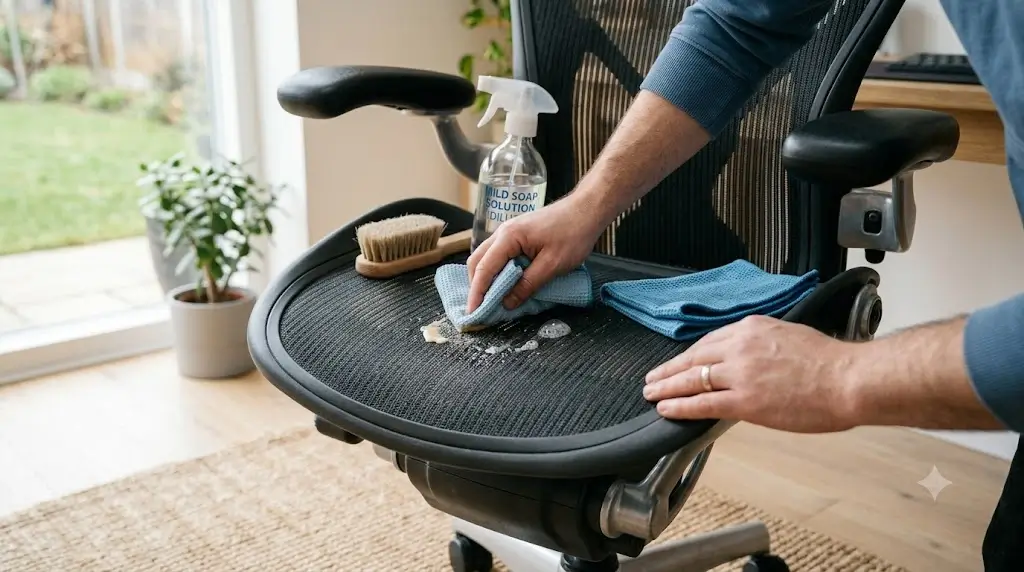
Step 5 — Spot-clean
Dampen the microfiber cloth rather than spraying cleaner directly onto the chair. For stubborn residue, use a small amount of manufacturer-approved mild cleaner.
Step 6 — Remove residue
If soap or another approved cleaner was used, wipe the area with a clean, lightly damp cloth as appropriate for the material.
Step 7 — Dry
Keep the chair uncovered in a well-ventilated location until the mesh and surrounding components are dry.

Step 8 — Inspect the hardware
Check caster movement, armrest stability, adjustment controls, visible fasteners, and mesh attachment points.
How to Clean a Mesh Office Chair Seat
Horizontal seat surfaces accumulate the highest concentration of friction oils and trapped clothing lint across the chair chassis.
The seat usually receives more contamination than the backrest because it is exposed directly to clothing, body oils, food, and drink.
Start dry
Vacuum the entire seating surface, including the front edge and perimeter. Remove crumbs and hair before using a damp cloth.
Spot-clean rather than soak
If a mark remains, lightly dampen the cloth and clean the affected area. A small amount of diluted mild soap may be appropriate if the manufacturer permits it.
Pay attention to the front edge
The front edge of a mesh seat can accumulate dust and oils because it contacts clothing and legs during normal use.
Do not flood the underside
The seat structure contains components that are harder to dry than the exposed mesh. Keep water away from adjustment hardware and enclosed areas.
How to Clean a Mesh Office Chair Backrest
Vertical backrest frames demand downward vacuuming and careful clearance around adjustable lumbar tracking rails.
The backrest generally needs less intensive cleaning than the seat, but it still accumulates dust, hair, and body oils.
Vacuum from the top of the backrest downward, then spot-clean visible marks with a lightly damp microfiber cloth.
If the chair has adjustable lumbar hardware attached to the backrest, clean around the mechanism without flooding moving components.
Avoid aggressive pressure. The mesh is designed to flex under load, so unnecessary mechanical force during cleaning provides no useful benefit.
How to Remove Stains From a Mesh Office Chair
Capillary action blotting neutralizes fresh liquid spills without spreading pigment into open polymer matrix weaves.
The safest approach is to identify the stain and use the least aggressive compatible method.
Fresh liquid spill
Blot the liquid with a clean cloth. Do not immediately scrub the area because rubbing can spread the contamination through a larger section of the mesh.
Dried residue
Use a lightly damp cloth to soften the residue. If water is insufficient, use a manufacturer-approved mild cleaning solution.
Unknown stain
Start with the mildest compatible cleaning method and test it on an inconspicuous area when possible.
Persistent stain
Do not automatically escalate to bleach, solvents, or abrasive chemicals. If the approved cleaning method cannot remove the stain, consult the manufacturer before using a stronger product.
How to Clean Sweat and Body-Oil Buildup From Mesh
Sebaceous oil accumulation requires mild surfactant wiping followed by complete rinse wiping to maintain elastomeric surface tension.
Body-oil residue tends to accumulate on areas that have frequent direct contact with skin or clothing. The armrests, seat, and portions of the backrest may therefore require more frequent wiping than the rest of the chair.
Vacuum the area first. Then use a lightly damp microfiber cloth. If the residue persists, a small amount of appropriately diluted mild soap can be used if the manufacturer permits it.
Finish by removing remaining cleaner residue and allow the surface to dry completely.
Regular light cleaning is preferable to waiting for a thick layer of residue to accumulate and then applying aggressive degreasers.
How to Remove Odor From a Mesh Office Chair
Persistent workstation odors dissipate when underlying bacterial sources on pelvic mesh and armrests are physically eliminated.
Odor is usually better addressed by removing the source rather than covering it with fragrance.
- Vacuum dust, hair, and debris.
- Clean visible body-oil or food residue.
- Clean high-contact armrests and nearby frame surfaces.
- Check beneath the seat.
- Allow all cleaned surfaces to dry completely.
- Improve airflow around the chair.
If odor returns quickly despite appropriate cleaning and complete drying, investigate the source rather than repeatedly applying fragrance or stronger chemicals.
How to Remove Pet Hair From a Mesh Office Chair
Dry mechanical brushing extracts pet dander and entangled fur without risking puncture damage from sharp blades.
Pet hair is primarily a dry-contamination problem, so moisture is usually unnecessary.
Use a vacuum with a soft attachment. A soft brush can loosen hair caught along the edges of the seat or backrest.
Avoid knives, scissors, needles, or other sharp objects around the mesh. Removing a small amount of hair is not worth risking a cut or puncture in the support material.
Also clean the floor around the chair. Hair collected near the casters can migrate back onto the chair during normal use.
How to Clean Mesh Chair Armrests
Polyurethane armpad formulations degrade when exposed to harsh industrial solvents or pooling liquid disinfectants.
Armrests are high-contact surfaces and may require more frequent cleaning than the mesh itself.
Wipe them with a soft cloth using a compatible mild cleaner. If the arm pad has a soft-touch or polyurethane-like finish, follow the manufacturer’s specific instructions because different surface formulations can react differently to cleaning chemicals.
Avoid leaving wet cleaner on the armrest. Remove residue as appropriate and allow the surface to dry.
How to Clean the Frame, Base and Underside
Chassis maintenance requires dry wiping of five-star spider bases while completely avoiding fluid infiltration into central cylinder hubs.
Plastic frame
Remove dust with a dry or lightly damp microfiber cloth. Avoid abrasive pads that can scratch or dull the finish.
Metal frame
Wipe dust and residue from accessible metal surfaces. Avoid leaving moisture standing on metal components.
Five-star base
Clean each leg and inspect the caster sockets. The base can collect dust and hair even when the seat and backrest look clean.
Underside
The underside often contains substantial dust. Vacuum loose debris rather than attempting to rinse it.
How to Clean and Maintain Office Chair Casters
Entangled wheel axle fibers increase floor rolling friction and accelerate structural caster socket stress.
Caster maintenance matters because hair and fibers can wrap around the wheel axle and increase rolling resistance.
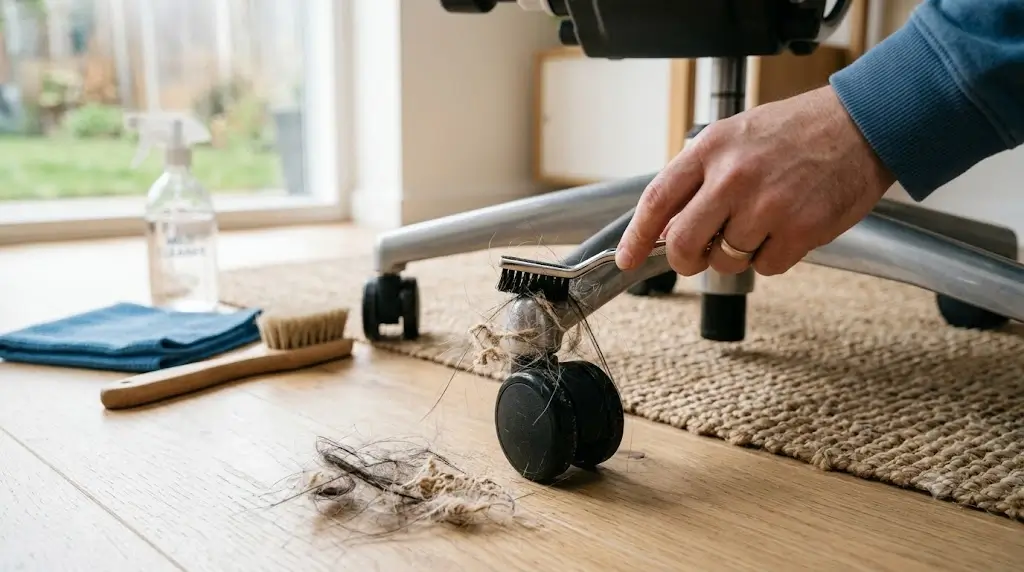
1. Inspect each wheel
Look for hair, thread, carpet fibers, and other debris.
2. Remove wrapped fibers
Use a suitable non-damaging method to remove accumulated fibers. Avoid damaging the wheel or caster housing.
3. Wipe the wheel
Remove surface dirt with a lightly damp cloth if appropriate.
4. Check rolling performance
Roll the chair and verify that the caster rotates and swivels normally.
If the caster remains cracked, loose, noisy, or difficult to rotate after cleaning, replacement may be more appropriate than adding lubricant.
How to Maintain an Ergonomic Chair’s Adjustment Mechanisms
Mechanical linkages require dry dust removal and fastener torque verification without spraying liquid aerosols into enclosed clutch springs.
Cleaning and mechanical maintenance are related but not identical. A mechanism that is dirty may need cleaning, while a mechanism that is worn may need service or replacement.
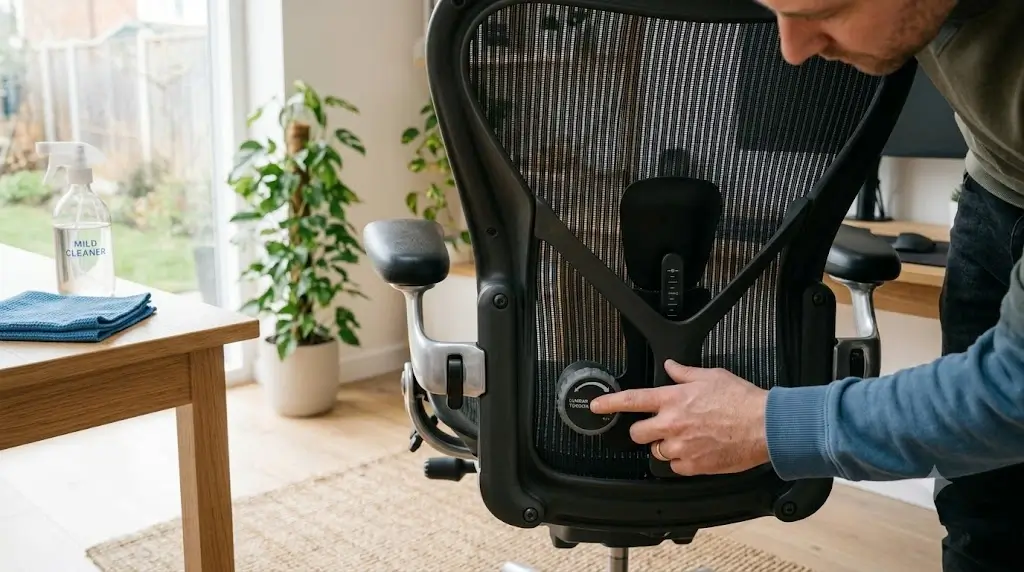
Check these components
- Seat-height control.
- Tilt and recline controls.
- Armrest adjustment controls.
- Lumbar adjustment controls.
- Seat-depth slider, if present.
- Backrest attachment points.
- Caster sockets.
- Visible fasteners.
If adjusting these mechanisms no longer relieves back fatigue, read our guide on why your lower back hurts in an ergonomic chair to identify whether it is a setup or posture issue.
Remove accessible dust with a cloth or vacuum. Do not spray cleaner or lubricant into enclosed mechanisms unless the manufacturer explicitly recommends it.
How to Dry a Mesh Office Chair After Cleaning
Natural convective room airflow dries synthetic mesh in two to four hours without exposing fibers to heat gun shrinkage.
Drying should be treated as part of the cleaning process because moisture that remains trapped around the seat structure, frame, or mechanisms can create additional maintenance problems.
- Leave the chair uncovered while drying.
- Use normal room airflow.
- Do not store the chair while damp.
- Do not cover damp mesh with a cushion.
- Keep moisture away from powered components.
- Avoid excessive direct heat unless the manufacturer specifically permits it.
For routine spot cleaning, the amount of moisture should be small enough that controlled air drying is practical.
How Often Should You Clean a Mesh Office Chair?
Workplace shift schedules establish bi-weekly vacuuming and monthly caster audits as baseline hygiene thresholds.
There is no single correct interval for every user. A chair used eight hours per day in a home with pets needs more frequent maintenance than a lightly used conference-room chair.
| Maintenance task | Typical starting interval | Increase frequency if… |
|---|---|---|
| Visual inspection | Weekly | Chair is heavily used or shows wear |
| Armrest wipe | Weekly / as needed | High-contact use or visible residue |
| Mesh vacuuming | Every 1–2 weeks | Pets, dust, or food near workstation |
| Spot cleaning | As needed | Spills or visible stains occur |
| Caster cleaning | Monthly | Long hair, carpet, or fibers accumulate |
| Mechanism inspection | Every 1–3 months | Controls feel unusual or movement changes |
| Detailed cleaning | Every few months | Heavy daily use |
These intervals are practical maintenance guidelines, not universal manufacturer requirements.
What Should You Not Use on a Mesh Office Chair?
Chemical compatibility charts warn that industrial bleaches, petroleum solvents, and steam jets destroy polymer elasticity.
Avoid assuming that a product is safe simply because it is marketed for upholstery or household cleaning.
| Method/product | General recommendation | Reason |
|---|---|---|
| Bleach | Avoid unless explicitly approved | Can affect fibers, finishes, or color. |
| Strong solvents | Avoid | May attack coatings or synthetic materials. |
| Abrasive powder | Avoid | Can abrade surfaces. |
| Hard-bristle brush | Avoid | Can place unnecessary stress on mesh. |
| Pressure washer | Avoid | Excess water and pressure can enter components. |
| Steam cleaner | Only with explicit approval | Heat and moisture may affect materials. |
| Direct spray into mechanism | Avoid | Liquid can migrate into moving components. |
| Random lubricant | Avoid | Not every mechanism or caster requires lubrication. |
Can You Use Disinfectant Wipes on a Mesh Office Chair?
Surface disinfectant wipes risk premature chemical embrittlement on elastomeric threads and polyurethane armrest pads.
Do not assume that a disinfectant wipe is compatible with every mesh material or chair finish.
Some disinfectants contain chemicals that can affect synthetic materials or coatings with repeated exposure. If disinfection is required, follow the chair manufacturer’s approved chemical and contact-time instructions.
For ordinary dust and dirt, routine cleaning does not necessarily require a disinfectant.
Can You Use Alcohol to Clean a Mesh Office Chair?
Alcohol solvent compatibility depends strictly on factory fiber coatings and polymer blend specifications.
Alcohol should not be treated as a universal mesh cleaner.
Its compatibility depends on the specific mesh, coating, plastic, and finish. If the manufacturer does not approve alcohol for the material, use a less aggressive cleaning method instead.
Can You Use a Steam Cleaner on a Mesh Office Chair?
Thermal steam temperatures frequently exceed the dimensional stability thresholds of thermoformed tension mesh.
Only use a steam cleaner when the manufacturer explicitly permits steam cleaning for the particular chair and its materials.
Steam introduces both heat and moisture. Those conditions may be unnecessary for ordinary maintenance and can affect materials or components that were not designed for steam exposure.
For normal cleaning, vacuuming followed by controlled spot cleaning is a simpler approach.
Can You Pressure-Wash a Mesh Office Chair?
High-pressure water jets strip factory grease from internal bearing races and force water into sealed tilt mechanisms.
No. Pressure washing is not an appropriate routine cleaning method for an office chair.
High-pressure water can force moisture and contamination into bearings, joints, adjustment mechanisms, and other enclosed areas. It also exposes the mesh and frame to forces far beyond normal cleaning conditions.
Can You Put a Mesh Office Chair in a Shower?
Full chair immersion creates internal moisture entrapment that corrodes structural steel springs and adjustment levers.
Generally, no. A shower exposes the entire chair to substantially more water than is needed for normal cleaning and makes hidden mechanical components difficult to dry.
Unless the manufacturer specifically provides instructions for washing the chair in this way, controlled spot cleaning is the safer approach.
12 Common Mesh Office Chair Maintenance Mistakes
Common user maintenance errors range from premature liquid spraying to neglecting entangled caster axles.
1. Cleaning before vacuuming
Wet cleaning can turn loose dust and crumbs into residue that is harder to remove.
2. Saturating the seat
Excess moisture can migrate into areas that are difficult to dry.
3. Spraying directly onto the chair
Cleaner can enter joints and mechanisms.
4. Scrubbing aggressively
More force does not necessarily produce better cleaning.
5. Using bleach automatically
Material compatibility should be confirmed first.
6. Using random solvents
Strong chemicals can damage synthetic materials and finishes.
7. Ignoring casters
Hair and fibers can restrict wheel movement.
8. Forgetting the underside
Dust often accumulates below the seat where it is less visible.
9. Masking odors
Fragrance does not remove the source of contamination.
10. Using sharp tools on mesh
A small snag can become structural damage.
11. Lubricating everything
Not every caster or mechanism requires lubricant.
12. Ignoring drying
Moisture should not be trapped under cushions or around mechanisms.
When Cleaning Will Not Fix a Mesh Office Chair
Physical material fraying and lost elastomeric tensile resilience represent structural component failures rather than surface dirt.
Cleaning is appropriate for contamination. It is not a solution for structural deterioration.
| Condition | Cleaning helps? | Better action |
|---|---|---|
| Dust | Yes | Vacuum |
| Food crumbs | Yes | Vacuum / brush |
| Light stain | Usually | Spot-clean |
| Body-oil residue | Usually | Approved mild cleaning method |
| Hair around caster | Yes | Remove debris |
| Torn mesh | No | Repair or replacement |
| Broken caster | No | Replace caster |
| Loose structural connection | No | Inspect and service |
| Worn mechanism | Usually not | Manufacturer service or replacement |
Visible tears, broken strands, severe stretching, or loose attachment points should be treated as structural concerns rather than stains. When the structural tension fails completely and no longer supports your spine, review our long-term durability teardown on how long ergonomic mesh chairs actually last or consider upgrading to one of the best ergonomic office chairs for lower back pain.
Can Cleaning Extend the Life of a Mesh Office Chair?
Preventative debris removal protects mesh fibers from micro-abrasion and catches mechanical fastener slackening early.
Understanding how to clean and maintain a mesh office chair not only keeps your workstation hygienic but also catches mechanical issues early to extend the chair’s total lifespan.
Mesh durability depends on the material, weave, frame construction, attachment method, user load, daily usage, environment, and mechanical design.
Maintenance helps in three practical ways:
- It reduces contamination. Dust, hair, and residue are removed before they accumulate heavily.
- It reduces neglected wear. Cleaning gives you a regular opportunity to inspect the chair.
- It catches mechanical problems earlier. Casters, armrests, and adjustment controls are easier to inspect when debris is removed.
The goal is not to make a chair last forever. The goal is to avoid preventable deterioration and identify components that need service or replacement.
How to Tell Whether Your Mesh Chair Is Actually Dirty
Visual inspection under angled lighting reveals microscopic dust loading within open pores long before visible fabric discoloration appears.
A chair does not have to look visibly stained to benefit from cleaning.
Check high-contact areas under normal lighting. Dust accumulation may be visible around the mesh perimeter, while body-oil buildup can appear as a darker or slightly different-textured area.
Also inspect underneath the seat and around the caster assemblies. These areas often collect contamination without being noticed during normal use.
Mesh Office Chair Cleaning for People With Pets
Pet-friendly home offices require weekly dry vacuum sweeps to prevent fine animal fur from migrating into caster axle bearings.
Homes with dogs or cats generally require a different maintenance frequency because hair and dander can accumulate faster.
Vacuum the mesh more frequently, inspect the caster axles, and clean the floor around the chair. Dry cleaning methods should be the first choice for hair.
If an animal regularly sleeps near the workstation, consider the surrounding floor and furniture as part of the contamination source rather than trying to solve the problem only on the chair.
Mesh Office Chair Maintenance for Heavy Daily Use
Intensive remote workstations benefit from weekly dry wipe-downs rather than infrequent aggressive wet overhauls.
A chair used for long workdays benefits from short, frequent maintenance rather than occasional aggressive cleaning.
For a high-use home office, a practical pattern is:
- Quick visual inspection each week.
- Armrest wipe as needed.
- Mesh vacuum every one to two weeks.
- Immediate attention to spills.
- Monthly caster inspection.
- Periodic inspection of adjustment mechanisms.
The important variable is not simply the number of hours you sit. The surrounding environment, food habits, pets, dust, and frequency of spills also affect the appropriate schedule.
Mesh Office Chair Maintenance Schedule
Structured maintenance calendars establish clear operational intervals for visual checks, vacuum sweeps, and mechanical lubrication audits.
| Interval | Task | Purpose |
|---|---|---|
| Weekly | Visual inspection | Catch stains, damage, and loose components. |
| Weekly | Wipe high-contact surfaces | Control oils and residue. |
| Every 1–2 weeks | Vacuum mesh | Remove dust, hair, and crumbs. |
| As needed | Spot-clean spills | Prevent residue from drying and accumulating. |
| Monthly | Clean casters | Remove wrapped hair and fibers. |
| Every 1–3 months | Inspect mechanisms | Identify unusual movement or wear. |
| Every few months | Detailed chair cleaning | Reach edges, underside, and base. |
Complete Mesh Office Chair Cleaning Checklist
Systematic eighteen-point checklists verify thorough contaminant removal across all textile and mechanical assemblies.
Best Routine: How to Clean and Maintain a Mesh Office Chair Safely
Standard operating procedures mandate a dry-vacuum-first approach followed by minimal damp blotting and complete air drying.
This approach works because it separates ordinary dirt from problems that actually require chemical cleaning. It also prevents a common mistake: exposing the entire chair to moisture when only one small area needs attention.
Frequently Asked Questions About Cleaning Mesh Office Chairs
Hardware maintenance technicians clarify common consumer inquiries regarding dish soap safety, water soaking risks, and caster care.
How do you clean and maintain a mesh office chair?
Vacuum loose dust, crumbs, and hair first. Then use a lightly damp microfiber cloth for marks and, if the manufacturer permits it, a small amount of diluted mild soap. Remove residue and allow the chair to air-dry completely.
What is the best way to clean a mesh office chair?
The best general method is dry debris removal followed by controlled spot cleaning. Start with the least aggressive method that can remove the contamination rather than soaking or aggressively scrubbing the chair.
Can you clean a mesh office chair with water?
A small amount of water can be appropriate for spot cleaning when the manufacturer’s instructions permit it. Avoid soaking the chair because water can migrate into hidden components.
Can I use dish soap on a mesh office chair?
A small amount of mild dish soap diluted in water may be suitable for some mesh materials, but check the manufacturer’s care instructions first and test an inconspicuous area when possible.
How do you remove dust from mesh?
Use a vacuum with a soft attachment or a soft brush. Dry cleaning is preferable because dust does not require moisture to be removed.
How do you remove stains from a mesh chair?
Blot fresh spills first. For remaining stains, use a lightly damp microfiber cloth and an approved mild cleaner if necessary. Avoid aggressive scrubbing and strong chemicals unless the manufacturer specifically permits them.
How do you remove sweat smell from a mesh office chair?
Clean the source of the odor rather than masking it. Vacuum the chair, clean body-oil residue and high-contact surfaces using an approved method, then allow the chair to dry completely.
How do you clean pet hair from mesh?
Vacuum the mesh with a soft attachment and use a soft brush for hair trapped around edges. Avoid sharp tools that could cut or snag the mesh.
Can you use disinfectant wipes on mesh office chairs?
Only when the manufacturer confirms that the disinfectant is compatible with the chair’s materials. Disinfectants can contain chemicals that are unsuitable for some synthetic materials or coatings.
Can you use alcohol to clean mesh office chairs?
Do not assume alcohol is universally safe. Its compatibility depends on the mesh, coatings, and adjacent materials. Use it only when the manufacturer permits it.
Can you steam clean a mesh office chair?
Only when explicitly approved by the manufacturer. Steam combines heat and moisture and may affect materials or components that are not designed for it.
Can you pressure-wash a mesh office chair?
No. Pressure washing can force water into mechanical components and expose the chair to unnecessary pressure.
Can you put a mesh office chair in the shower?
Generally no. A shower exposes the entire chair to more water than routine cleaning requires and makes hidden components difficult to dry.
How often should I clean my mesh office chair?
A useful starting point is weekly inspection, armrest cleaning as needed, mesh vacuuming every one to two weeks, monthly caster maintenance, and a more detailed inspection every few months.
How do I clean office chair casters?
Remove hair, thread, and carpet fibers from the wheel and axle area, wipe away surface dirt, and check that the caster rolls and swivels normally. Replace damaged casters rather than trying to clean them back into working condition.
Should I lubricate office chair casters?
Not automatically. First remove debris and inspect the caster. If lubrication is recommended, use the manufacturer’s specified maintenance procedure.
How do I know if mesh needs to be replaced?
Tears, broken strands, severe stretching, loose attachment points, or loss of normal support indicate structural damage that cleaning cannot repair. Check for manufacturer-supported replacement parts.
Does cleaning a mesh office chair make it last longer?
Regular cleaning can reduce contamination and help identify wear early, but lifespan also depends on mesh construction, frame quality, mechanisms, usage, and environmental conditions.
