
HBADA vs Sihoo M57: Which Ergonomic Chair Is Better? (2026 Comparison)
Evaluated by: Ryan Miller, Ergonomic Hardware Specialist
Evaluation scope: Published specification analysis and workstation-fit comparison.
Focus areas: Seat construction, lumbar adjustment, armrest configuration, recline, desk compatibility, body-fit considerations, comfort characteristics, and ownership limitations.
Testing limitation: No unpublished laboratory measurements, thermal-camera readings, fatigue-cycle results, or long-term durability figures are presented as measured facts.
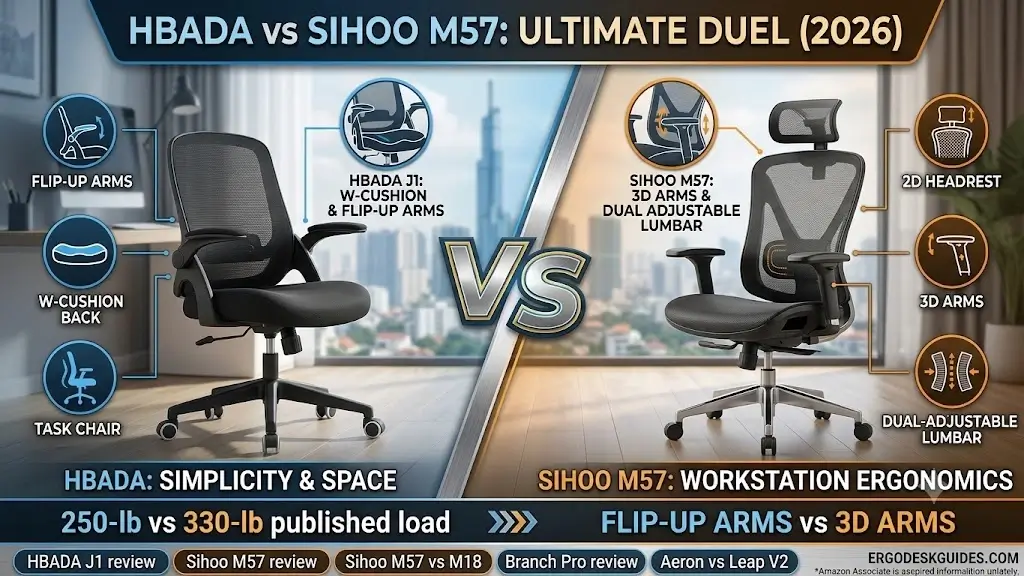
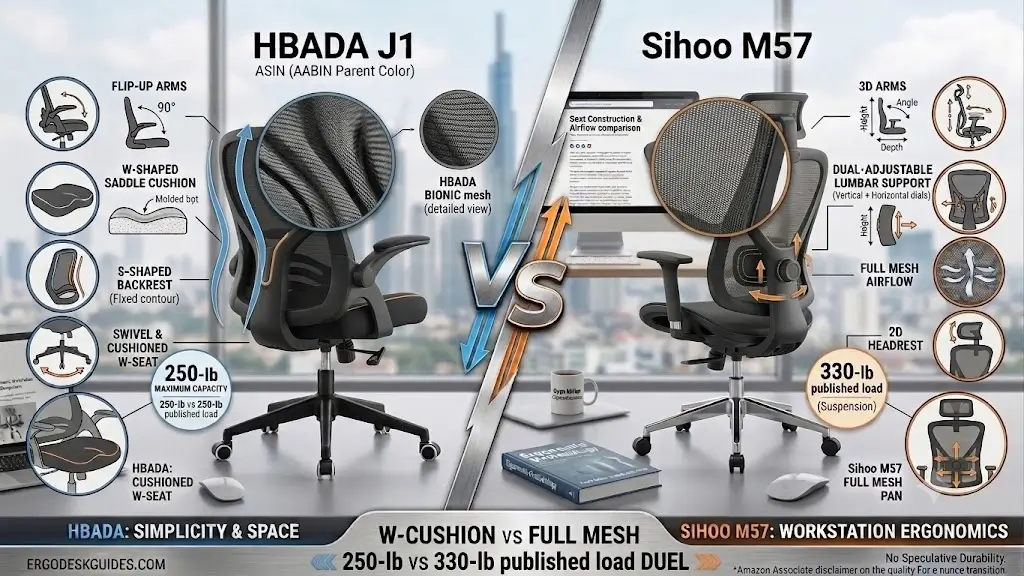
Short answer: The Sihoo M57 is the stronger choice for users who want a more adjustable ergonomic workstation chair, particularly for computer-heavy work. Its main advantages are a full-mesh seat and back, dual-adjustable lumbar support, 3D armrests, adjustable headrest, 126° recline, and a published 330-lb maximum load. Both chairs stand as popular picks in our benchmark of the best ergonomic office chairs under $150.
The HBADA J1 is the better fit for users who prioritize a cushioned seat, flip-up armrests, compact desk compatibility, and a simpler office-chair design. Featured as an accessible option in our guide to the best ergonomic desk chairs with flip-up arms for small spaces, its W-shaped memory-foam seat and flip-up arms make it particularly practical where space and seating preference matter more than extensive ergonomic adjustment.
Sihoo M57 is an adjustability-first design: It gives the user more ways to position the lumbar support and armrests with a full-mesh seat pan.
HBADA J1 is a simplicity-and-space design: It combines a padded W-shaped cushion with a breathable mesh back and flip-up arms to tuck neatly under tight desks.
Editorial Disclosure: ErgoDeskGuides independently evaluates ergonomic office chairs using manufacturer documentation, product specifications, design analysis, and workstation-fit criteria. As an Amazon Associate, we earn from qualifying purchases at no additional cost to you.
Quick Reference Specification: HBADA J1 vs. Sihoo M57
| Technical Feature | HBADA J1 | Sihoo M57 | Biomechanical Extraction Takeaway |
|---|---|---|---|
| Seat Pan Construction | W-shaped memory-sponge cushion | Full breathable suspension mesh | HBADA eliminates frame rim friction; M57 maximizes 360° airflow |
| Armrest Mechanism | 90° vertical flip-up folding hinges | 3D adjustable (height, depth, pivot) | HBADA slides flush under tight desks; M57 aligns forearms during typing |
| Lumbar Support Type | Static integrated S-shaped curve | Dual-axis rotary dial (height & depth) | M57 targets L1–L5 vertebrae precisely; HBADA provides passive boundary support |
| Recline Kinematics | Free-rocking tilt tension cradle | 126° synchro-tilt (3 lock stops) | M57 locks securely at upright and resting angles; HBADA rocks freely |
| Cervical Headrest | No integrated adjustable headrest | 2D articulated mesh headrest (height & tilt) | M57 supports the suboccipital cervical curve during reclined rest periods |
| Certified Load Limit | 250 lbs (version dependent) | 330 lbs (BIFMA / SGS certified) | Sihoo M57 provides a higher certified structural load ceiling |
| Criterion | HBADA J1 | Sihoo M57 | Better Fit |
|---|---|---|---|
| Seat | W-shaped memory-foam / sponge cushion | Full breathable mesh | M57 for airflow; HBADA for cushioning |
| Backrest | Breathable mesh, S-shaped design | Full mesh, S-shaped backrest | M57 |
| Armrests | Flip-up (90° folding) | 3D adjustable | M57 for ergonomics; HBADA for space |
| Lumbar | Contoured / integrated support | Height + depth adjustment | M57 |
| Recline / Tilt | Rocking / tilt function | Up to 126° | M57 for controlled recline |
| Headrest | Not a major adjustment advantage | Height + angle adjustable | M57 |
| Seat Depth | 17.7″ published (fixed) | 18.11″ published (fixed) | Tie / body fit dependent |
| Maximum Load | 250 lbs (listing dependent) | 330 lbs | M57 |
| Small Desk | Excellent because arms flip upward | Very good; armrests are adjustable | HBADA |
| Best Overall Use | Compact / multipurpose office seating | Computer-heavy ergonomic workstation | M57 |
Specification note: HBADA’s current J1 documentation lists a 250-lb maximum capacity, while older marketplace listings associated with ASIN B09KV9HPSH have listed up to 280 lbs. Verify the exact rating on the product documentation supplied with your chair.
Which HBADA Chair Is Being Compared With the Sihoo M57?
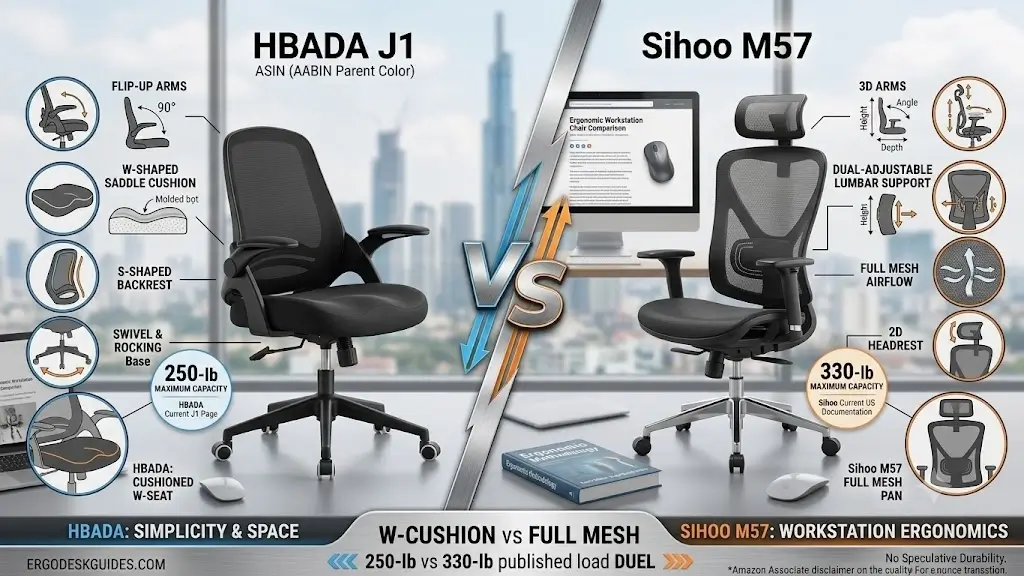
Official catalog listings identify the HBADA J1 configuration by its penguin-shaped frame, W-shaped foam pan, and ninety-degree folding armrests.
This comparison uses the HBADA J1 / Penguin-inspired office chair configuration represented by the product listing associated with ASIN B09KV9HPSH: mesh back, W-shaped cushioned seat, flip-up armrests, swivel base, and rocking functionality.
That distinction matters because HBADA sells multiple ergonomic office-chair models. For instance, if you are looking for higher-end ergonomic performance with 720° armrests and dynamic floating lumbar wings, read our dedicated Hbada E3 Pro review. A comparison using a different HBADA model produces materially different conclusions about lumbar support, armrest adjustment, seat construction, and load capacity.
Important model-version warning: The current HBADA J1 page lists a 250-lb maximum weight capacity and a 17.7-inch seat depth, while archived/retailer listings for the B09KV9HPSH configuration show different published values, including 280 lbs. This is why the comparison distinguishes manufacturer-current specifications from older marketplace data instead of silently combining them.
HBADA J1 vs Sihoo M57 Specifications
Published technical matrices show the Sihoo M57 provides a 330-pound maximum load rating and 3D armrests against the HBADA J1’s flip-up configuration.
The following table focuses on specifications that affect actual workstation fit without adding estimated measurements where documentation is unavailable:
| Specification | HBADA J1 | Sihoo M57 | Evidence / Interpretation |
|---|---|---|---|
| Seat Construction | W-shaped memory-foam / sponge cushion | Full breathable mesh | Published product documentation |
| Backrest | Breathable mesh | Breathable mesh | Published product documentation |
| Back Shape | S-shaped / contoured | Integrated S-shaped backrest | Design documentation |
| Armrests | Flip-up (90° vertical rotation) | 3D: height, forward/back, rotation | Published features |
| Lumbar Adjustment | Contoured / integrated support | Vertical + horizontal | Adjustment architecture |
| Recline / Tilt | Rocking / tilt function | Up to 126° | Manufacturer/product documentation |
| Headrest | No comparable adjustment advantage | Height + 45° rotation | Manufacturer documentation |
| Seat Height Range | 16.75–20.67 in | ~17.5–21.5 in (Regional dependent) | Consult our desk height guidelines |
| Seat Depth | 17.7 in (Fixed) | 18.11 in (Fixed) | Published dimensions |
| Maximum Load | 250 lbs (older listing: 280 lbs) | 330 lbs | Version-sensitive manufacturer data |
| Material | Mesh + cushion + polymer frame | Aluminum + mesh | Published material descriptions |
| Warranty | Current: up to 5-year (terms apply) | 3 years | Manufacturer documentation |
HBADA vs Sihoo M57: 8 Differences That Actually Matter
Biomechanical evaluation principles divide the HBADA J1’s compact space-saving frame from the Sihoo M57’s workstation-focused adjustment system.
1. Seat Design: Cushion vs Full Mesh
The HBADA J1 uses a padded W-shaped seat with memory-sponge cushioning designed around the contours of the pelvis and thighs. The Sihoo M57 uses full breathable suspension mesh across both seat and back. If you want to evaluate how full mesh seating compares against traditional molded foam within the same brand family, explore our head-to-head comparisons of budget ergonomic task chairs.
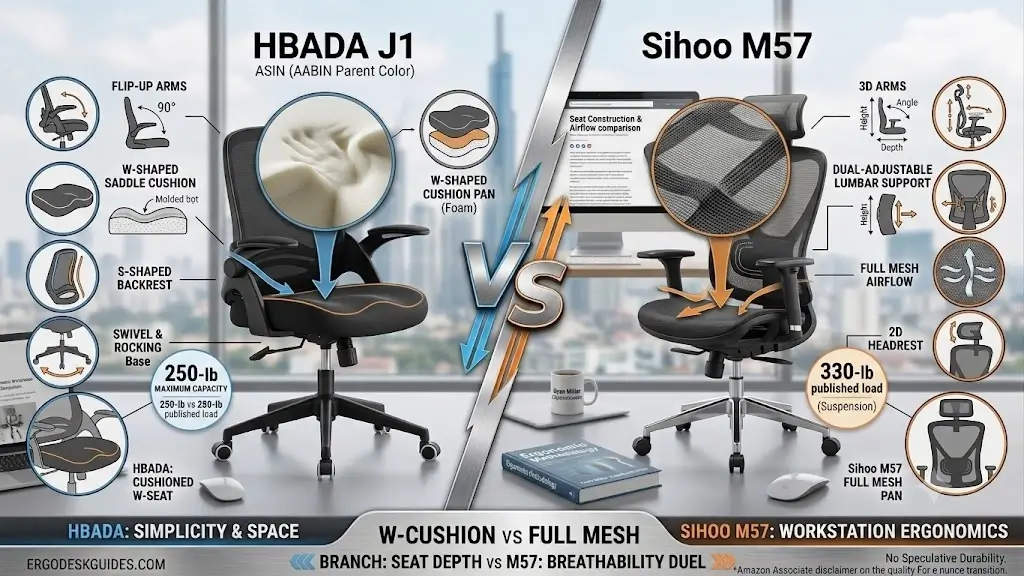
Note: If you choose the M57 and find the rigid plastic outer rim uncomfortable when shifting postures, adding an orthopedic pad from our best ergonomic seat cushions for office chairs guide eliminates hard edge contact.
2. Armrests: Flip-Up vs 3D Adjustment
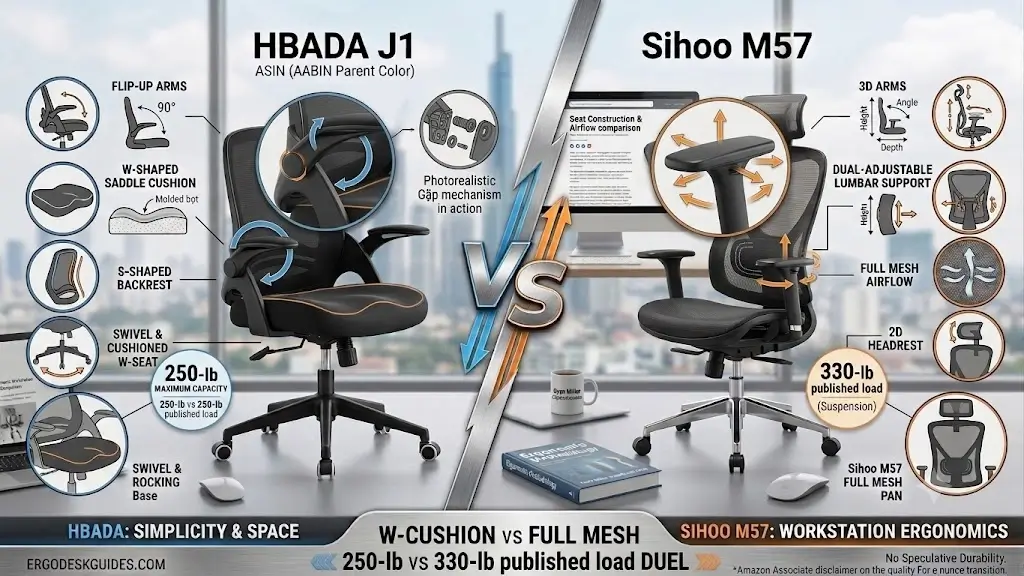
The HBADA J1’s armrests flip upward 90 degrees, allowing you to push the chair fully under shallow desks. However, the Sihoo M57 uses 3D coordinated armrests with height, depth, and inward/outward angle adjustments, making it vastly superior for forearm support during prolonged typing.
3. Lumbar Support: Adjustable vs Contoured
The HBADA J1 relies on a static contoured backrest shape. In contrast, the Sihoo M57 features a dual-adjustable rotary lumbar module allowing precise vertical and horizontal depth travel to match individual spinal curves. For a detailed breakdown of how this mechanical lumbar dial performs over long work sessions, read our full Sihoo M57 review.
4. Recline: Controlled Work Recline vs Simple Rocking
The M57 provides a 3-position lockable tilt mechanism reclining up to 126°. The HBADA J1 provides a basic spring-loaded rocking tilt function without a deep multi-angle lock.
5. Headrest Adjustment
The M57 includes a 2D adjustable headrest with 3.9 inches of height travel and a 45-degree pivot angle. The HBADA J1 configuration does not offer comparable head and neck positioning.
6. Airflow: Full Mesh vs Mesh Back + Cushion
While both chairs have mesh backrests, the M57’s open mesh seat pan allows full ambient air circulation beneath the pelvis, making it ideal for warm climates or poorly ventilated rooms.
7. Desk Compatibility: The HBADA Has a Real Space Advantage
For tight spaces, student bedrooms, or desks shallower than 24 inches, HBADA’s flip-up arms completely eliminate clearance friction, allowing the chair to tuck away cleanly.
8. Weight Capacity and Specification Confidence
Sihoo documents a clear 330-lb maximum load rating for the M57 backed by BIFMA and SGS certifications. HBADA documentation varies between 250 lbs and 280 lbs depending on the retailer revision.
Comfort: HBADA J1 vs Sihoo M57
User comfort profiles establish that the HBADA J1 favors casual padded sitting while the Sihoo M57 enforces structured upright workstation posture.
HBADA J1 Comfort Profile
The HBADA J1 functions as a comfortable task chair. It is the better choice for users who prefer conventional foam cushioning, dislike the edge pressure of mesh frames, and use their home office for mixed-duration computer sessions.
Sihoo M57 Comfort Profile
The M57 provides a suspended, supportive feel that stays cool over 8+ hour workdays. Its multi-axis adjustments let you dial in wrist, elbow, and lumbar alignment for intensive workstation tasks.
Full Mesh vs Cushioned Seat: Which Is Better?
Thermal ventilation comparisons show suspended mesh eliminates pelvic heat buildup while memory sponge cushions provide immediate soft surface compliance.
| Factor | HBADA J1 | Sihoo M57 |
|---|---|---|
| Seat Material | Memory-foam / sponge cushion | Mesh |
| Airflow | Moderate at seat | High through full mesh |
| Initial Feel | Cushioned & soft | Firm & suspended |
| Seat Temperature | Insulating | Ventilated |
| Best Match | Foam cushion lovers | Breathable mesh seekers |
What the HBADA J1 and Sihoo M57 Do Not Do
Hardware limitation reviews indicate neither chair incorporates an adjustable sliding seat pan to accommodate variable femur lengths.
- Neither provides a sliding seat pan mechanism: Both chairs feature a fixed seat depth (17.7″ on HBADA, 18.11″ on Sihoo). If you have longer legs and require dedicated seat-depth adjustability, consider models with sliding seat pans like the one evaluated in our Branch Ergonomic Chair Pro review.
- The HBADA does not provide multi-axis armrest positioning: Its flip-up mechanism solves a clearance problem rather than adjusting for typing angles.
- The M57 lacks traditional foam cushioning: Users who dislike the firm tension of suspended mesh may find it too rigid.
- HBADA weight capacity varies by retail version: Listings alternate between 250 lbs and 280 lbs.
Who Should Buy Each Chair?
Workstation dimension constraints dictate whether flip-up arm practicality outweighs multi-directional forearm support and mesh breathability.
Choose the HBADA J1 If:
- You prefer a cushioned foam seat instead of full mesh.
- You need flip-up armrests to tuck the chair under a compact desk.
- You want a lightweight, simple home-office chair.
- Your budget calls for basic, practical daily seating.
Avoid HBADA if you require 3D armrests, multi-axis lumbar tuning, or 330-lb load support.
Choose the Sihoo M57 If:
- You want full breathable mesh across both seat and back.
- You work at a computer for extended 8+ hour stretches.
- You need 3D armrests to angle forearms during keyboard typing.
- You want height and depth adjustable lumbar support with a 126° recline lock.
Avoid M57 if you strongly dislike mesh seating surfaces.
Final Verdict: HBADA vs Sihoo M57
Comparative design analysis confirms the Sihoo M57 earns our overall recommendation for dedicated computer workstations.
Frequently Asked Questions: HBADA vs Sihoo M57
Ergonomics specialists clarify key differences regarding flip-up arm mechanisms, full-mesh airflow, and load capacities.
1. Is the Sihoo M57 better than HBADA?
The Sihoo M57 is the stronger overall choice for computer-heavy workstation use because it provides full-mesh seating, dual-adjustable lumbar support, 3D armrests, adjustable headrest positioning, and a 126° recline. HBADA J1 is better suited to users who prefer a cushioned seat and flip-up arms.
2. Is HBADA J1 a good ergonomic chair?
Yes. The HBADA J1 combines a shaped backrest, breathable mesh back, cushioned W-shaped seat, adjustable height, flip-up armrests, and a rocking function. Its ergonomic adjustment range is simpler than the Sihoo M57.
3. Which chair has better lumbar support, HBADA or Sihoo M57?
The Sihoo M57 has the stronger lumbar adjustment system because its lumbar support moves vertically and horizontally. HBADA J1 relies more heavily on the contour of its backrest.
4. Does HBADA have flip-up armrests?
Yes. The HBADA J1 configuration compared here uses flip-up armrests, allowing the arms to move out of the way when the chair is stored under a desk or when additional clearance is needed.
5. Does the Sihoo M57 have 3D armrests?
Yes. The Sihoo M57 uses 3D armrests with height, forward/backward, and rotational adjustment.
6. Which chair is cooler, HBADA or Sihoo M57?
The Sihoo M57 should provide better passive airflow because its seat and back are both mesh. The HBADA J1 has a breathable mesh back but a cushioned seat.
7. Which chair is better for a small desk?
The HBADA J1 has the more useful space-saving feature because its armrests flip upward, making it easier to position the chair underneath a compact desk.
8. Which chair is better for long hours at a computer?
The Sihoo M57 is the stronger choice for extended computer work because it combines full-mesh seating with adjustable lumbar support, 3D armrests, adjustable headrest positioning, and controlled recline.
9. What is the weight capacity of the Sihoo M57?
Sihoo’s current US product documentation lists a maximum load of 330 lbs for the M57.
10. Should I choose HBADA or Sihoo M57?
Choose HBADA J1 for a cushioned seat, flip-up arms, and compact-space practicality. Choose Sihoo M57 for full-mesh seating, adjustable lumbar support, 3D armrests, adjustable headrest positioning, and a more workstation-focused ergonomic setup.
