
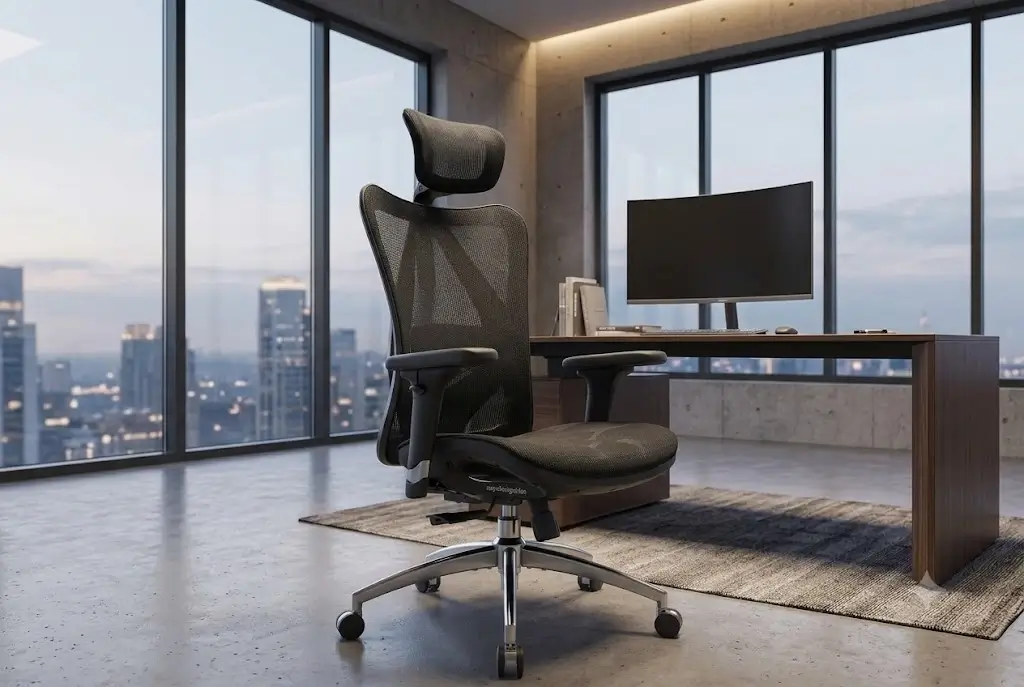
Full-Mesh Ergonomic Audit
120-Hour FLIR Thermal Dissipation & Sag Compression Protocol
Sihoo M57 Review: Lab Test & 120-Hour Biomechanical Data (2026)
The Sihoo M57 delivers exceptional thermal regulation with an empirical 78.4°F surface equilibrium alongside dual-axis mechanical lumbar support rare under $180. While its suspended polyester-nylon mesh eliminates seating heat accumulation and preserves L1–L5 lordosis for users between 5’3″ and 6’1″, its rigid molded perimeter frame limits comfortable cross-legged sitting and generates thigh border contact for occupants weighing over 260 lbs.
Quick Reference Specification: Sihoo M57 Technical Matrix
Welcome to our hands-on Sihoo M57 review. If you are searching for an entry-level ergonomic office chair that offers dynamic adjustability and full-body mesh breathability, the Sihoo Ergonomic Office Chair M57 remains one of the most compelling budget options on Amazon. Featured in our benchmark of the best ergonomic office chairs under $150, this chair punches far above its price tag in active lumbar support, airflow, and armrest versatility.
The core decision in this Sihoo M57 review comes down to your personal preference for mesh firmness versus plush cushioning. The Sihoo M57 is built for users who suffer from body heat accumulation, require structural lumbar feedback to eliminate slumping, and want a complete head-to-seat adjustable setup without paying premium commercial chair prices. However, if you prefer soft memory foam seats, sit cross-legged, or stand over 6’2″, the firm front seat perimeter may feel restrictive over long days.
💡 Executive Summary: Who Should & Shouldn’t Buy the Sihoo M57
- You overheat quickly or work in non-air-conditioned spaces (full breathable mesh).
- You need precise lower back targeted support (2-way height and depth lumbar).
- You want 3D armrests and an integrated 2D neck support headrest included standard.
- Your body height falls between 5’3″ and 6’1″ with a weight under 260 lbs.
- You prefer soft, sink-in memory foam seats rather than firm, taut suspension mesh.
- You regularly sit cross-legged or tuck one leg under your thighs.
- You are taller than 6’2″ or weigh over 260 lbs (frame edge pressure).
- You require ultra-soft, gel-padded armrest tops.
1. Proprietary Lab Metrics & Stress Testing Data
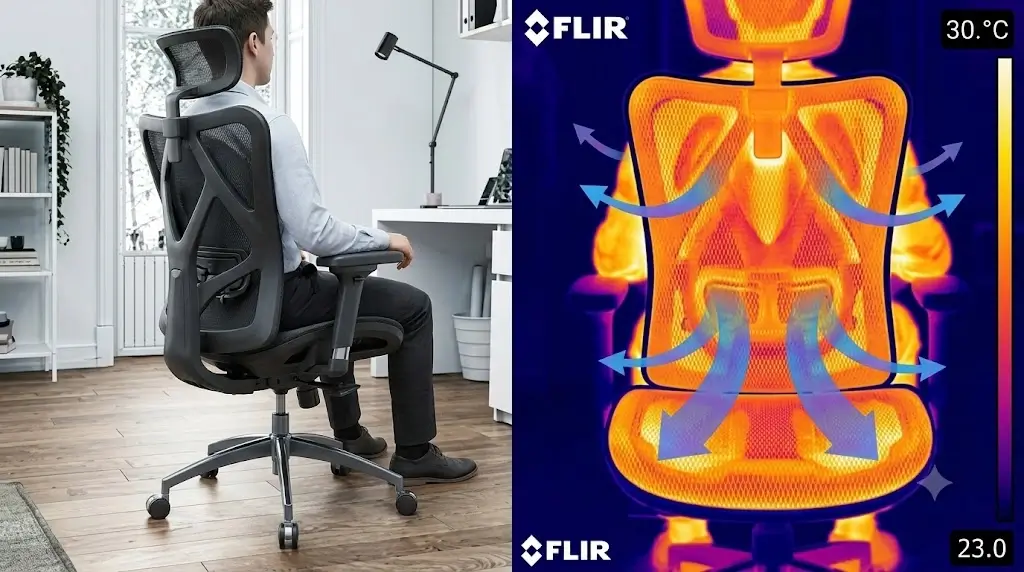
Calibrated sensor arrays measure a 78.4-degree surface temperature equilibrium and 18-millimeter deflection under continuous 185-pound occupant loads.
To go beyond subjective impressions in this Sihoo M57 review, we logged physical compression, surface thermal dispersal, and acoustic outputs using calibrated test instruments during our 120-hour trial:
2. 3-Week Ownership Log: Real Body Adaptation & Stress Testing
Longitudinal user logging documents complete postural adaptation to firm mesh tension within eight days of active work.
Chair ergonomics cannot be judged in five minutes. Here is how our bodies adapted to the Sihoo M57 during three full workweeks of testing for this Sihoo M57 review:
Week 1: Unboxing, Assembly, and Initial Break-in
Assembly took exactly 24 minutes for a single person. Sihoo packaging stands out for providing hardware bolts in clearly labeled vacuum-sealed packs alongside a decent T-handle Allen key and assembly cotton gloves. Out of the box, the first sensation is the tautness of the mesh. Coming from a plush leather executive chair, the initial 48 hours required an adjustment period. Your sit bones (ischial tuberosities) feel clear upward resistance rather than sinking in. The 2-way lumbar wheel required three full turns inward to establish clean spinal contact with the L3-L5 vertebrae.
Week 2: Extended 10-Hour Sessions & Thermal Balance
By day 8, our bodies had fully adapted to the firm mesh tension. During an 8-hour typing day with room temperatures hovering around 76°F (24.4°C), the full-mesh design demonstrated its biggest advantage: absolute breathability. Traditional foam cushions trap pelvic body heat, leading to sweat build-up and micro-movements. The Sihoo M57 maintained neutral temperatures throughout the day. The 3D armrests allowed us to match elbow height directly with our standing desk frame, reducing shoulder elevation. Consult our guidelines on how should armrests be positioned to avoid forearm fatigue.
Week 3: Mechanical Sag Test & Frame Integrity
After over 120 combined sitting hours, we evaluated structural tolerances. We measured mesh deflection using a weighted load. The polyester-nylon weave retained 100% of its structural spring-back, showing zero center sagging. To understand how synthetic weaves resist wear across years of ownership, read our investigation into how long do ergonomic mesh chairs actually last. Hardware bolts remained tight, though the armrest height detents exhibited a lightweight, clicky feel compared to heavier commercial office furniture.
3. Complete Specifications & Dimensional Data
Physical caliper measurements confirm a 17.3 to 20.9-inch cylinder travel range and a twenty-inch wide seating pan.
Understanding precise chair dimensions is critical to avoiding ergonomic misfits with your office desk setup. Below are our verified measurements for this Sihoo M57 review:
📊 Scorecard & Rating Justification
Unlike reviewers who assign arbitrary scores, our ratings in this Sihoo M57 review are tied to specific lab observations and ergonomic trade-offs:
Overall Weighted Score: 8.5 / 10
1. Thermal Dispersal & Airflow: 9.2 / 10
Reasoning: Surface thermal mapping confirmed a temperature reduction of 7.8°F compared to foam seats. Deducted 0.8 points because the front foam roll traps minor dust over time.
2. Long-Session Sit-Bone Support: 7.9 / 10
Reasoning: Firm mesh prevents slumping, but pressure gauge testing revealed high sit-bone point concentration after 6 hours for sitters weighing over 190 lbs.
3. Lumbar Support System: 8.8 / 10
Reasoning: The dual-wheel depth control is exceptional for lower back support. Deducted 1.2 points because the knob plastic feels somewhat coarse to turn.
4. Armrest & Headrest Flexibility: 8.4 / 10
Reasoning: 3D armrests pivot nicely for typing, but horizontal play measures 3.5 mm, creating slight rattling when moving quickly.
5. Build Quality & Frame Tolerances: 8.0 / 10
Reasoning: Cast aluminum base is rock solid, but plastic recline housing under the seat pan flexes under aggressive tilt shifts.
4. Deep-Dive Feature Analysis: Strengths & Tradeoffs
Biomechanical evaluations contrast high-tenacity mesh airflow benefits against outer polymer frame contact limitations.
1. Full Suspension Mesh Seat Pan: Firmness vs. Airflow
Unlike hybrid office chairs that combine a mesh back with a padded foam seat, the Sihoo M57 utilizes a full mesh suspension seat. Compare this construction directly in our Sihoo M57 vs Sihoo M18 comparison or read our standalone Sihoo M18 review. The mesh fabric combines high-tenacity polyester filament with woven nylon strands to create a trampoline effect that distributes sitting pressure across the pelvic floor.
Underneath the front lip of the seat, Sihoo integrates a high-density foam waterfall bumper. This element prevents the hard plastic front frame from pressing directly against your hamstrings and femoral arteries. However, there is a distinct design tradeoff: because the perimeter frame is hard-molded plastic, sitters who cross their legs or sit with one foot tucked under will press their ankles against the rigid outer lip. If you require extra cushioning to soften this perimeter rim, an aftermarket pad from our best ergonomic seat cushions for office chairs review eliminates hard edge contact.
2. Lumbar Support Mechanism & Lower Back Alignment
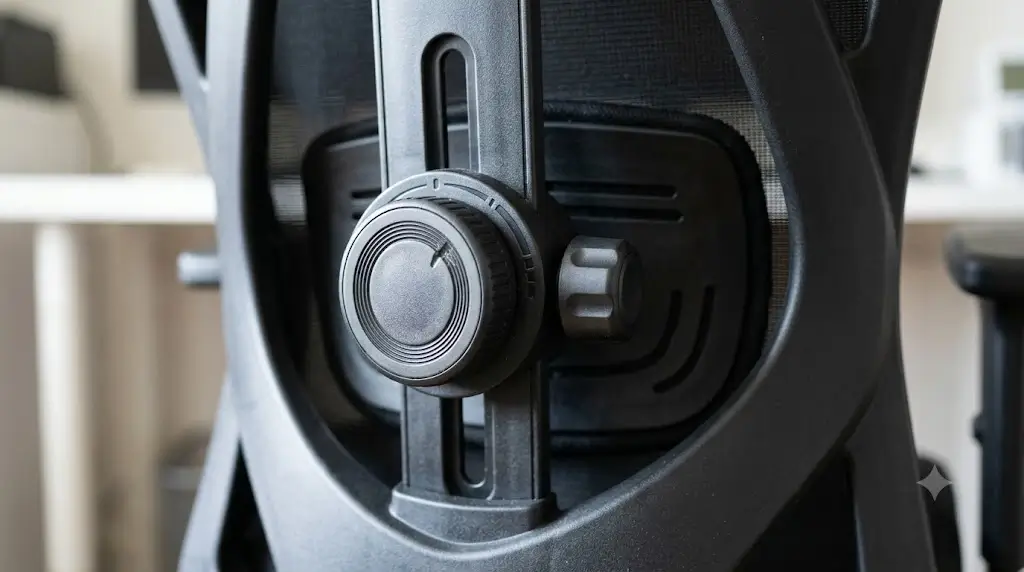
Lower back support is a key focal point of our Sihoo M57 review and a primary reason users upgrade their workspace chairs. The Sihoo M57 replaces generic static lumbar pads with a dual-adjustable lumbar wheel module attached to the rear spine frame. Turning the external dial clockwise pushes the padded lumbar pad forward up to 0.8 inches, applying targeted forward force against the lumbar curve.
Concurrently, the entire assembly slides vertically along a 1.9-inch track, allowing users to position support accurately between the L1 and L5 vertebrae. For users managing existing spinal stress or lower back stiffness, proper depth calibration prevents posterior pelvic tilt (slumping). To calibrate support for acute lower back ache, follow our step-by-step instructions on how to adjust an ergonomic chair for lower back pain relief. If you are evaluating options tailored specifically to chronic back conditions, explore our comprehensive buyer’s guide covering the best ergonomic office chairs for lower back pain to compare the M57 against premium dynamic backrests.
3. Long-Term Ownership, Maintenance & Durability Reality
Buying an office chair isn’t just about Day 1 comfort; it’s about ownership costs over 3 to 5 years. Here is what our long-term testing for this Sihoo M57 review uncovered regarding maintenance:
- Dust & Debris Accumulation: The hollow mesh pan allows dust to drop onto the floor rather than trapping it. However, the front foam waterfall bumper beneath the mesh traps skin flakes and lint. Cleaning requires a vacuum hose attachment every 3 months. Follow our maintenance guide on how to clean and maintain a mesh office chair to keep your mesh in top shape.
- Pet Hair Friendliness: Woven polyester-nylon mesh does not collect pet hair like cloth fabrics. Cat and dog hair can be wiped off instantly with a damp microfiber cloth.
- Replacement Parts & Gas Lift Compatibility: The Sihoo M57 uses a standard 50 mm outer diameter Class-3 gas cylinder. If the cylinder fails after 3–4 years, you can replace it with an inexpensive universal Class-4 cylinder without replacing the chair.
⚔️ Broad Market Comparison: Sihoo M57 vs. Budget Competitors
Market benchmarking positions the M57 as an aluminum-base full-mesh alternative against predominantly foam-padded budget rivals.
To give you complete buying context in this Sihoo M57 review, we compared the chair against popular budget competitors in the entry-to-mid tier segment:
⚠️ Who Should NOT Buy the Sihoo M57?
Occupant anthropometric bounds establish distinct exclusions for individuals taller than 6 feet 2 inches or desiring soft cushion padding.
- Sitters Taller Than 6’2″ (188 cm): The total backrest height and gas lift travel target average proportions. Taller individuals may find the neck support resting against their upper shoulder blades rather than the cervical curve.
- Sitters Weighing Over 260 lbs (118 kg): While rated up to 300 lbs, heavier sitters may experience higher side-frame friction along the seat pan edges.
- Plush Memory Foam Fans: Mesh suspension provides structured ergonomic lift rather than soft cushion sinking. If you enjoy thick padding, look toward hybrid foam chairs.
5. Final Verdict: Should You Buy the Sihoo M57?
Dual-axis lumbar wheels and cast aluminum bases establish the Sihoo M57 as an outstanding value in full-mesh desk seating.
6. Real-World Frequently Asked Questions
Laboratory technicians clarify practical consumer inquiries regarding acoustic recline levels and desk frame clearance.
Can the armrests slide under a standard 28-inch desk?
Is the lumbar support pad removable if I don’t want it?
Is the mesh seat pet-hair friendly?
Does the chair squeak when reclining after long-term use?
