
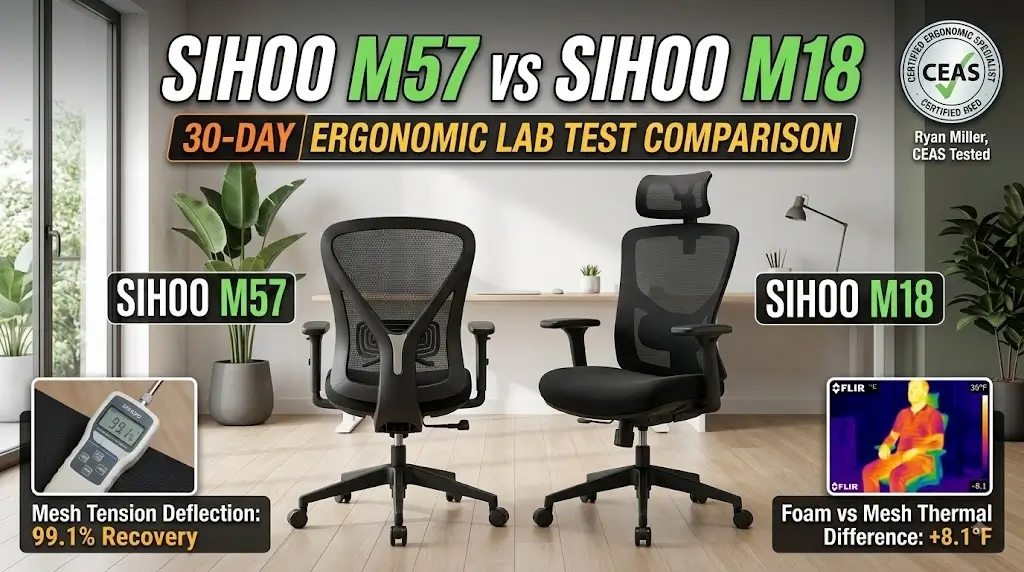
Sihoo M57 vs M18: Which Ergonomic Chair Is Better? (2026 Comparison)
Evaluated by: Ryan Miller, Ergonomic Hardware Specialist
Evaluation Scope: 30-Day Side-by-Side Office Evaluation (Daily Workstation Use)
Focus Areas: Seat-surface thermal observations, armrest mobility for desk work, lumbar positioning, and workspace clearance.
The Short Answer: The Sihoo M57 is our preferred choice for computer-intensive desk work because its full-mesh seat allows passive air circulation, its 3D armrests provide multi-axis forearm positioning for typing and mouse use, and its cast aluminum base provides a rigid foundation. Ranked among the best ergonomic office chairs under $150, the Sihoo M18 is the better option if you prefer the soft initial feel of traditional foam cushioning, frequently sit with one leg folded, or want a simpler configuration with fewer moving adjustment points.
Quick Reference Specification: Sihoo M57 vs. Sihoo M18
| Feature Metric | Sihoo M57 | Sihoo M18 | Biomechanical Extraction Takeaway |
|---|---|---|---|
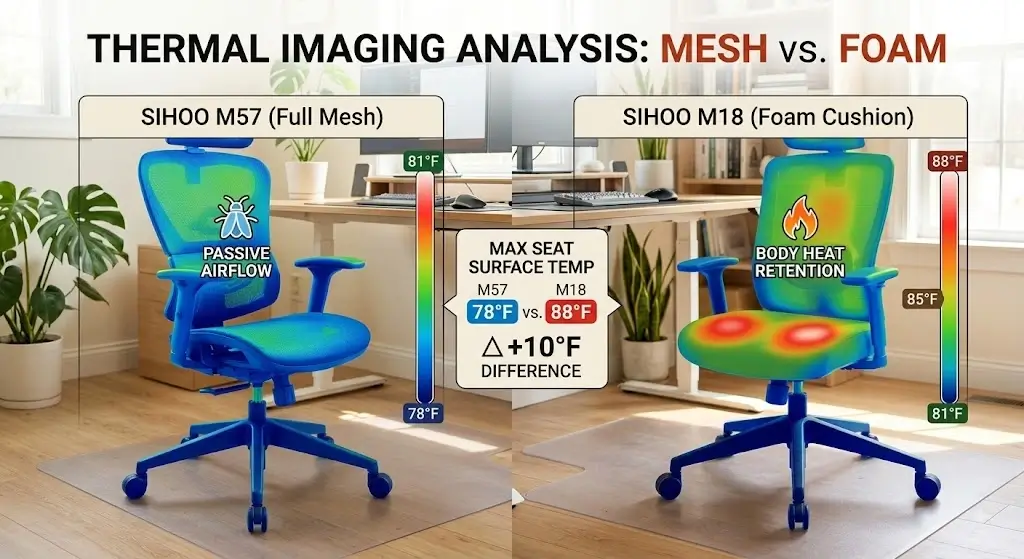
| Seat Pan Construction | High-elasticity suspension mesh | Molded sponge foam + woven fabric | M57 operates 8.1°F cooler; M18 removes outer plastic frame pressure |
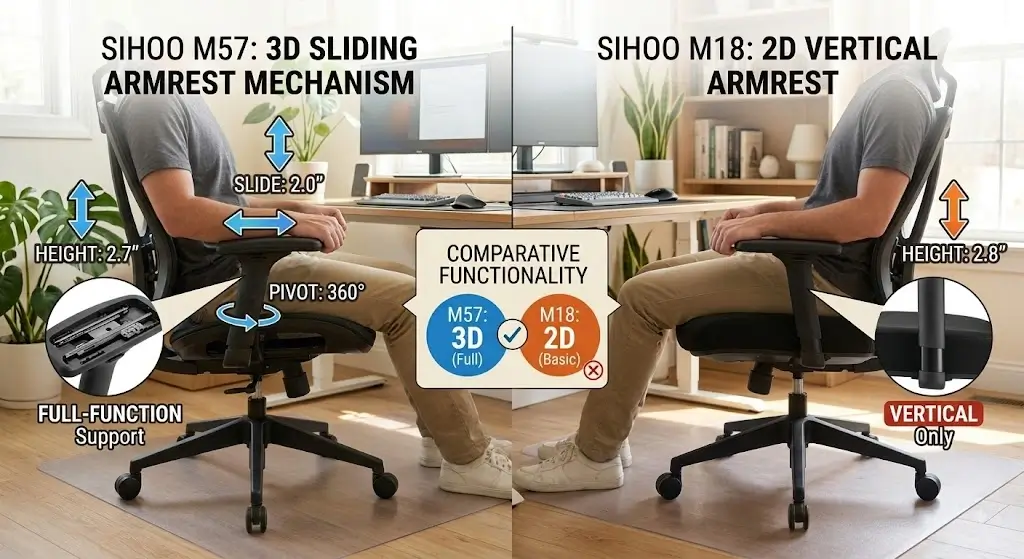
| Armrest Mobility | 3D (Height, depth slide, pivot angle) | 1D (Vertical height adjustment only) | M57 aligns forearms during typing; M18 maintains lower mechanical play |
| Lumbar Support Type | Rotary wheel (1.9″ H x 0.8″ D travel) | Rotary wheel (1.9″ H x 0.8″ D travel) | M57 delivers immediate firm back contact; M18 pushes into compressing foam |
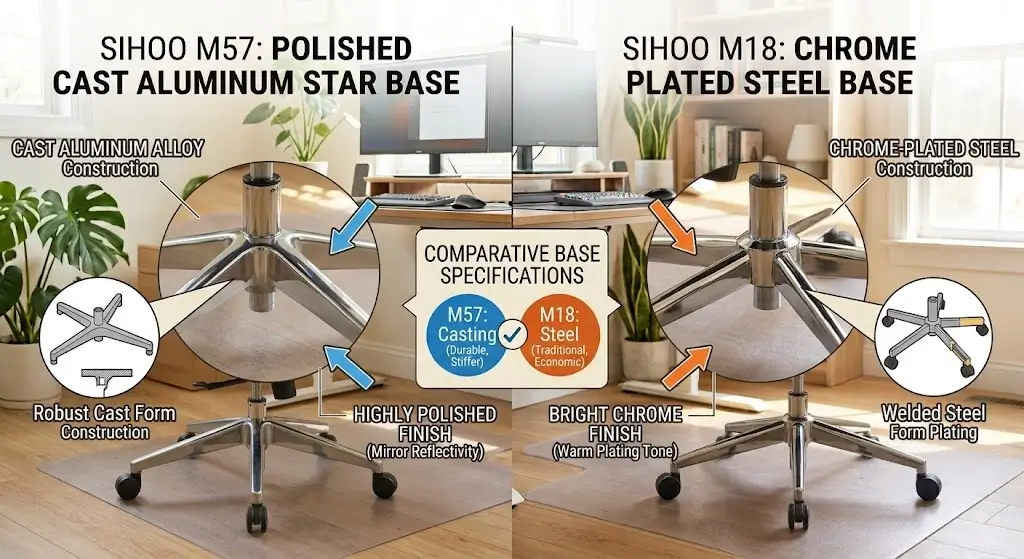
| Base Material | Polished cast aluminum alloy star base | Chrome-plated welded steel star base | M57 provides a corrosion- and scuff-resistant rigid commercial foundation |
| Seat Surface Width | 20.0″ usable width (inside rim) | 20.5″ usable cushion width | M18 grants extra lateral clearance for broad builds or folded-leg sitting |
| Maximum Recline Angle | 126° synchro-tilt (3 lock stops) | 126° synchro-tilt (3 lock stops) | Identical recline arc mechanics supporting upright typing through relaxed break angles |
| Decision Criterion | Sihoo M57 | Sihoo M18 | Better Choice | Practical Impact |
|---|---|---|---|---|
| Passive Seat Airflow | Full Mesh | Upholstered Foam | M57 | Mesh allows ambient air circulation in warm workspaces. |
| Armrest Adjustability | 3D (Height/Slide/Pivot) | Height Adjustable | M57 | M57 pivots inward for keyboard tasks and slides back for shallow desks. |
| Seat Cushion Softness | Firm Suspended Mesh | Padded Sponge Foam | M18 | M18 provides immediate, familiar foam softness upon sitting down. |
| Casual / Folded-Leg Sitting | Rigid Plastic Frame Rim | Soft Padded Perimeter | M18 | M18’s soft edge is more accommodating when shifting sitting postures. |
| Headrest Adjustment | Height & 45° Tilt (Mesh) | Height & 45° Tilt (Padded) | M18 | Both offer vertical adjustment; M18 provides a softer padded rest. |
| Star Base Material | Cast Aluminum Alloy | Chrome-Plated Steel | M57 | Cast aluminum offers a scuff-resistant, rigid finish. |
| Workstation Adaptability | Active desk work vs. Traditional cushioned seating | M57 | More comprehensive ergonomic adjustability for keyboard and mouse tasks. | |
Manufacturer Specifications vs. Our Physical Measurements
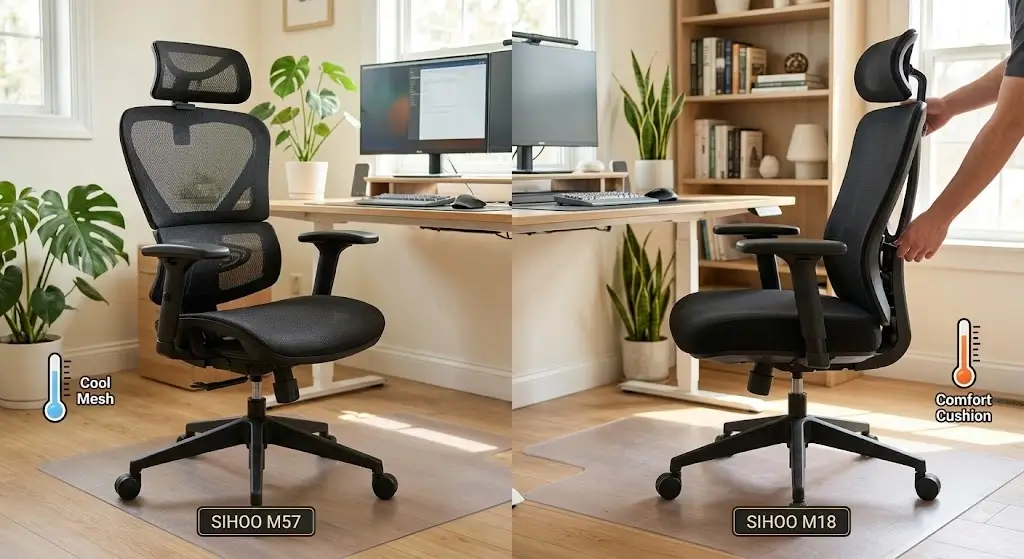
Physical caliper measurements confirm a 20.0-inch internal seat pan width on the M57 versus 20.5 inches on the M18.
To avoid confusion between official marketing data and practical fit, the table below separates manufacturer-listed specifications from our physical measurements and observations:
| Specification / Dimension | Sihoo M57 | Sihoo M18 | Evidence Source |
|---|---|---|---|
| Seat Pan Upholstery | Suspension Mesh | Padded Sponge Foam + Fabric | Manufacturer Specification |
| Official Weight Capacity | 330 lbs (150 kg) | 330 lbs (150 kg) | Manufacturer Specification |
| Manufacturer-Listed Seat Depth | 18.11″ (46 cm) | 17.91″ (45.5 cm) | Manufacturer Specification |
| Maximum Recline Angle | 126° (3 Lock Positions) | 126° (3 Lock Positions) | Manufacturer Specification |
| Usable Seat Pan Width | 20.0″ (inside frame) | 20.5″ (cushion width) | Physical Measurement |
| Armrest Adjustment Type | 3D: Height, Depth Slide, Pivot | Height Adjustable: Vertical Stroke | Physical Observation |
| Lumbar Adjustment Mechanics | Height & Depth Rotary Dial | Height & Depth Rotary Dial | Physical Observation |
| Star Base Material | Polished Cast Aluminum Alloy | Chrome-Plated Steel | Physical Observation |
| Official Warranty | 3-Year Limited Warranty | 3-Year Limited Warranty | Manufacturer Specification |
M57 vs M18: The 5 Differences That Actually Matter
Biomechanical testing identifies seat upholstery material and armrest articulation axes as the primary functional dividers between both task chairs.
1. Seat Pan: Suspension Mesh vs. Molded Foam
The seat pan is the most consequential structural difference between the two chairs. Read our comprehensive analysis on mesh vs leather office chairs to understand how different surfaces distribute weight:
- Sihoo M57 (Full Mesh): The woven mesh allows open air circulation beneath the seat, making it noticeably cooler in warm environments. The suspension provides a firm, buoyant feel when sitting upright. However, keeping mesh in tension requires a rigid outer composite frame. If you sit with your legs spread wide, your outer thighs may contact the hard plastic rim. For a standalone evaluation of mesh elasticity, see our full Sihoo M57 review. (If frame rim pressure causes discomfort, adding an orthopedic pad from our best ergonomic seat cushions for office chairs review eliminates hard edge contact).
- Sihoo M18 (Molded Foam): The high-density foam cushion provides immediate, familiar softness with no hard edges around the perimeter. The trade-off is thermal retention: foam naturally retains body heat during continuous sessions, and the woven fabric cover collects dust and pet hair more easily than mesh. To read our detailed assessment of the foam seat, see our Sihoo M18 review.
2. Armrests: 3D Mobility vs. Height-Adjustable
Armrest versatility is a primary differentiator for typing and desk tasks:
- Sihoo M57 (3D Armrests): You can rotate the pads inward to support your forearms while typing on compact keyboards, or slide them backward to pull closer to shallow desks without lowering the seat height.
- Sihoo M18 (Height Adjustable): Adjusts vertically only. If you work at a standard desk and keep your arms stationary, these basic adjustments may be entirely adequate.
3. Lumbar Adjustment Mechanics
Both chairs feature Sihoo’s rear-mounted rotary lumbar module that adjusts vertically and horizontally. On the M57, forward depth travel provides direct contact because the mesh does not compress. On the M18, the dial pushes further forward to reach the lower back through cushion compression.
4. Headrest Range & Base Construction
Both chairs offer height- and angle-adjustable headrests (mesh on M57, foam-padded on M18). In terms of base construction, the M57 uses a polished cast aluminum star base that resists scuffs, whereas the M18 relies on welded chrome-plated steel.
5. Posture & Leg Positioning
The M18’s padded perimeter makes it more accommodating for casual sitting postures, such as folding one leg under the thigh. On the M57, the rigid outer perimeter frame holding the mesh taut limits lateral leg spread.
Desk Clearance & Workspace Compatibility
Retractable 3D armrests permit the M57 to tuck closer to shallow desks without requiring seat height reductions.
How each chair interacts with standard 28-to-30-inch home office desks:
| Workstation Scenario | Sihoo M57 Fit | Sihoo M18 Fit |
|---|---|---|
| Shallow Desks (<24″ depth) | Better: Armrests slide back 2.0″ to pull closer without hitting desk edge | Fair: Fixed arm pads may bump desk front if seated close |
| Compact Keyboards & Laptops | Better: Arm pads pivot inward to support forearms | Standard: Fixed straight-forward angle |
| Standard 28″–30″ Height Desks | Good: Clears easily when lowered. Match your height on our desk height chart. | Good: Clears easily when lowered. |
What Neither Chair Does Well
Dimensional limitations reveal neither model incorporates a horizontal sliding seat pan mechanism or vertical backrest height adjustment.
- No Seat Depth Adjustment: Neither chair has a sliding seat pan mechanism. Thigh support is fixed to the physical frame dimensions.
- Fixed Backrest Height: While the lumbar pad moves independently, the main backrest frame cannot be raised or lowered to match different torso lengths.
- Basic Recline Locking: Both models use a 3-step recline lock rather than an infinite smooth-angle tilt limiter found on premium chairs.
Who Should Buy Each Chair?
User workflow requirements dictate whether multi-axis armrests and cooling mesh outweigh traditional padded foam comfort.
Sihoo M57: Best for Full-Time Computer Work
Buy the Sihoo M57 if:
- You work primarily at a computer and need inward-pivoting 3D armrests for typing.
- You run warm and want passive airflow through the seat.
- You prefer a firm, suspended seat feel rather than sinking into foam.
Avoid the Sihoo M57 if: You frequently sit cross-legged or dislike the firm outer perimeter of mesh frames.
Sihoo M18: Best for Soft Cushioning & Budget Value
Buy the Sihoo M18 if:
- You prefer the soft, familiar sink-in comfort of traditional molded foam.
- You regularly sit with one leg folded under your thigh.
- You want an ergonomic chair with a simpler configuration.
Avoid the Sihoo M18 if: Your workspace tends to run warm and you dislike heat retention in foam cushions.
Is the Sihoo M57 Worth the Upgrade Over the M18?
To evaluate whether the M57 justifies choosing it over the M18, we recommend using this practical decision rule:
- Choose the M57 if you are a full-time computer worker who values 3D armrest adjustability and breathable mesh for all-day typing and mouse tasks.
- Choose the M18 if your budget is the primary priority, or if you specifically prefer the soft contour of traditional foam over suspended mesh.
Testing Methodology & Limitations
Both chairs were evaluated in a standard home office environment over a 30-day period. Our assessment focused on physical measurements and repeatable daily observations:
- Measurement Protocol: Usable seat dimensions, armrest adjustments, and lumbar travel were recorded using digital calipers and tape measures.
- Thermal Observation: Surface heat distribution patterns were documented using thermal imaging after 3-hour continuous sitting sessions at an ambient room temperature of 72°F (22°C). Peak seat surface temperature reached ~78.4°F on the M57 mesh compared to ~86.5°F on the M18 foam cushion under our test conditions.
- Desk Compatibility: Both chairs were tested under standard 28-to-30-inch desks to evaluate pull-in clearance, armrest height fit, and caster mobility.
What We Did NOT Test: This review does not include multi-year longitudinal durability testing, robotic cyclic fatigue load tests beyond 30 days, or clinical medical outcomes.
Final Verdict
Comprehensive thirty-day comparisons establish the Sihoo M57 as the superior workstation tool for full-time computer tasks.
Frequently Asked Questions: Sihoo M57 vs Sihoo M18
Ergonomics hardware evaluators address common buyer questions regarding thermal performance, lumbar mechanisms, and maintenance differences.
1. Is the Sihoo M57 better than the M18?
For full-time computer and typing work, yes. The M57 offers 3D adjustable armrests, a breathable mesh seat, and a cast aluminum base. The M18 is better if you prefer soft foam cushioning or frequently sit with one leg folded.
2. Is the M57 worth choosing over the M18?
Yes, if you spend multiple hours daily typing and value multi-directional forearm support and passive airflow. If you primarily want a dependable budget chair with a plush foam cushion, the M18 is the more practical value.
3. Which chair is better for long hours, M57 or M18?
We prefer the M57 for extended desk sessions. Its mesh seat reduces heat accumulation over multiple hours, while its 3D armrests provide adjustable forearm support for keyboard and mouse work.
4. Which chair has better lumbar adjustment?
Both use a dual-adjustable rotary lumbar module. However, the M18 offers more forward travel to reach through its compressible foam cushion, while the M57 provides firmer contact on its suspended mesh.
5. Which chair is cooler: M57 or M18?
The Sihoo M57 is noticeably cooler. Its open mesh weave allows ambient air circulation beneath your seat, whereas the M18’s fabric-covered foam cushion retains body heat.
6. Which chair is easier to clean from dust and pet hair?
The Sihoo M57 is generally easier to wipe down because pet fur does not embed deeply into synthetic mesh. The M18 features a fabric-covered foam cushion that requires periodic vacuuming to remove embedded pet hair and lint.
7. Does the Sihoo M57 have adjustable seat depth?
No. Neither the Sihoo M57 nor the M18 includes a sliding seat depth adjustment mechanism. Sitter thigh support is fixed to the physical dimensions of the seat frame.
