Best Memory Foam Chair Cushions for Long Hours Sitting (2026)

Best Memory Foam Chair Cushions for Long Hours Sitting (2026)

Looking for the best memory foam chair cushions? Compare 7 top picks for sitting long hours, coccyx pressure relief, firmness, and office chair fit.

7 Best Memory Foam Chair Cushions for Long Hours of Sitting (2026)

Affiliate Disclosure: As an Amazon Associate, I earn from qualifying purchases. When you click links on this page to buy products on Amazon, ErgoDeskGuides.com may earn an affiliate commission at no extra cost to you. This independent data synthesis helps fund our comprehensive research operations.

Finding the best memory foam chair cushion for long office hours isn’t just about choosing the softest padding. For long desk sessions, the better choice depends on how the cushion changes your sitting height, distributes pressure, fits your chair, and affects heat buildup. A 3-inch cushion can feel comfortable in one chair but create an awkward setup in another if your feet lose stable floor contact or your lumbar support no longer lines up correctly.

Depending on the model, adding roughly 2 to 3.5 inches of uncompressed seat height alters your posture geometry; actual compressed height will vary based on user weight and foam resilience.

📋 How We Ranked These Memory Foam Chair Cushions (Editorial Analysis, Not Hands-On Lab Testing):

Testing Status: No independent laboratory testing.

Evaluation Basis: Manufacturer specifications, physical design analysis, chair compatibility, and recurring buyer-feedback patterns.

We did not independently laboratory-test these cushions for foam density, compression loss, thermal performance, or long-term durability. When evaluating the best memory foam chair cushions, rankings were based primarily on published specifications, product design analysis, chair-fit considerations, and publicly available customer feedback used as qualitative context rather than controlled performance data. Where a manufacturer does not publish foam density, weight capacity, or durability data, we treat that lack of disclosure as an evaluation limitation rather than estimating the missing specification.

Selection Criteria: We prioritized cushions with distinct ergonomic designs—such as broad pelvic support, dedicated coccyx clearance, structured sit-bone relief, initial surface cooling feel, or portability—rather than simply listing seven near-identical flat foam models.

Who this guide is for: Office workers, software engineers, remote professionals, and gamers sitting long daily hours who experience tailbone tenderness, sitting fatigue, hip tightness, or general lower-back discomfort.

Who should exercise caution: Individuals with acute spinal conditions, or users whose existing office chair gas lift cannot be lowered sufficiently to maintain flat foot placement on the floor after adding a seat cushion.

Medical Note: Our editorial team focuses on product specifications, workstation fit, seating design, and consumer usability. We do not provide medical diagnosis or treatment advice. A seat cushion may improve sitting comfort for some individuals, but persistent pain, numbness, tingling, or symptoms that worsen over time warrant professional medical evaluation. If your primary sitting complaint stems from radiating nerve discomfort, explore our dedicated guide to seat cushions for sciatica discomfort.

The Best Memory Foam Chair Cushions at a Glance

Product Best For Primary Pressure-Relief Design Main Trade-off Price Tier
Cushion Lab Best Overall (Adjustable Chairs) Contoured seat geometry Raises sitting height (~3.5″ uncompressed) $$$
ComfiLife Premium Tailbone Pressure Rear U-shaped coccyx cutout Velour cover fabric may retain warmth $$
Everlasting Comfort General-Purpose Value Perimeter contour + U-cutout Can feel firm in cool environments initially $$
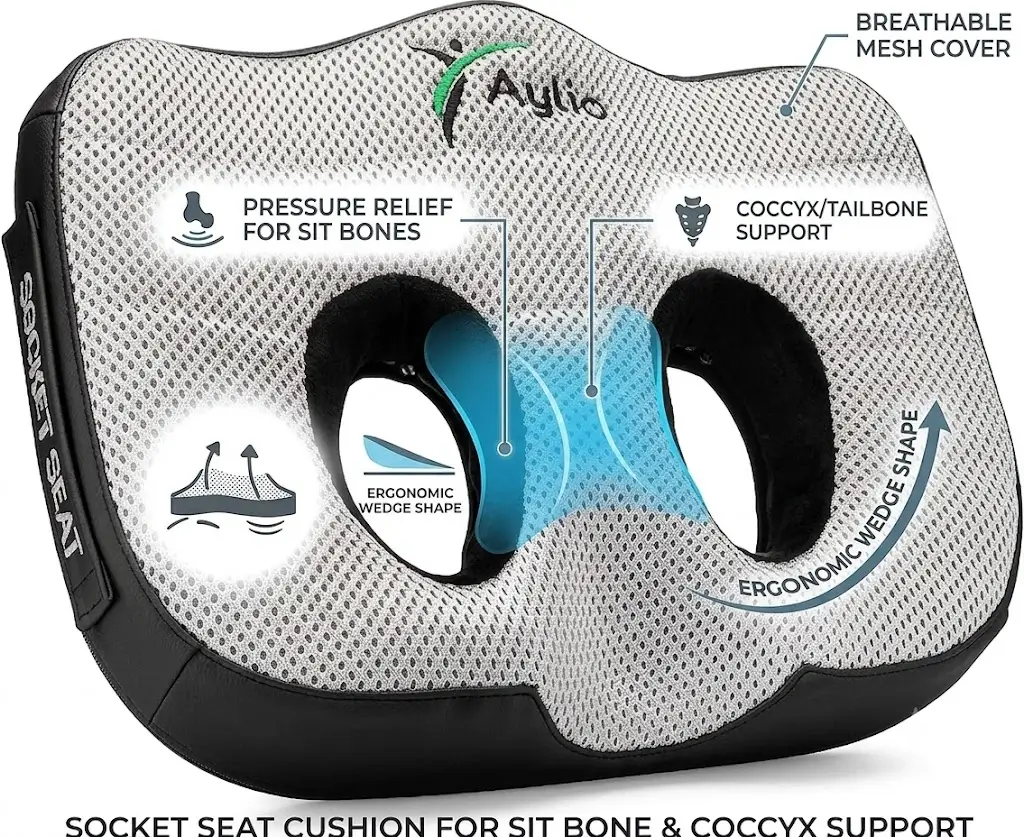
Aylio Socket Seat Sit-Bone (Ischial) Relief Dual recessed ischial sockets Firmer feel; requires wider chair seat pan $$$$
ComfiLife Gel Initial Cooling Touch Gel top layer + 3D mesh cover Gel layer gradually approaches body temperature $$
WAOAW Ergonomic Low-Cost Basic Padding Basic U-cutout memory foam Thinner base; faster compression under heavy loads $
Everlasting Portable Portability Compact footprint with strap Less surface coverage on large desk chairs $$

Why Cushion Lab ranks #1 overall: When comparing the best memory foam chair cushions overall, Cushion Lab takes top honors because its contoured geometry is designed for broad pressure distribution across the thighs and pelvis rather than targeting only one localized pressure point. For long desk sessions, that makes it the most versatile design in this group—provided your chair can accommodate the added height. However, buyers with localized coccyx pressure may get better direct value from the #2 ComfiLife Premium.

Quick Decision Shortcut

  • Tailbone pressure / Coccyx soreness: Consider ComfiLife Premium (#2) for its dedicated rear cutout.
  • General multi-hour desk work: Consider Cushion Lab (#1) for broad pelvic contouring.
  • Surface heat concerns: Consider ComfiLife Gel Enhanced (#5) for an initially cooler touch.
  • Structured sit-bone (ischial) pressure: Consider Aylio Socket Seat (#4) for recessed sockets.
  • Low-cost basic padding: Consider WAOAW Ergonomic (#6).
  • Frequent commuters / Travel: Consider Everlasting Portable (#7).

Qualitative Editorial Scorecard & Ranking Logic

Our comparative evaluation of the best memory foam chair cushions prioritizes versatility for the article’s primary audience—long-duration desk workers—rather than treating every category as equally weighted.

Cushion Model Pressure Relief Chair Fit Heat Management Base Stability Why It Ranks Here
Cushion Lab (#1) Excellent Good Moderate Excellent Broadest pelvic contouring for 8+ hour desk sitters with height-adjustable chairs.
ComfiLife Premium (#2) Excellent Good Moderate Good Targeted coccyx isolation design; slightly less versatile for general sitters than #1.
Everlasting Comfort (#3) Good Excellent Good Good Balanced everyday utility and competitive price point; lower custom contour depth.
Aylio Socket Seat (#4) Excellent Fair Good Excellent Highly specialized dual-socket design for sit bones; higher price tier keeps it behind #3.
ComfiLife Gel (#5) Good Good Good (Initial) Good Hybrid gel surface for initial thermal feel; passive gel eventually warms to body temp.
WAOAW Ergonomic (#6) Fair Good Good Fair Accessible budget option for light/occasional desk sitting.
Everlasting Portable (#7) Fair Excellent Good Good Top choice for transportability; reduced footprint provides less coverage on large office chairs.

*Rankings reflect editorial judgment across design analysis, published specifications, and buyer feedback patterns rather than mathematically normalized laboratory scores.

Memory Foam Chair Cushion Fit Check: How Much Height Can Your Chair Handle?

A 3-inch cushion does not necessarily raise your seated position by a full 3 inches because the foam compresses under load. The actual height increase varies with foam construction, user weight, and cushion geometry. Listed thickness describes uncompressed dimensions, whereas actual sitting height depends on foam compression under load.

4-Step Sitting Height Check

  1. Calculate Expected Position: New Sitting Height ≈ Current Seat Height + Actual Compressed Cushion Height. Because compression varies significantly by foam construction and user load, test the cushion at your normal sitting position rather than assuming a fixed height offset.
  2. Measure Current Seat Range: Check whether your chair can be lowered enough after installing the cushion to maintain stable foot contact and comfortable desk height.
  3. Verify Foot Contact: Ideally, your feet should have stable support from the floor or a properly positioned footrest, with thighs supported comfortably without excess pressure behind the knees.
  4. Check Lumbar Alignment & Desk Clearance: Confirm your knees clear the desk underside and check whether your chair’s backrest and lumbar support still contact your lower back comfortably after the cushion raises your seated position.

5 Things to Measure Before Buying a Chair Cushion

A cushion that is too deep can push you forward, while a cushion that is too narrow can leave parts of the thighs unsupported. Don’t judge fit from cushion dimensions alone; compare them with the usable seating area of your chair.

Chair Compatibility Checklist

  • 1. Usable Seat Width: Measure between chair armrest posts to ensure the cushion fits flat without curling at the edges.
  • 2. Usable Seat Depth: Measure from the backrest to the front seat edge. Ensure the cushion doesn’t overhang awkwardly.
  • 3. Minimum Seat Height: Measure from the floor to the top of the chair’s seat surface at its lowest setting, then repeat with the cushion installed.
  • 4. Desk Underside Clearance: Measure clearance between your thighs and the bottom edge of your desk or keyboard tray.
  • 5. Lumbar Support Vertical Range: Check whether your chair’s lumbar support height can be adjusted upward to match your elevated spine curve.

Detailed Reviews: The Best Memory Foam Chair Cushions for 2026

1. Cushion Lab Pressure Relief Seat Cushion
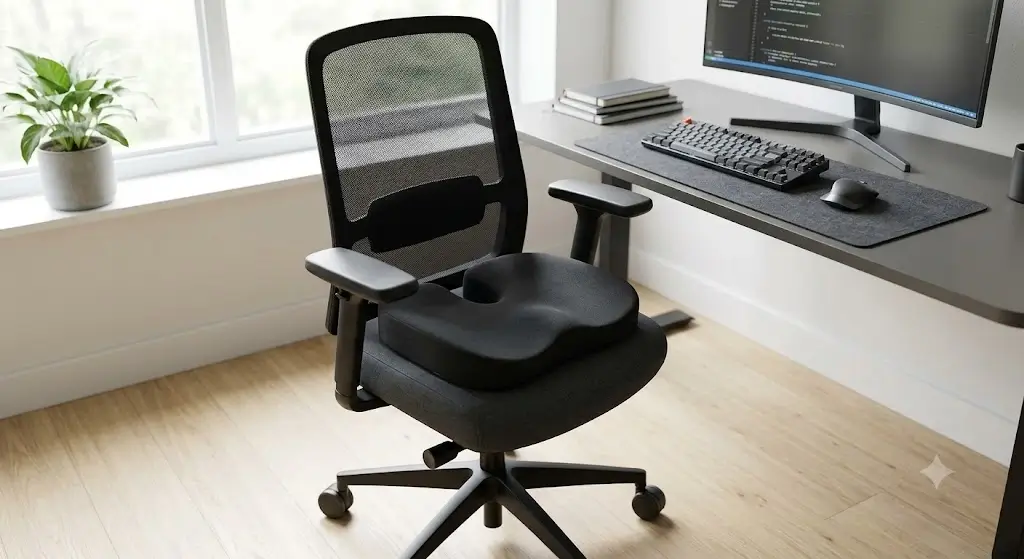
Cushion Lab Pressure Relief Seat Cushion placed on an office desk chair

Best for: Contoured seating geometry for extended desk work (requires adjustable chair height).

Why we picked it: As a versatile option among the best memory foam chair cushions for general desk sitting, Cushion Lab features a contoured foam shape designed to support the pelvis and distribute contact across a broader sitting surface than a simple flat cushion.

The Good:

  • Contoured surface spreads contact area across thighs and pelvic base.
  • The structured foam construction is intended to provide a more stable sitting surface than a very soft, highly compressible cushion.
  • Non-slip base is intended to reduce movement on smooth and fabric chair surfaces.
  • Recycled velvet cover is soft, removable, and machine washable.

The Bad:

  • The manufacturer lists ~3.5″ maximum height at its highest uncompressed point, elevating sitting position notably.
  • Defined leg channels may feel restrictive for users who shift sitting positions frequently.
  • Higher price point than simple flat foam cushions.

Who Should Buy It: Desk workers seeking a structured, contoured cushion that distributes surface pressure evenly while sitting in standard office chairs with fully adjustable gas lifts.

Who Should Avoid It: Users with limited chair-height adjustment, low desk clearance, or those who prefer a flat cushion that allows unrestricted leg movement.

Why It Ranks #1 Above ComfiLife Premium: Cushion Lab offers broader, full-pelvic contouring that benefits general desk sitters. While ComfiLife is specifically tailored for tailbone clearance, Cushion Lab provides a more comprehensive posture surface for general office work.

Better Alternative: If your primary issue is sharp, direct pressure at the tip of your tailbone rather than general sitting fatigue, consider a cushion with a dedicated rear U-cutout like the ComfiLife Premium instead.

The Verdict: Our take: This is the strongest general-purpose option if your chair cylinder has enough vertical adjustment to accommodate its profile height.

Confirm your chair height adjustment range and desk clearance before ordering.


2. ComfiLife Premium Comfort Seat Cushion
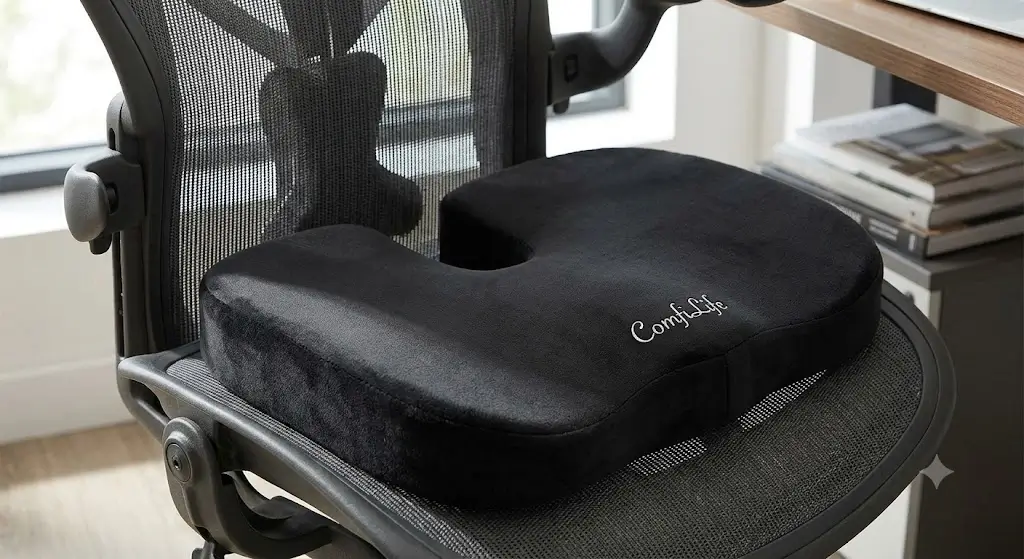
ComfiLife Premium Comfort Seat Cushion with rear coccyx cutout

Best for: Localized tailbone (coccyx) pressure reduction.

Why we picked it: It stands out among the best memory foam chair cushions for targeted coccyx relief due to its dedicated rear U-shaped cutout, making it a strong option for buyers who specifically want tailbone clearance while sitting back in their chair.

The Good:

  • Rear U-cutout reduces direct contact and pressure around the coccyx.
  • Built-in side handle makes transport between home and office convenient.
  • Plush velour cover is easily removable for machine washing.

The Bad:

  • Long-term compression performance under heavy body weight is difficult to verify because the manufacturer does not publish foam density data.
  • Velour fabric cover may feel warmer than a more breathable mesh cover in unconditioned rooms.
  • Thinner perimeter profile than heavy-duty structural options.

Who Should Buy It: Anyone experiencing discomfort focused specifically at the tailbone who needs a dedicated rear cutout shape.

Who Should Avoid It: Users who need a cushion with a clearly documented higher weight capacity or stronger structural base under heavy loads.

Why It Ranks #2 Above Everlasting Comfort: ComfiLife ranks second because its coccyx cutout geometry offers clear isolation around the spine base for tailbone-focused buyers.

Better Alternative: For users who need documented structural support for heavier weight or sit-bone isolation, consider the Aylio Socket Seat instead.

The Verdict: A strong option for buyers who specifically want a rear coccyx cutout, provided the cushion dimensions and seat height work with their chair.

If direct tailbone pressure is your main complaint while sitting, confirm your seat dimensions before buying.


3. Everlasting Comfort Memory Foam Seat Cushion
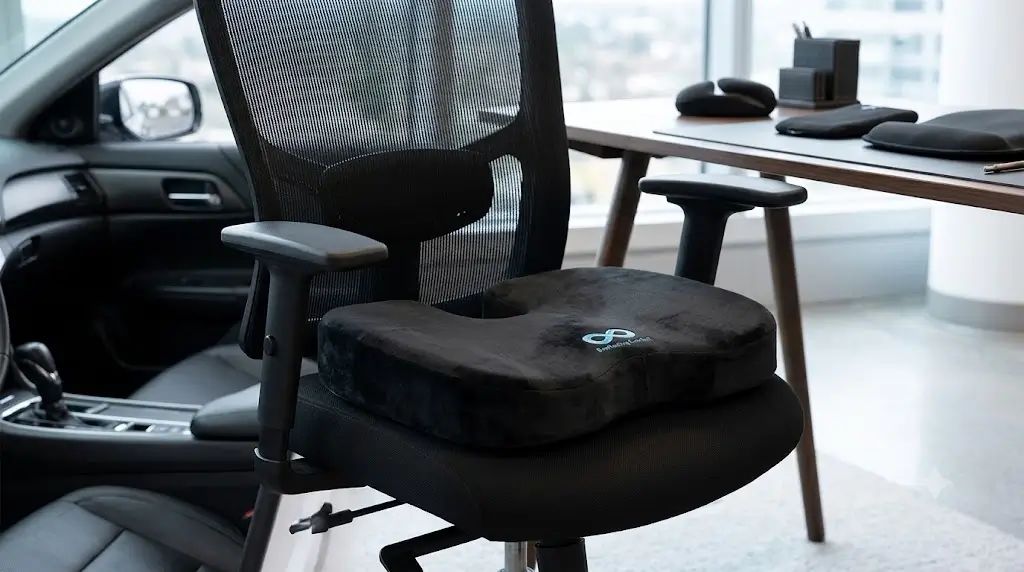
Everlasting Comfort Memory Foam Seat Cushion with mesh cover

Best for: Versatile daily desk sitting and general pelvic cushioning.

Why we picked it: A dependable middle-of-the-road choice among the best memory foam chair cushions for standard office chairs, combining a supportive perimeter contour with a breathable mesh cover and non-slip rubberized base.

The Good:

  • The foam is designed to contour under body heat and pressure during prolonged sitting.
  • Textured non-slip base helps reduce shifting on smooth chair materials.
  • Listed 3-inch thickness provides a balanced cushioning layer.

The Bad:

  • Foam can feel firm during initial minutes in cool rooms before body heat softens the material.
  • Exact foam density specifications are not publicly disclosed.
  • Mesh cover fabric feels textured if sitting in short clothing.

Who Should Buy It: Desk workers seeking a versatile, general-purpose seat cushion for home or office chairs at a competitive price point.

Who Should Avoid It: Buyers looking for an ultra-soft feel or those who dislike textured mesh covers.

Why It Ranks #3 Above Aylio Socket Seat: Everlasting Comfort offers broader general utility and lower cost for standard desk workers, whereas Aylio is a specialized, higher-priced niche design.

Better Alternative: If surface heat is a primary complaint during summer, consider the Gel-Enhanced ComfiLife instead.

The Verdict: A dependable middle-of-the-road choice that delivers practical memory foam support.

If you want a versatile memory foam cushion with a breathable mesh cover, check current availability.


4. Aylio Socket Seat

Aylio Socket Seat

Best for: Sit-bone (ischial tuberosity) pressure relief and buyers who prefer a firmer, structured cushion.

Why we picked it: Recognized as one of the best memory foam chair cushions for sit-bone unloading, it uses dual recessed ischial sockets designed to reduce direct contact on the sit bones while supporting surrounding thigh structures on firm foam.

The Good:

  • Dual recessed sockets reduce pressure directly beneath the sit bones.
  • Its firmer construction may feel more resistant to bottoming out than softer cushions, although actual performance will vary with user weight and foam compression characteristics.
  • Wider physical footprint supports broader seating positions.

The Bad:

  • Higher price point than standard single-cutout memory foam cushions.
  • Firmer base feel may feel rigid to buyers wanting plush padding.
  • Wider physical dimensions require a spacious chair seat pan.

Who Should Buy It: Individuals experiencing focal pressure under the sit bones or buyers seeking a firmer, structured seating surface.

Who Should Avoid It: Petite users with small office chairs, or buyers looking for plush, sink-in memory foam.

Why It Ranks #4 Above ComfiLife Gel: Its specialized socket design provides unique structural support for sit-bone pressure, though its higher cost places it behind broader picks.

Better Alternative: For general desk comfort on a lower budget, standard options like Cushion Lab (#1) or ComfiLife (#2) are more cost-effective.

The Verdict: A specialized, structurally supportive option built specifically for sit-bone unloading.

If standard cushions flatten too quickly under your weight, measure your seat pan width before buying.


5. ComfiLife Gel Enhanced Seat Cushion ComfiLife Gel Enhanced Seat Cushion featuring gel top layer
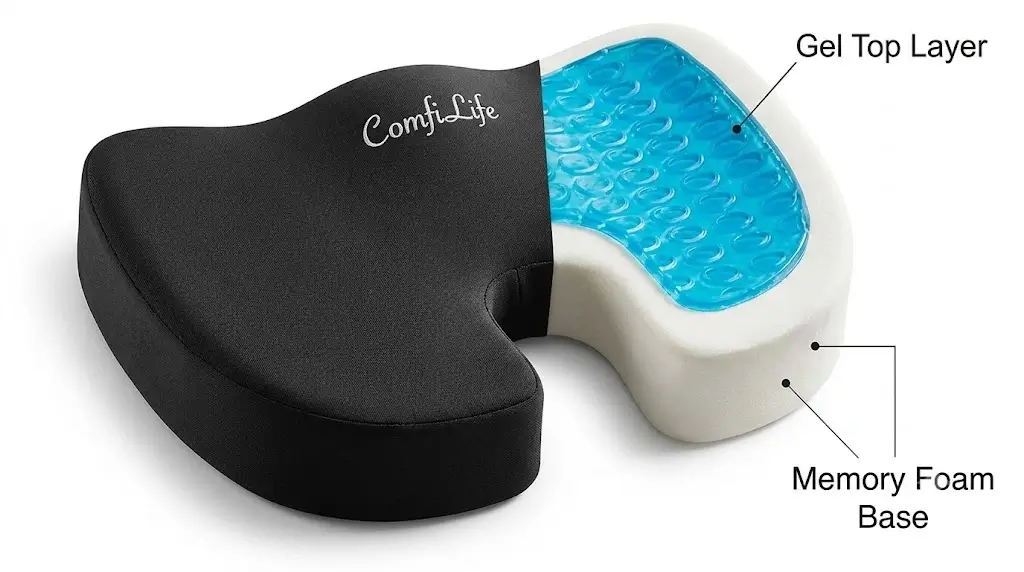
Best for: Buyers seeking an initially cool surface touch combined with memory foam support.

Why we picked it: If heat retention is a concern, this model stands out among memory foam chair cushions by combining a top gel layer over contoured memory foam, encased in a 3D breathable mesh cover.

The Good:

  • A gel layer may feel cooler initially because it can draw heat away from the skin more quickly than some foam surfaces.
  • Breathable 3D mesh fabric allows better air exchange than velour covers.
  • Includes rear U-cutout for coccyx clearance.

The Bad:

  • Passive gel does not provide continuous cooling and will gradually approach body temperature during prolonged contact.
  • Gel layer adds slight extra physical weight to the cushion.
  • Foam density rating is not officially published by the manufacturer.

Who Should Buy It: Desk workers in warm offices who dislike the immediate warmth of plush velour covers.

Who Should Avoid It: Users expecting active, powered refrigeration or all-day low temperatures.

Why It Ranks #5 Above WAOAW Ergonomic: It provides better cover breathability and higher overall material refinement than entry-level budget cushions.

Better Alternative: If surface temperature is not a primary concern, the standard ComfiLife Premium offers similar ergonomic support without the gel insert.

The Verdict: A practical hybrid choice for sitters wanting initial surface heat dissipation alongside tailbone clearance.

If you tend to get warm when first sitting down at your desk, check current availability.


6. WAOAW Ergonomic Memory Foam Seat Cushion
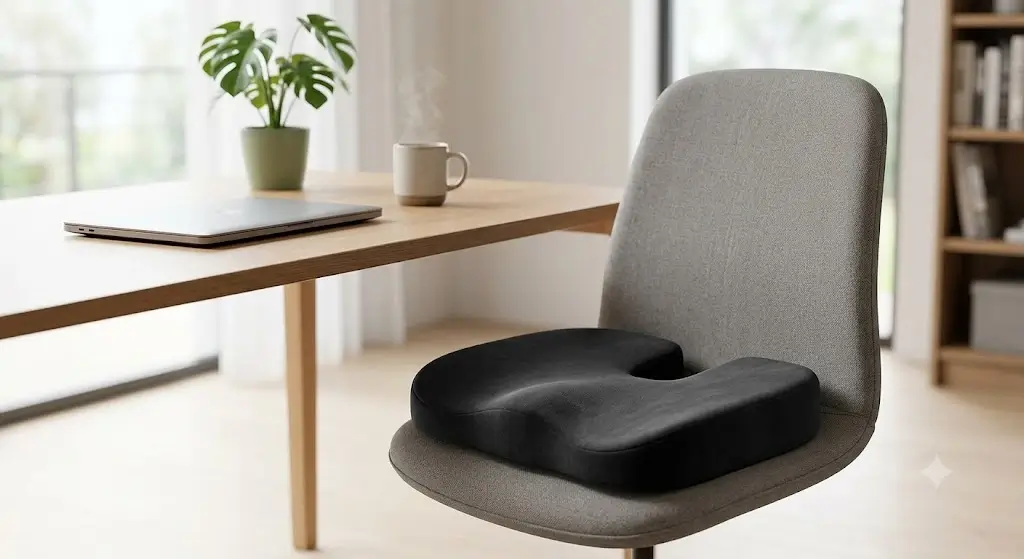
WAOAU Ergonomic Memory Foam Seat Cushion

Best for: Inexpensive entry-level chair padding for light to moderate daily sitting.

Why we picked it: An accessible option for buyers seeking the best memory foam chair cushions on a budget, offering a contoured U-shaped design, basic memory foam support, and a breathable cover without a premium price tag.

The Good:

  • Highly accessible price point for budget-minded desk workers.
  • Breathable, removable mesh cover helps reduce heat buildup.
  • U-shaped cutout effectively elevates the tailbone off hard seating surfaces.

The Bad:

  • Thinner profile compresses more significantly under heavier weight.
  • Foam density and rebound speed are less robust over multi-year daily use.
  • Non-slip rubber bottom requires occasional readjustment on smooth leather seats.

Who Should Buy It: Part-time desk users, students, or home office workers seeking affordable padding for basic chairs.

Who Should Avoid It: Full-time 8+ hour sitters, heavy users, or those requiring high-density posture support.

Why It Ranks #6 Above Everlasting Portable: WAOAW offers a standard full-sized footprint tailored for desk chairs, whereas the Portable model uses a smaller, scaled-down design meant for transit.

Better Alternative: If you sit for more than 6–8 hours daily, upgrading to ComfiLife Premium or Cushion Lab provides superior long-term density and pelvic support.

The Verdict: An affordable, functional entry-level solution for softening hard desk chairs on a budget.


7. Everlasting Comfort Portable Seat Cushion
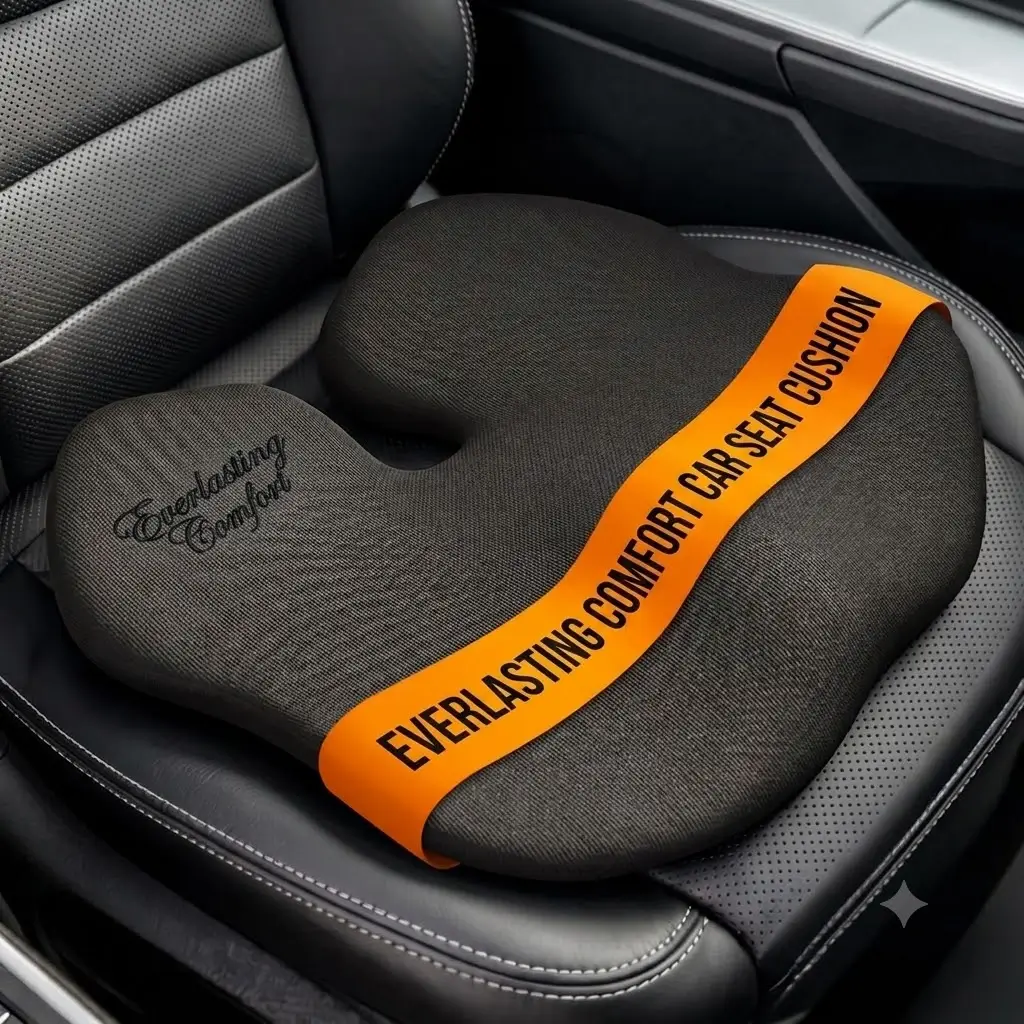
Everlasting Comfort Portable Seat Cushion

Best for: Commuters and hybrid workers moving between offices, cars, and travel seats.

Why we picked it: For hybrid commuters, it offers the compact versatility needed in portable memory foam chair cushions, featuring an integrated carrying strap and durable cover fabric for easy transport between locations.

The Good:

  • Its compact construction is better suited to frequent transport than larger full-size cushions.
  • Integrated handle facilitates easy daily transit between home and office.
  • Durable outer fabric cover.

The Bad:

  • Smaller footprint provides less thigh coverage on large office chair seats.
  • Thinner foam height provides less compression depth.
  • Minimal tailbone cutout depth compared to full-size models.

Who Should Buy It: Hybrid office workers and frequent commuters who prioritize portable cushion transport.

Who Should Avoid It: Users needing maximum full-seat coverage for a dedicated 8-hour office chair setup.

Why It Ranks #7: While highly mobile, its reduced dimensions make it less suitable as a primary full-coverage office cushion than the larger models above.

Better Alternative: For a stationary office desk setup, full-sized cushions like Cushion Lab (#1) or ComfiLife (#2) offer broader seat coverage.

The Verdict: Its compact design and carrying handle make it easier to move between locations.

If you need a cushion that easily travels between your home, car, and office, check current availability.

Are Memory Foam Chair Cushions Right for Your Desk Setup?

Choosing the right seating material depends on whether you prioritize slow-rebound contouring, initial thermal response, springiness, or high weight resistance.

Material Type Main Strength Main Weakness Best For
Memory Foam Slow-rebound custom contouring & pressure distribution Can retain body heat in unventilated designs General pressure distribution
Gel + Memory Foam Initial cooler surface feel upon sitting down Passive gel eventually warms to body temperature Warm offices & initial thermal comfort
Latex Foam Highly responsive, springy support & natural airflow Less body-conforming contour depth Sitters wanting easy position shifting
High-Resilience (HR) Foam Structural firmness & high weight resistance Less surface pressure conforming Heavy loads & firm posture support

What Most Chair Cushion Reviews Get Wrong

  • 1. Listed Thickness ≠ Actual Sitting Height: Manufacturer thickness measures uncompressed foam. A 3-inch cushion does not necessarily raise your seated position by a full 3 inches because the foam compresses under load.
  • 2. Foam Density ≠ Direct Durability: Foam density measures the mass of foam per unit volume; it is not a direct durability rating. Higher-density foam often has better resistance to premature compression than lower-density foam, but actual durability also depends on foam formulation, construction, load, and usage. Density should therefore be treated as one durability indicator rather than a standalone prediction of lifespan.
  • 3. Gel ≠ Continuous Active Cooling: A gel layer may feel cooler initially because it can draw heat away from the skin more quickly than some foam surfaces. However, passive gel does not provide continuous cooling and will gradually approach body temperature.
  • 4. Coccyx Cutouts Aren’t Universally Better: Cutouts isolate tailbone pressure, but for sitters with general muscle fatigue, full-pelvic contoured surfaces often provide better weight distribution.
  • 5. A Seat Cushion Cannot Fix Excessive Seat Depth: If your chair seat pan is too deep (pressing the back of your knees), a seat cushion will not resolve leg clearance issues.

Who Should Skip a Memory Foam Chair Cushion?

  • Skip if your chair is already too high: If your gas cylinder is at its lowest and your feet barely touch the floor, adding even the best memory foam chair cushion will lift your feet off the ground.
  • Skip if your desk is fixed and low: If your thighs barely clear the underside of your desk, adding 2–3 inches of cushion height will cause your knees to bump the desk.
  • Skip if your chair seat is already soft: Placing a cushion on an already soft or sagging seat can create a less stable sitting surface and may make it harder to maintain a consistent sitting position.
  • Skip if you need active cooling: Traditional dense memory foam can retain body heat better than highly ventilated foam or mesh. Consider open-cell ventilated foam or breathable mesh chair seats instead.
  • Skip if you require rigid seating geometry: If you need a firmer seating surface that changes your sitting geometry, a structured wedge or firmer high-resilience foam may be more appropriate.

Understanding Sitting Posture & Pain Patterns

Tailbone Discomfort During Sitting

Tailbone discomfort during sitting can have several causes, including direct pressure, prolonged static sitting, posture slumping, or an underlying medical condition. A cushion featuring a rear cutout is designed to reduce direct contact and pressure around the coccyx for some individuals, but it does not address every root cause of coccyx pain. If sitting pain persists, consult our guide on tailbone seat cushions and posture adjustments.

Sciatica Symptoms & Seating Stability

Prolonged sitting can aggravate symptoms for some people with sciatica, although the underlying mechanism varies by individual and medical diagnosis. Some users may find a medium-firm cushion more stable than a very soft cushion, particularly if they dislike sinking into the seat. However, the ideal firmness varies by body shape, weight, and sitting preference.

Lower Back Geometry & Lumbar Support Interplay

Raising your sitting height changes your position relative to the chair’s lumbar support. Depending on the chair’s backrest geometry and your body proportions, the lumbar support may no longer align with your lower-back curve as intended. Always re-adjust your chair’s lumbar support height after adding a seat cushion. For full workstation upgrades, see our review of office chairs for lower back support.

Hip Width vs. Cushion Surface Area

A cushion that is too narrow or poorly shaped may feel restrictive and uncomfortable, particularly for users with wider hips or thighs. Look for adequate width and subtle leg contours rather than restrictive side bolsters. Learn more about managing hip discomfort while sitting at work.

The Vital Role of Movement Breaks

No cushion turns prolonged static sitting into a risk-free activity. Even the best memory foam chair cushions should be paired with regular position changes and movement breaks. Explore our practical desk worker movement break protocol to keep your spine mobile.

Technical Specifications: What Actually Matters

Foam Density vs. Firmness

Foam density measures the mass of foam per unit volume; it is not a direct durability rating. Higher-density foam often has better resistance to premature compression than lower-density foam, but actual durability also depends on foam formulation, construction, load, and usage. Firmness (how soft or stiff the cushion feels initially) is independent of foam density.

Cushion Thickness Considerations

There is no universal ideal cushion thickness. Thicker cushions can provide more cushioning depth but also raise your sitting height. Therefore, chair height range, desk clearance, and proper foot support matter just as much as foam thickness when evaluating the best memory foam chair cushion options.

Foam Lifespan & Resilience

Higher-quality foam generally resists premature loss of resilience better than lower-quality foam, but actual lifespan depends on foam construction, user weight, daily sitting time, and usage conditions. Higher-density foam may be more resistant to permanent compression, but all foam eventually loses resilience with repeated use.

When a Cushion Won’t Fix Your Sitting Problem

A seat cushion can improve surface padding, but it cannot resolve fundamental workstation flaws or health issues:

  • Broken Chair Cylinder or Wobbling Frame: A cushion cannot stabilize a structurally broken chair.
  • Incorrect Desk Height: If your desk is too high, adding a cushion without adjusting monitor/keyboard height can increase shoulder strain.
  • Unadjusted Seat Depth: If the front edge of your chair presses into the back of your knees, a cushion won’t shorten seat depth.
  • Persistent Medical Symptoms: Persistent pain, numbness, tingling, or symptoms that worsen over time warrant professional medical evaluation rather than product fixes alone.

Workstation Ergonomics Knowledge Hub

Explore our related ergonomic research guides for complete desk setup optimization:

Frequently Asked Questions

Are memory foam chair cushions good for long hours of sitting?

Memory foam cushions can help redistribute sitting pressure during extended desk sessions. However, overall sitting comfort also depends on chair height adjustment, seat pan depth, desk clearance, and regular movement breaks.

Is memory foam better than gel for an office chair?

Memory foam primarily contributes to contouring and surface pressure distribution, while gel layers can alter the initial thermal feel and absorb initial surface heat. Neither material is universally superior.

What thickness of memory foam chair cushion is best?

There is no single ideal thickness. Thicker cushions (3+ inches) offer more cushioning depth but raise sitting height substantially. Choose thickness based on whether your chair height can be lowered sufficiently.

Is a firm or soft memory foam cushion better?

A medium-firm cushion may feel more stable than a very soft cushion for some users, but ideal firmness depends on body weight, shape, and personal sitting preference.

Can a memory foam cushion help tailbone discomfort?

Cushions featuring a dedicated rear U-shaped cutout are designed to reduce direct contact and pressure around the coccyx, which may improve comfort for some users.

Can memory foam chair cushions help sciatica?

A supportive cushion may improve sitting stability and reduce focal surface pressure, but it does not treat underlying nerve irritation or spinal conditions.

Does memory foam get hot?

Traditional dense memory foam can retain body heat better than highly ventilated foam or mesh. Look for breathable covers, ventilation channels, or gel-infused surface layers if heat buildup is a primary concern.

How long do the best memory foam chair cushions last?

Actual lifespan depends on foam construction, user weight, daily sitting hours, and care. Higher-quality foam generally resists premature resilience loss better than lower-cost alternatives.

Final Verdict: Which Cushion Should You Buy?

Ready to improve your daily desk setup? Start by matching your primary comfort priority to the right cushion design.

Leave a Reply

Your email address will not be published. Required fields are marked *