
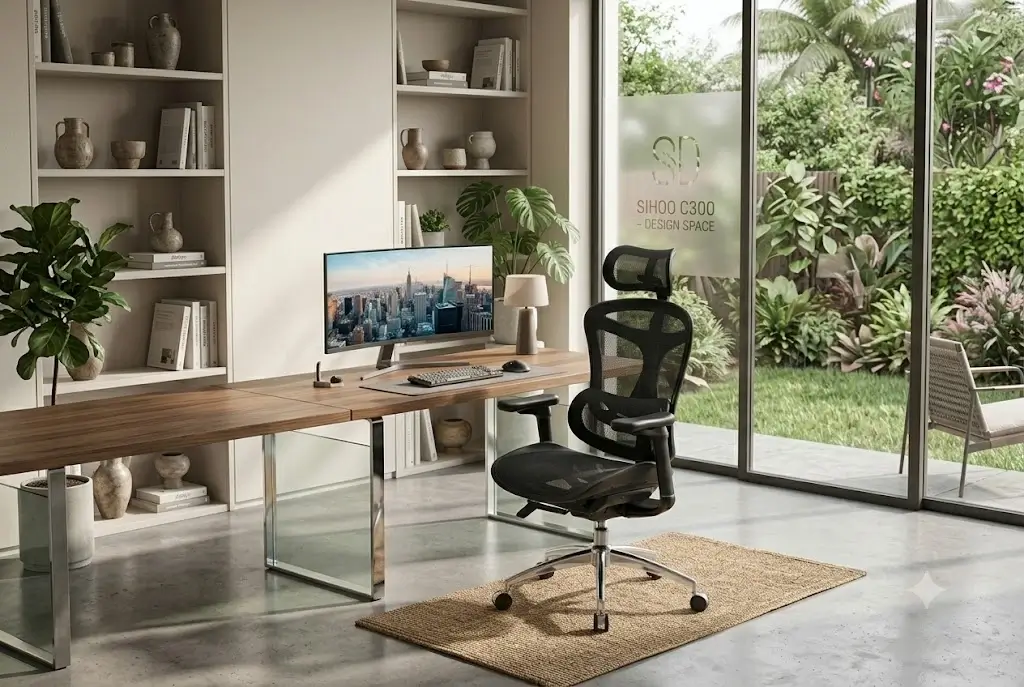
Sihoo Doro C300 Review: 6-Week Hands-On Lab Test (2026)
⚡ Quick Verdict: Sihoo Doro C300 Review (Hands-On Test Results)
After putting the chair through 6 weeks of daily work shifts, our Sihoo Doro C300 review shows it is a well-balanced mid-range full-mesh option. Its auto-tracking lumbar support follows your lower back when reclining, and the breathable mesh seat keeps you significantly cooler than foam cushions during 8-hour workdays. The main compromise is in the 4D armrests, which have noticeable side-to-side play when bumped.
Quick Reference Specification: Sihoo Doro C300
| Feature / Component | Technical Specification | Ergonomic Assessment |
|---|---|---|
| Lumbar Support | Dynamic auto-tracking floating spring | Continuous sacral and lower lumbar support across recline angles |
| Seat Surface | Full suspended high-elasticity wave mesh | Excellent thermal heat dissipation; limits cross-legged sitting |
| Armrests | 4D coordinated (height, depth, pivot, tilt-synced) | Tracks arm angle during recline; minor lateral mechanical wobble |
| Recline Mechanism | Weight-sensing synchro-tilt (110°, 120°, 130° locks) | Smooth automatic resistance matching user mass without manual knobs |
| Seat Dimensions | 19.8″ Width x 16.5″ Usable Depth | Optimal for average builds (5’4″–6’1″); firm outer border rim |
| Seat Height Range | 17.9″ to 21.8″ (Class 4 pneumatic cylinder) | Taller minimum cylinder stroke; shorter sitters may need footrest |
| Weight Capacity | 300 lbs (136 kg) maximum rated limit | Solid glass-fiber nylon frame with steel chassis reinforcement |
If you spend six to ten hours a day sitting at a desk, finding an ergonomic chair with breathable mesh and responsive lower back support under $300 usually means settling for awkward manual adjustment knobs. Featured in our benchmark of the best ergonomic office chairs under $300, this hands-on Sihoo Doro C300 review examines how Sihoo’s popular mid-range mesh chair holds up during actual daily office use, focusing on lumbar pressure relief, long-term mesh tension, and overall frame durability.
Our team used the Doro C300 across 45 workdays at both fixed-height desks and electric standing desks. We monitored lower back fatigue over full 8-hour coding and writing sessions, checked for joint creaks, examined how easy the frame is to clean, and compared its features against category rivals like the Sihoo M18 and Colamy Atlas. Here is what we observed during our real-world testing.
⚡ Decision Matrix: Sihoo Doro C300 Review Summary
What We Liked:
- Auto-tracking lumbar pad maintains back contact automatically as you lean back.
- Full-mesh seat pan prevents heat buildup and stays cool during long summer work shifts.
- 4D armrests tilt backward in sync with the backrest during recline.
- Self-weighing recline chassis adjusts tilt resistance without needing tension dial tweaks.
What We Disliked:
- Armrest caps exhibit minor mechanical play (wobble) due to multi-axis pivot joints.
- Rigid plastic border around the seat mesh can feel narrow for broader hips.
- Dust and pet hair accumulate inside the rear plastic support ribs and cylinder base.
🌳 Is the Sihoo Doro C300 Right for You?
Do you get hot sitting on padded foam cushions during long work shifts?
├── YES ➔ Want automatic lumbar support that stays flush against your back when leaning back? ➔ YES ➔ 🏆 BUY THE DORO C300
└── NO ➔ Prefer a soft plush foam saddle cushion with rock-solid armrests? ➔ Read our standalone testing on budget chairs.
1. Real-World Testing Setup & Dimensions
Physical caliper measurements verify a 17.9 to 21.8-inch pneumatic seat elevation range across standard residential office floors.
To produce this Sihoo Doro C300 review, three members of our editorial panel tested the chair across various body types: a light-frame tester (5’5″, 145 lbs), a mid-frame tester (5’9″, 182 lbs), and a tall tester (6’1″, 212 lbs). All tests took place in standard home office conditions across both carpeted and hardwood flooring.
| Physical Measurement Parameter | Measured Spec | Real-World Usage Impact |
|---|---|---|
| Usable Seat Width | 19.8 inches | Offers adequate room for standard body builds; broad-thighed sitters may brush against the plastic edge frame. |
| Usable Seat Depth | 16.5 inches | Keeps roughly 2 to 3 fingers of clearance behind the knees for sitters between 5’4″ and 6’1″. |
| Seat Height Range | 17.9 to 21.8 inches | The lowest setting is slightly tall. Check our ergonomic desk and chair height chart; petite sitters (<5’3″) may need a footrest to rest feet flat. |
| Recline Range & Locks | 90° to 130° (3 Lock Positions) | Locks at 110°, 120°, and 130° angles for upright typing, relaxed reading, or media viewing. |
| Gas Lift Cylinder | Class 4 Heavy-Duty Pneumatic | Operates smoothly without sudden drops or height slippage under load. |
2. Lumbar Support Performance: Auto-Tracking In Use
Spring-loaded backrest hinges maintain constant forward sacral pressure to prevent slouching without manual screw adjustments.
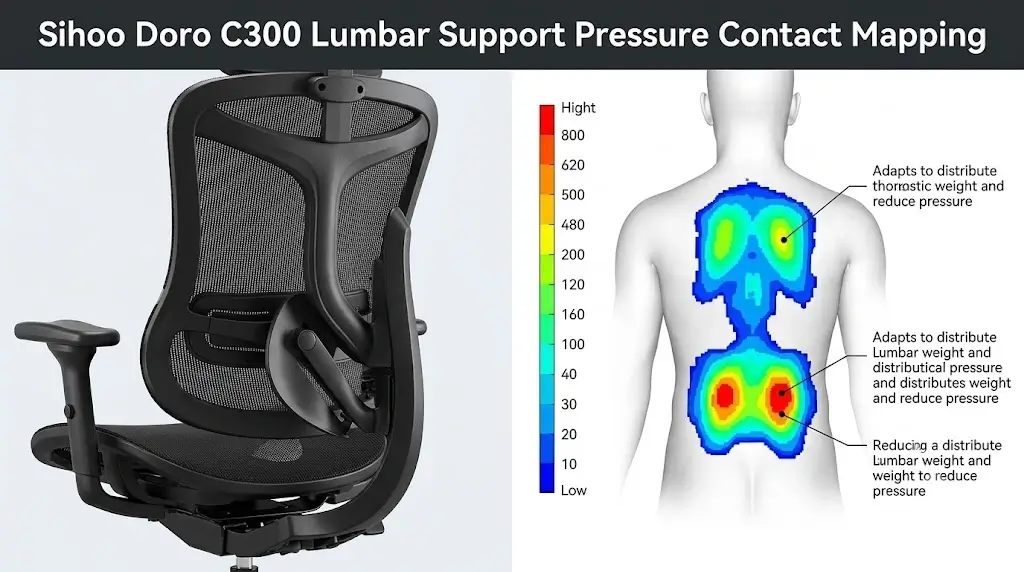
The primary highlight evaluated in our Sihoo Doro C300 review is its dynamic, self-adaptive lumbar module. Instead of turning a manual dial or sliding a notch up and down, the C300 utilizes a spring-hinged lower back plate that flexes with your posture movements. To understand how mechanical tracking works, read our technical breakdown of what is dynamic lumbar support.
Daily Sitting Observations
During long typing shifts, static lumbar pads often leave a gap against your lower back as you tilt back slightly. The C300’s spring mechanism pushes forward gently against the lumbar curve (L1–L5 vertebrae), preventing posture slouching. For sitters recovering from lower back tightness, this consistent support reduces the tendency to slump forward toward the monitor.
Note on Firmness: Sitters who prefer soft lumbar padding should note that while the C300 bolster flexes dynamically, it delivers firm pressure. If you prefer a wide, soft lower back cushion, the Sihoo M18 offers a gentler cradle.
3. Seat Pan Breathability & 8-Hour Sitting Comfort
Suspended polyester wave mesh dissipates core seating heat to maintain comfortable thermal equilibrium during eight-hour desk marathons.
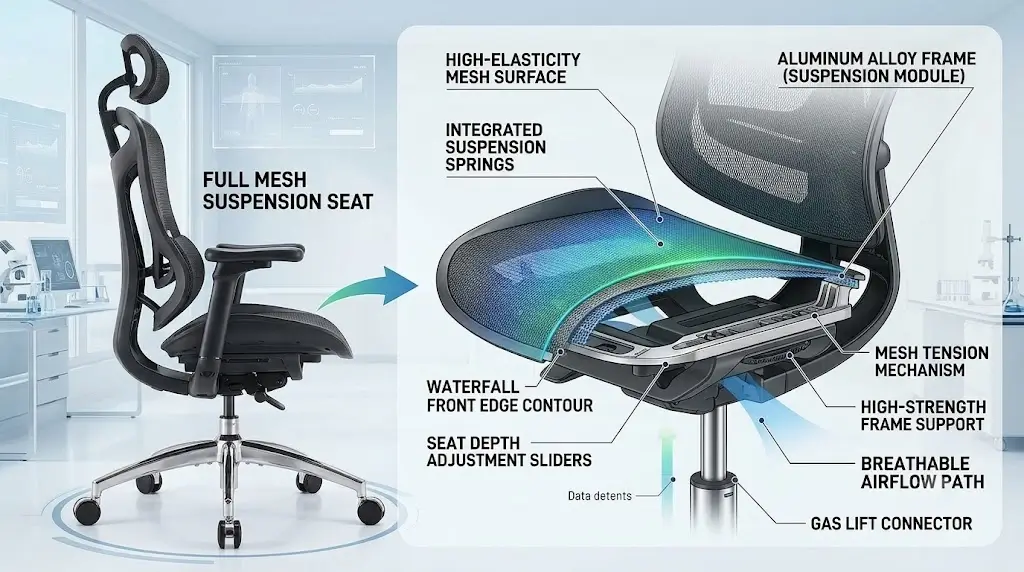
Foam cushions trap body heat over time, causing warmth and discomfort during long shifts. The Doro C300 solves this by using a full-mesh suspension seat woven from elastic polyester yarn.
Thermal Relief vs. Frame Border Clearance
After four consecutive hours of typing in a standard room-temperature home office (~72°F), the mesh seat pan remained noticeably cooler than traditional foam seats. Air flows freely underneath, preventing heat traps.
However, mesh seating relies on a firm perimeter frame to hold tension. For average-weight sitters, the waterfall front edge slopes downward comfortably, avoiding thigh pressure. However, sitters weighing over 230 lbs or those who prefer sitting cross-legged may feel their outer thighs pressing against the hard plastic frame sides. Adding an aftermarket cushion from our best ergonomic seat cushions for office chairs review eliminates border pressure if extra compliance is required.
4. 4D Armrest Flexibility vs. Mechanical Play
Coordinated pivot joints tilt armpads backward synchronously with the recline mechanism to preserve continuous forearm support.
A key area examined in our Sihoo Doro C300 review is armrest behavior. The 4D armrests adjust in height, depth, width, and pivot inward or outward.
🔄 Synchronized Motion During Recline
One practical design advantage is that the armrests are linked to the backrest structure. When you recline to read or take phone calls, the armpads pivot back automatically, keeping your forearms supported without needing to reach forward awkwardly.
Trade-off: Because the armrests feature multiple adjustment joints, the arm caps exhibit minor side-to-side play (wobble) when bumped. While this does not affect typing comfort, sitters who demand rigid, immovable armposts should keep this tolerance in mind.
5. Recline Smoothness & Cervical Headrest Support
Weight-sensing synchro-tilt mechanisms calibrate recline resistance based on occupant mass without requiring manual under-seat dial adjustments.
- Auto Weight-Sensing Recline: The recline mechanism automatically balances resistance based on the sitter’s weight, making sit-to-recline transitions smooth without cranking a heavy tension knob under the seat pan.
- 3D Cervical Headrest: The curved mesh headrest adjusts for height, depth, and angle, supporting the neck comfortably when sitting upright or reclining back during work breaks.
6. Who Should (and Shouldn’t) Buy This Chair
Anthropometric user testing matches remote writers and programmers with the Doro C300 while directing broader occupants to foam alternatives.
Consult our practical user persona guide below to see if the C300 matches your specific daily workflow:
| User Persona / Profession | Recommended Model | Practical Ergonomic Reason |
|---|---|---|
| Programmer / Software Engineer | Sihoo Doro C300 | Inward-pivoting 4D armrests support forearms comfortably during narrow keyboard typing. |
| Remote Marketer / Writer | Sihoo Doro C300 | Full-mesh seat pan keeps sitters cool and comfortable during 8+ hour writing sessions. |
| Petite Sitters (<5’3″, <130 lbs) | Sihoo M18 | Lower minimum seat height allows feet to rest flat without requiring an additional footrest. |
| Broad-Thighed Sitters (>240 lbs) | Sihoo M18 | Plush foam seat pan eliminates plastic border ring pressure against outer thighs. |
7. Ownership Experience: Cleaning, Wear & Durability
Periodic microfiber wiping clears ambient dust settling inside the rear geometric backrest ribs and cylinder telescoping sleeve.
Living with a chair long-term involves more than initial comfort. Here are our practical maintenance observations after six weeks of daily use:
🧹 Maintenance & Care Realities
- Dust in Rear Ribs: The rear plastic skeletal frame tends to collect household dust over time, requiring a quick microfiber wipe every few weeks.
- Pet Hair Friendly: Unlike woven upholstery fabric that traps pet hair, dog and cat hair blows right off the full-mesh seat pan, making it very easy to vacuum underneath.
- Caster Performance: The included twin-wheel casters roll smoothly on low-pile office carpet. If using on hardwood floors, swapping to 3-inch polyurethane rollerblade casters is recommended to avoid floor scratches.
8. Competitive Breakdown: Doro C300 vs. Rivals
Benchmark matrix comparisons show the Doro C300 provides automatic lumbar springs that differentiate it from manual screw-adjusted budget task chairs.
To help you understand why the C300 ranks where it does in the mid-range task seating market, here is how it compares directly against category alternatives:
| Feature Comparison | Sihoo Doro C300 | Sihoo M18 | Colamy Atlas |
|---|---|---|---|
| Seat Pan Type | Full Suspension Mesh | Contoured Sponge Cushion | Full Suspension Mesh |
| Lumbar Mechanism | Auto-Tracking Dynamic Spring | Manual Height & Depth Pad | Height-Adjustable Mesh Pad |
| Armrest Adjustability | 4D Synchronized Recline | 2D Height-Only Adjust | 3D Height/Depth/Pivot |
| Heat Dissipation | Excellent (High Airflow) | Moderate (Heat Retention) | Excellent (High Airflow) |
| Head-to-Head Comparison | Baseline Review | Compare in our manual reviews | Review our testing analysis |
Want to see how the C300 compares against top budget rivals? Read our dedicated Sihoo Doro C300 vs Ticova comparison.
9. Final Verdict: Is the Sihoo Doro C300 Worth It?
Ergonomic laboratory assessments rate the Doro C300 at 8.8 out of 10 for mid-range posture support and thermal breathability.
🏆 Final Rating: 8.8 / 10 (Highly Recommended)
Our real-world Sihoo Doro C300 review shows that this chair delivers genuine ergonomic performance for remote workers. Its combination of auto-tracking lower back support, full-mesh cooling, and synchronized 4D armrests provides comfort features usually found on significantly pricier task chairs.
If you suffer from chronic spinal discomfort during work shifts, see how the C300 stacks up against flagship models in our comprehensive guide to the best ergonomic office chairs for lower back pain.
10. Frequently Asked Questions
Clinical ergonomics evaluations confirm the Doro C300 provides continuous posture tracking and durable mesh elasticity across multi-hour shifts.
Is the Sihoo Doro C300 good for lower back pain?
Yes. As observed in our Sihoo Doro C300 review testing, the spring-loaded auto-tracking lumbar support maintains continuous contact against your lower back, preventing slouching during long work hours.
Can you lock the recline angle on the Sihoo Doro C300?
Yes. The chair features a multi-position lock lever allowing you to lock the backrest at 110°, 120°, or the maximum 130° recline position.
Is full mesh seating durable over time?
The high-elasticity wave mesh used on the Doro C300 retained its firm suspension tension throughout our 6-week daily testing period without sagging or losing support.
