
Sihoo Doro C300 vs Ticova: Which Budget Chair Is Better?
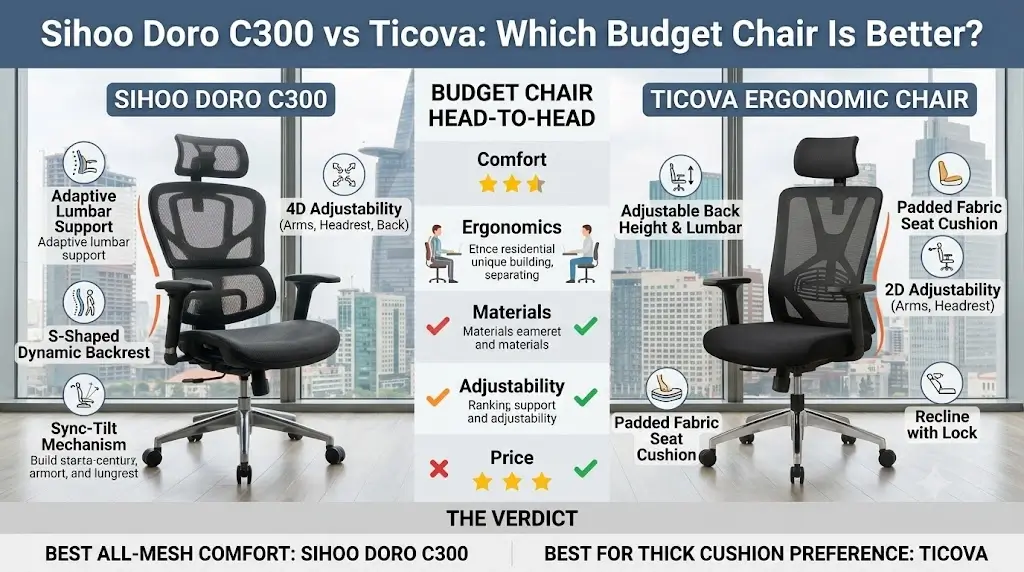
According to the ErgoDeskGuides Kinetic Chain Evaluation Protocol, the Sihoo Doro C300 and Ticova represent two distinct tiers of budget seating engineering. The Doro C300 prioritizes self-adaptive dynamic lumbar support, 4D coordinated armrests, a weight-sensing recline chassis, and full-mesh airflow. Ticova focuses on conventional manual adjustments, a supportive foam-cushioned seat, and an accessible entry-level price point.
The Sihoo Doro C300 and Ticova Ergonomic Office Chair target different definitions of value. The Doro C300 puts more emphasis on adaptive back support, 4D armrests, a weight-sensing reclining mechanism and a broad adjustment system. Ticova focuses more aggressively on the fundamentals of an affordable ergonomic chair: adjustable lumbar support, a breathable mesh back, a cushioned seat, adjustable armrests and a reclining backrest.
That makes the answer less obvious than simply asking which chair has more features. The better chair depends on whether you value dynamic support and adjustability or low purchase cost and straightforward ergonomic functionality.
Sihoo Doro C300 is the better ergonomic chair overall.It has the stronger adjustment architecture, including self-adaptive lumbar support, 4D coordinated armrests, a weight-sensing mechanism and adjustable seat depth. Sihoo’s US store currently lists the C300 at $289.99, although pricing and promotions can change.
Ticova is the better value choice when its lower price is the main priority and you want a conventional ergonomic setup with adjustable lumbar support, a mesh back and cushioned seat.
Ticova has appeared in multiple listings and configurations, and published specifications are not perfectly consistent across third-party sources. This comparison therefore avoids presenting uncertain Ticova measurements as universal specifications. Verify the exact model and current listing before purchasing.
Sihoo Doro C300 vs Ticova: Quick Verdict
| Category | Winner | Why |
|---|---|---|
| Overall ergonomics | Sihoo Doro C300 | More advanced support and adjustment architecture |
| Lumbar support | Sihoo Doro C300 | Self-adaptive dynamic lumbar system |
| Armrests | Sihoo Doro C300 | 4D coordinated armrests |
| Seat adjustability | Sihoo Doro C300 | Published 17.13–18.11″ seat-depth range |
| Simple value | Ticova | Typically positioned substantially below C300 pricing |
| Cushioned-seat preference | Ticova | Traditional foam seat rather than an all-mesh seat |
| Breathable back | Tie | Both use mesh back construction |
| Adjustment range | Sihoo Doro C300 | More independent and coordinated adjustments |
| Budget under ~$200 | Ticova | Usually the more budget-oriented purchase |
Sihoo Doro C300 vs Ticova: Specifications That Actually Matter
The most useful comparison is not a giant list of marketing specifications. It is the set of dimensions and mechanisms that determine whether the chair can be adjusted around your workstation. Before purchasing, verify your desk clearance against our reference on the ideal ergonomic desk and chair height chart by body height.
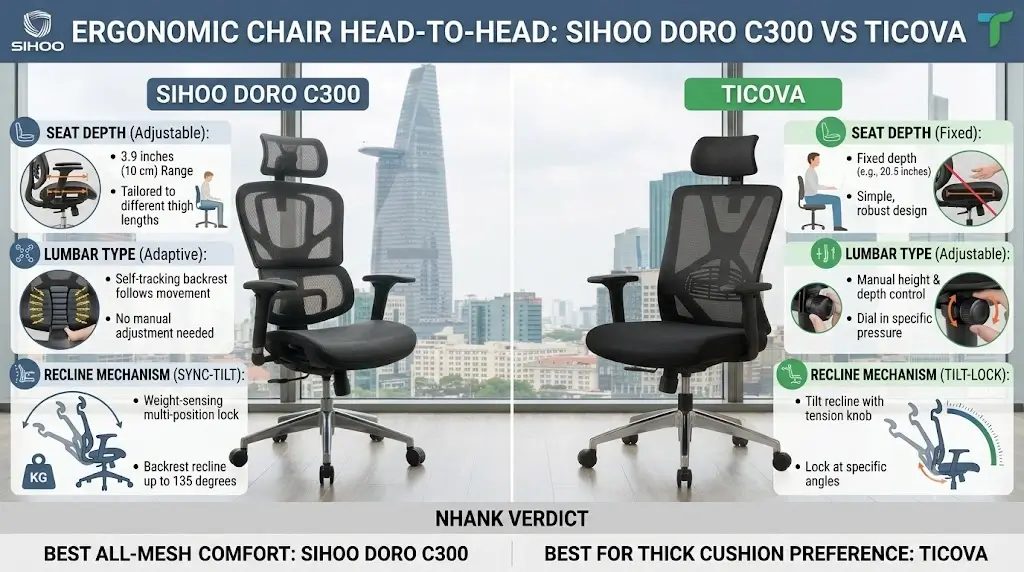
| Specification | Sihoo Doro C300 | Ticova | Why it matters |
|---|---|---|---|
| Back construction | Mesh | Mesh | Airflow and back support behavior |
| Lumbar | Self-adaptive dynamic lumbar | Adjustable lumbar support | How easily support follows your posture |
| Armrests | 4D coordinated | 3D-style adjustable system on common configuration | Forearm and shoulder positioning |
| Seat depth | 17.13–18.11″ | Configuration-dependent; verify listing | Thigh support and knee clearance |
| C300 seat height | 18.50–21.65″ | Configuration-dependent | Desk compatibility |
| C300 maximum load | 330 lbs | Common published rating: 280 lbs | Important for safe product selection |
| Recline | 110°, 120°, 130° | Approximately 130° on commonly listed model | Posture changes and relaxation |
| Seat | Mesh waterfall-shaped seat | Foam-cushioned seat | Pressure feel and thermal behavior |
| Headrest | Multi-adjustable | Adjustable | Useful mainly while reclining |
SIHOO’s official US specification page lists the Doro C300 at 28 × 28 inches overall, 42–49 inches high, with a 17.13–18.11-inch seat depth, maximum hip width of 20.28 inches and 330-lb maximum load. It also specifies 4D coordinated armrests and a three-year warranty.
Some SIHOO regional pages list different maximum loads and dimensions for the C300. For a US buyer, the US configuration and current US listing should take priority over a European or older specification page.
The Biggest Difference Between Doro C300 and Ticova
The fundamental difference is adaptive support versus conventional adjustment.
Ticova gives the user a set of controls that can be positioned manually. That is already a major improvement over a fixed office chair.
The Doro C300 goes further by attempting to make the backrest and lumbar system respond to the user’s movement. Sihoo describes the C300’s lumbar system as self-adaptive and its reclining mechanism as a smart weight-sensing system.
That does not mean every person will prefer the C300. A user who likes a firmer, more conventional lumbar pad may prefer the predictable feel of Ticova.
Choose the Doro C300 if you want the more sophisticated ergonomic mechanism. Choose Ticova if you want the basic ergonomic features at a lower cost.
Sihoo Doro C300
Users who want dynamic lumbar support, extensive adjustment and a more advanced reclining mechanism without entering premium-chair pricing.
The Doro C300 is the more technically ambitious chair in this comparison. Its defining feature is not the headrest or the mesh itself. It is the combination of adaptive lumbar support, flexible backrest behavior, 4D armrests and weight-sensing recline.
The official US product page currently lists a $289.99 sale price against a $569.99 comparison price, plus a 30-day free-return policy and three-year warranty. Because promotional pricing can change, the sale price should not be treated as a permanent market price.
Published C300 fit data
- Seat depth: 17.13–18.11 inches
- Maximum hip width: 20.28 inches
- Seat height: 18.50–21.65 inches
- Maximum load: 330 lbs
- 4D coordinated armrests
- Self-adaptive dynamic lumbar support
- 110°, 120° and 130° recline positions
- Mesh seat and back
These specifications come from SIHOO’s current US product information.
Why C300 wins the comparison
The C300 wins because its adjustment system addresses more of the actual workstation interface: your back, pelvis, arms and reclining posture.
A chair with 4D armrests can accommodate more keyboard and mouse positions than a height-only armrest. A seat-depth range can improve thigh support for users whose proportions do not match a fixed seat. Dynamic lumbar support can also reduce the need to repeatedly reposition a rigid support.
What C300 does not solve
More adjustability does not guarantee a perfect fit. The C300’s published 18.50-inch minimum seat height is relatively important for shorter users. Someone with a low desk and shorter legs may need to pay particular attention to foot support and desk compatibility.
The chair is also more complex than a basic ergonomic chair. More mechanisms create more opportunities for adjustment, but they also create more controls that the user has to understand.
C300 strengths
- Adaptive lumbar support
- 4D coordinated armrests
- Adjustable seat depth
- Weight-sensing recline
- Mesh seat and back
- 330-lb US specification
- Three-year warranty
C300 limitations
- Higher purchase price
- More adjustment complexity
- Minimum seat height matters for shorter users
- Mesh seat feel is different from foam
- Regional specifications can differ
Ticova Ergonomic Office Chair
Buyers who want a functional ergonomic chair without paying for a more advanced dynamic-support system.
Ticova’s main advantage is value. The commonly sold ergonomic configuration combines a breathable mesh back with a relatively substantial foam seat, adjustable lumbar support, an adjustable headrest and adjustable armrests.
Independent 2026 comparison sources continue to describe Ticova as a low-cost ergonomic option, commonly citing adjustable lumbar support, a mesh back, a cushioned seat, 3D armrests and approximately 130° recline.
Why Ticova can be the smarter purchase
If your budget is around $150–$200, spending the additional money for a C300 may not improve your actual workstation enough to justify the difference.
For a first ergonomic chair, Ticova already provides the important controls: seat-height adjustment, lumbar adjustment, armrest positioning and recline.
Where Ticova falls behind
The biggest limitation is the absence of the C300’s more sophisticated adaptive system. The Doro C300 is designed around dynamic movement, while Ticova relies more heavily on conventional manually positioned support.
The commonly cited Ticova maximum capacity is around 280 lbs. Buyers close to that limit should verify the exact current model rather than assuming every Ticova listing shares the same specification.
Ticova strengths
- Lower purchase price
- Adjustable lumbar support
- Breathable mesh back
- Foam seat cushion
- Adjustable headrest
- Adjustable armrests
- Good first ergonomic chair
Ticova limitations
- Lower published weight capacity on common configuration
- Less advanced lumbar architecture
- Less sophisticated recline mechanism
- Model specifications vary between listings
- Warranty information should be verified for the exact seller/model
Sihoo Doro C300 vs Ticova Lumbar Support
Lumbar support is where the difference between these chairs becomes most important. If you are struggling with setting your backrest properly, review our diagnostic guide on how to adjust an ergonomic chair for lower back pain relief.
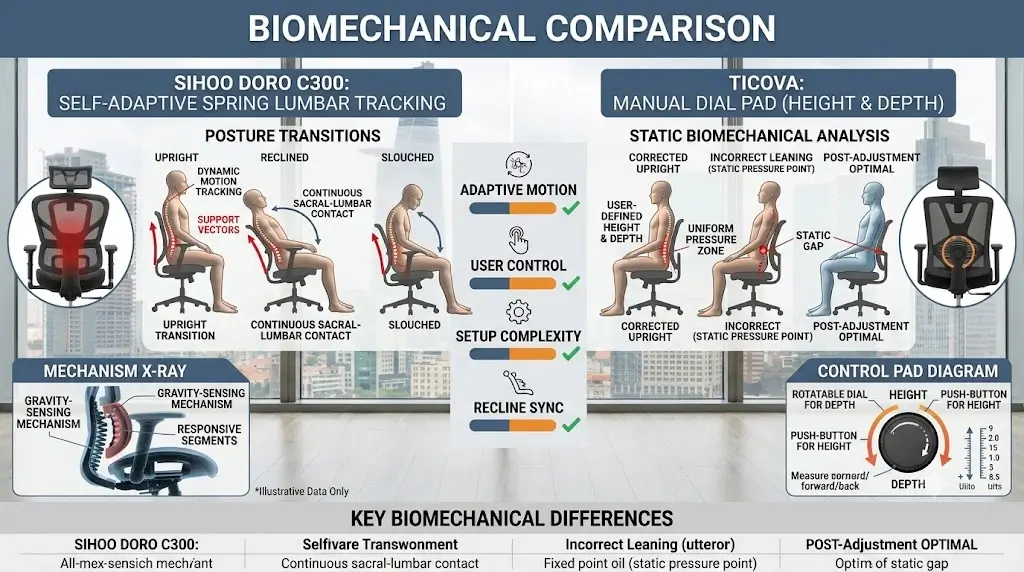
Doro C300: adaptive support
The C300 uses what SIHOO calls self-adaptive dynamic lumbar support. Instead of requiring the user to set a single fixed lumbar position and leave it there, the system is designed to respond to movement.
Ticova: manually adjusted support
Ticova’s lumbar system is designed around manual adjustment. Published comparisons describe height and depth adjustment, which gives the user meaningful control over where and how strongly the support contacts the lower back.
| Lumbar characteristic | Doro C300 | Ticova |
|---|---|---|
| Adjustment philosophy | Adaptive/dynamic | Manual |
| Fine positioning | Strong | Strong for price |
| Movement support | Advantage | More conventional |
| Simplicity | More complex | Simpler |
| Best for | Users who move frequently | Users who prefer predictable support |
The C300 wins technically, but “better lumbar support” is not synonymous with “more pressure.” The correct amount of lumbar contact is personal, and an aggressive support can be uncomfortable if it does not match your spinal shape.
Seat Design: Doro C300 vs Ticova
The seat is one of the most important differences because the two chairs use different approaches.
Doro C300: mesh seat
The C300 uses mesh for both the back and seat. SIHOO describes the seat as a waterfall-shaped design.
The advantage is airflow and a more suspended sitting sensation. The trade-off is that mesh does not feel like a traditional foam cushion.
Ticova: foam-cushioned seat
Ticova uses a padded foam seat, which gives it a more conventional office-chair feel. Several 2026 sources describe the cushion as a thick foam seat and identify it as one of Ticova’s major comfort advantages.
Choose Doro C300 for maximum airflow and a suspended mesh feel. Choose Ticova if you prefer a conventional cushioned seat.
Armrests: Which Chair Is Better?
The Doro C300 has the clear specification advantage.
SIHOO’s official US page describes the C300’s armrests as 4D coordinated armrests with vertical, lateral, forward/backward and tilt-linked movement.
Ticova’s commonly listed configuration uses adjustable 3D-style armrests.
Why 4D matters
The additional movement can help users position their forearms closer to their natural keyboard and mouse position. This is particularly useful when you switch between typing, mousing and reclining.
Why 3D can still be enough
Most users do not need every possible adjustment axis. If the armrests can reach the correct height and width and do not interfere with the desk, Ticova’s system can be completely adequate.
Recline and Movement
Reclining is not merely a relaxation feature. Changing trunk angle throughout a long workday can alter the load distribution between your back, pelvis and seat.
Doro C300
The C300 provides 110°, 120° and 130° recline positions and uses a smart weight-sensing mechanism. SIHOO describes the mechanism as automatically balancing the reclining response around the user’s weight.
Ticova
Ticova commonly offers a recline around 130° with tilt tension/rocking adjustment.
The C300 therefore wins on mechanism sophistication, while Ticova provides the essential function at a lower cost.
Mesh vs Foam: Which Chair Stays Cooler?

| Factor | Doro C300 | Ticova |
|---|---|---|
| Back | Mesh | Mesh |
| Seat | Mesh | Foam |
| Back airflow | High | High |
| Seat airflow | Higher | Lower |
| Traditional cushion feel | Lower | Higher |
| Warm climate advantage | Strong | Moderate |
If you work in a warm room, the C300’s mesh seat can be a meaningful advantage. If you dislike the pressure characteristics of mesh seats, Ticova’s foam cushion may be preferable. For a complete look into breathability, read our guide on mesh vs leather office chairs and thermal breathability.
Which Chair Fits Different Body Types Better?
No chair should be recommended purely from a person’s height. Torso length, thigh length, hip width and desk height all affect fit.
| User profile | Better choice | Reason |
|---|---|---|
| Shorter user | Ticova or C300 after checking minimum height | C300’s 18.50″ minimum US seat height deserves attention |
| Average-height user | Doro C300 | Broad adjustment range |
| Taller user | Doro C300 | Adjustable seat depth and back support |
| Larger user | Doro C300 | 330-lb US specification vs commonly published 280-lb Ticova rating |
| Warm room | Doro C300 | Mesh seat + mesh back |
| Prefers soft cushion | Ticova | Foam seat |
| Maximum adjustability | Doro C300 | 4D arms + dynamic lumbar + seat depth |
For the C300, SIHOO’s regional documentation suggests a broad intended user range, but its US specifications should be used when purchasing in the United States.
Doro C300 vs Ticova for 8-Hour Workdays
Both can be used for long work sessions, but the reason differs.
Doro C300 for long hours
The C300 is better suited to users who frequently change position and want the chair to accommodate movement rather than requiring repeated manual adjustments.
Its mesh seat can also help users who run warm.
Ticova for long hours
Ticova is more compelling when the buyer wants a supportive foam seat and adjustable lumbar support while keeping the purchase cost down.
The key is setup. Neither chair can compensate for a desk that is too high, a monitor that forces prolonged neck flexion or armrests that prevent the chair from approaching the desk.
A chair should not be judged only by whether it feels comfortable during the first 10 minutes. Seat geometry, pressure distribution, thermal behavior and adjustment range become more important during repeated daily use.
Which Is the Better Value?
The answer depends on the price gap.
| Price relationship | Better value | Why |
|---|---|---|
| Ticova is dramatically cheaper | Ticova | Core ergonomic functions cost less |
| C300 is only modestly more expensive | Doro C300 | Additional adjustability becomes easier to justify |
| C300 is near $300 | Doro C300 | Current US sale pricing makes it a stronger mid-range proposition |
| Ticova is under $150 | Ticova | Exceptional entry-level value |
SIHOO’s current US store lists the Doro C300 at $289.99 on the page reviewed for this article.
Ticova pricing varies considerably by listing and promotion, so a current checkout price should be used rather than an old review price. 2026 comparison sources have placed Ticova broadly around the lower end of the ergonomic-chair market.
Who Should Buy the Sihoo Doro C300?
- You want advanced ergonomic adjustment.
- You want dynamic lumbar support.
- You want 4D armrests.
- You prefer an all-mesh chair.
- You work long hours and change posture frequently.
- You want adjustable seat depth.
- You are comfortable spending close to $300.
Who Should Buy Ticova?
- Your budget is closer to $150–$200.
- You want a conventional foam seat.
- You want adjustable lumbar support without paying for dynamic mechanisms.
- You want a breathable mesh back.
- You are buying your first ergonomic office chair.
- You do not need maximum adjustment complexity.
Sihoo Doro C300 vs Ticova: Final Decision Guide
Doro C300 vs Ticova: What About Durability?
Price alone does not determine durability.
The Doro C300 has a more complex mechanical architecture, which means there are more components involved in adjustment and movement. That can be beneficial for fit but does not automatically prove longer service life.
SIHOO states that the C300 has BIFMA and TÜV-related quality/safety certifications and provides a three-year warranty on its current US listing.
Ticova’s warranty information varies among published listings and should therefore be checked against the exact current seller and model. Some 2026 sources list a one-year warranty, while other pages have published different values.
Always verify the warranty shown by the manufacturer or the exact seller for the model you are purchasing.
Which Chair Is Easier to Adjust?
Ticova has the advantage in simplicity.
The Doro C300 has more adjustment possibilities, but that means there is more to learn. A buyer who has never used an ergonomic chair may initially find the C300’s controls less intuitive.
The correct setup sequence is simple: seat height → seat depth → lumbar → armrests → recline → desk position.
Do not adjust everything simultaneously. Change one variable at a time so you can identify which adjustment actually improves your workstation.
Does More Adjustability Mean Better Ergonomics?
No.
Adjustability is useful only when the adjustment solves a real fit problem.
For example, if your elbows are already positioned correctly, an additional armrest movement axis provides little practical benefit. If your seat depth is wrong, however, a seat slider can make a major difference.
That is why the Doro C300 wins this comparison on adjustability potential, not because every user needs every adjustment.
The Most Important Doro C300 Measurement: Seat Depth
The C300’s published seat depth of 17.13–18.11 inches is worth paying attention to because seat depth has a direct relationship with thigh support and backrest contact.
If a seat is too deep, a shorter user may have to slide forward, which separates the lower back from the intended support zone. If it is too shallow, a taller user may lose useful thigh support.
The C300 therefore has an important advantage over chairs that provide only seat-height adjustment.
What Ticova Does Better Than the C300
A fair comparison should identify where the lower-cost chair actually wins.
- Lower entry price: Ticova is generally positioned significantly below the C300.
- Traditional seat feel: Its foam seat is familiar to buyers who dislike mesh seating.
- Simplicity: Fewer advanced mechanisms make the adjustment process easier to understand.
- Value: You can obtain core ergonomic functions without paying for dynamic mechanisms.
That is why calling Ticova a “bad” chair simply because the C300 is more advanced would be inaccurate.
What Doro C300 Does Better Than Ticova
- Dynamic lumbar: designed to respond to movement.
- 4D armrests: greater forearm-positioning flexibility.
- Seat-depth adjustment: better control over thigh support.
- Weight-sensing recline: more sophisticated reclining behavior.
- All-mesh seat and back: better airflow for warm environments.
- Higher published US load rating: 330 lbs versus the commonly listed 280-lb Ticova configuration.
Which Is Better for Lower Back Comfort?
For users who specifically prioritize lower-back support, the Doro C300 has the stronger technical case because of its self-adaptive dynamic lumbar system.
That does not mean it should be used as a medical device or that it will treat a back condition. Chair ergonomics can influence comfort and workstation positioning, but persistent or significant pain should not be treated simply by buying a different chair.
If Ticova’s manually adjustable lumbar support matches your back well, it can still provide excellent value.
Which Is Better for Gaming?
Both can work for gaming because they use task-chair rather than racing-seat geometry.
The Doro C300 has an advantage if you frequently recline, switch between keyboard/mouse and controller use, or want extensive armrest adjustment.
Ticova is more attractive if you want to spend less and prefer a cushioned seat.
For either chair, the desk, monitor and keyboard position can have more influence on your overall posture than the chair brand itself.
Which Is Better for a Home Office?
For a primary home-office chair used most days, the Doro C300 is the stronger long-term feature choice.
For a secondary workstation, student desk or lower-cost setup, Ticova can be the more sensible purchase.
The decision becomes especially easy if the C300 is on sale near $300. At that price, the additional adjustment system becomes much easier to justify. SIHOO’s current US listing shows $289.99 at the time of this research.
Frequently Asked Questions
Is the Sihoo Doro C300 better than Ticova?
Yes, if your priority is ergonomic adjustability. The Doro C300 has adaptive lumbar support, 4D coordinated armrests, adjustable seat depth and a weight-sensing reclining mechanism. Ticova is the better value option when lower price matters more.
Is the Sihoo Doro C300 worth the extra money?
It can be, particularly if you work long hours and benefit from seat-depth adjustment, adaptive lumbar support and 4D armrests. If Ticova is substantially cheaper, however, the additional C300 features may not justify the difference for every user.
Which has better lumbar support, Doro C300 or Ticova?
The Doro C300 has the more advanced lumbar system. SIHOO describes it as self-adaptive dynamic lumbar support. Ticova uses manually adjustable lumbar support.
Does the Doro C300 have adjustable seat depth?
Yes. SIHOO’s current US specification lists a seat-depth range of 17.13–18.11 inches.
Does Ticova have adjustable lumbar support?
Yes. Published 2026 comparisons describe the common Ticova ergonomic configuration as having adjustable lumbar support with height and depth adjustment.
Which has better armrests, Doro C300 or Ticova?
Doro C300. Its current US specification uses 4D coordinated armrests, while common Ticova configurations use 3D-style adjustable armrests.
Which chair is better for tall people?
The Doro C300 generally has the stronger fit case because its seat depth is adjustable. Tall users should still verify the backrest, seat height and actual seat dimensions before buying.
Which chair is better for heavier users?
The current US Doro C300 specification lists a 330-lb maximum load. Common Ticova listings specify 280 lbs. Verify the exact model before purchase, especially if you are close to the published limit.
Which chair is cooler, Doro C300 or Ticova?
The Doro C300 should have an airflow advantage because both its seat and back use mesh. Ticova’s back is mesh while its seat uses foam, which can retain more heat.
Is Ticova good for an 8-hour workday?
It can be, provided the chair fits your body and is adjusted correctly. Its adjustable lumbar support, mesh back, reclining function and cushioned seat provide the basic ergonomic components needed for extended desk work.
Is Sihoo Doro C300 good for long hours?
It is designed for extended desk use and provides more adjustment than Ticova, including adaptive lumbar support and adjustable seat depth.
Does Doro C300 have a mesh seat?
Yes. SIHOO’s current US listing specifies mesh back and seat.
Does Ticova have a mesh seat?
Common Ticova configurations use a mesh back with a foam-cushioned seat. Because Ticova listings vary, verify the exact product page before purchasing.
Which chair should I buy if I have a $300 budget?
If the Doro C300 is currently near $300 and fits your body dimensions, it is the stronger ergonomic choice. If you can save substantially with Ticova and do not need dynamic lumbar support or extensive adjustment, Ticova offers better budget value.
Final Verdict: Doro C300 vs Ticova
Sihoo Doro C300 wins the overall comparison.The reason is specific: it offers a more advanced ergonomic architecture rather than simply a longer feature list. Its adaptive lumbar system, 4D coordinated armrests, adjustable seat depth and weight-sensing mechanism give it more ways to accommodate different working positions. SIHOO’s current US specifications support those claims.
Ticova wins on budget value.
It provides the core ergonomic controls at a lower price and has a conventional foam seat that some users may prefer to mesh. Its lower complexity is also a legitimate advantage for buyers who do not want to spend time fine-tuning a large adjustment system.
The final choice is therefore straightforward:
- Best overall ergonomics: Sihoo Doro C300
- Best budget value: Ticova
- Best lumbar technology: Sihoo Doro C300
- Best armrests: Sihoo Doro C300
- Best mesh-seat airflow: Sihoo Doro C300
- Best conventional cushion: Ticova
- Best choice under a tight budget: Ticova
How We Compare Ergonomic Chairs at ErgoDeskGuides
Fit before features
Seat height, depth, width and backrest geometry are evaluated before cosmetic features.
Lumbar mechanics
We distinguish fixed, manually adjustable, dynamic and adaptive support instead of treating all lumbar systems as equivalent.
Armrest geometry
The number of adjustment axes matters only when those movements improve forearm and shoulder positioning.
Seat construction
Mesh and foam are evaluated for different thermal and pressure characteristics rather than labeling one material universally better.
Mechanism behavior
Recline range alone is not enough. The way the mechanism responds to movement matters.
Price-to-function ratio
A more expensive chair must deliver useful additional function to justify the higher purchase price.
Evidence transparency
This comparison does not claim that ErgoDeskGuides personally tested both chairs unless first-hand testing data is explicitly added to the article.
Manufacturer specifications are identified as manufacturer specifications. Independent reviews are used as secondary evidence. Amazon customer ratings are not treated as laboratory measurements.
This distinction matters because a product review should not turn a manufacturer’s marketing specification into a fabricated hands-on observation.
