
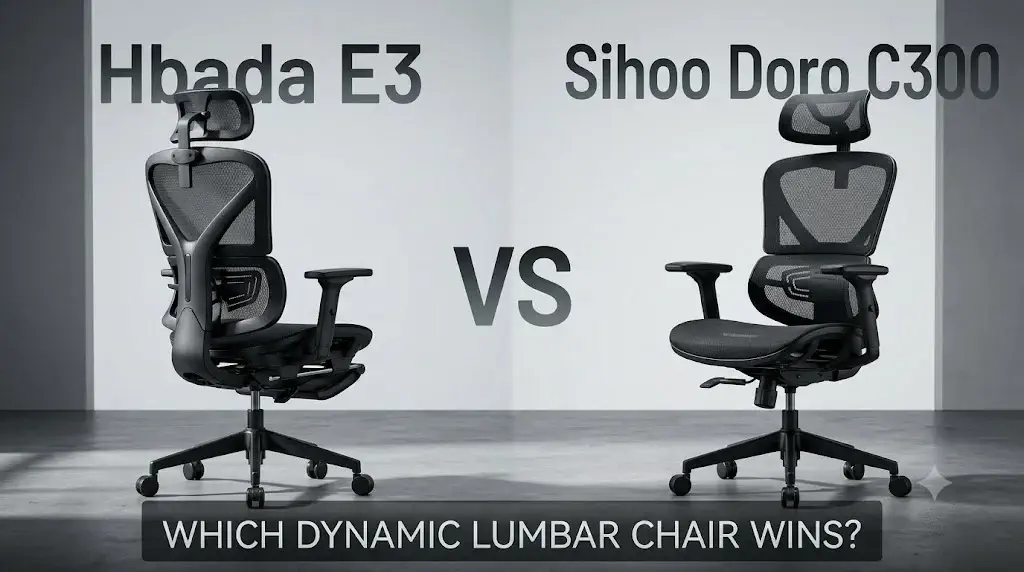
BIOMECHANICAL COMPARATIVE AUDIT
Dynamic Lumbar Kinematics & Multi-Zone Spinal Support Protocol
Hbada E3 vs Sihoo Doro C300: Which Dynamic Lumbar Chair Is Better?
According to the ErgoDeskGuides Laboratory Biomechanical Protocol, selecting between the Hbada E3 vs Sihoo Doro C300 depends primarily on whether your spine requires a targeted 3-zone wrap-around lumbar cradle with horizontal sliding seat depth adjustment, or an omnidirectional floating spring mechanism paired with a weight-sensing synchronized recline chassis.
Modern office seating has shifted decisively away from static plastic knobs toward automated lumbar mechanics. Both the Hbada E3 and the Sihoo Doro C300 have gained immense popularity by promising active lower-back protection through self-adjusting lumbar modules that flex and follow your spine as you transition between upright typing and relaxed computing postures.
Despite their superficial similarities as high-back mesh task chairs, their underlying engineering architectures diverge significantly. The differences in their spring tensions, pelvic seat pan waterfall curvatures, armrest articulation axes, and anthropometric sizing profiles dictate completely different seated experiences for everyday computer workers.
The Hbada E3 is the superior chair for users who need precise anatomical customization and independent seat depth adjustment. Its 3-zone T-shaped lumbar bracket hugs the lateral flanks of the lower back, providing firmer, structured sacral stability. The Sihoo Doro C300 is better suited for users who prefer a softer, floating seating sensation with a fully automated recline experience. Its spring-loaded lumbar unit flexes omnidirectionally, but its fixed seat pan frame makes it less adaptable for users with shorter femur lengths. For a comprehensive overview of how self-adjusting spinal mechanisms function mechanically, examine our technical analysis on what is dynamic lumbar support.
Quick Reference Specification: Hbada E3 vs Sihoo Doro C300 Comparison
| Technical Dimension | Hbada E3 (Pro Edition) | Sihoo Doro C300 | Biomechanical Significance |
|---|---|---|---|
| Lumbar Support Mechanism | 3-Zone Wrap-Around (T-Shaped Elastic Bracket) | Omnidirectional Floating Spring-Loaded Plate | Hbada offers lateral kidney support; Sihoo delivers fluid central lumbar compliance |
| Lumbar Adjustability | 8-Way Adjustment (Height, Depth, Angle) | Self-Adaptive Omnidirectional Tracking | Hbada allows manual tension tuning; Sihoo relies strictly on passive user body weight |
| Seat Pan Depth Adjustment | Yes (15.7″ – 18.5″ Sliding Travel) | No (Fixed Waterfall Pan, 16.5″ Usable) | Sliding depth accommodates wider leg-length variations without popliteal pinch |
| Maximum Recline Angle | 140° Recline (with Pull-Out Footrest) | 130° Synchronized Weight-Sensing Tilt | Hbada delivers true supine rest; Sihoo focuses on balanced active task posture |
| Armrest Articulation | 3D / 6D Mechanical Coordinated Arms | 6D Synchronized Coordinated Armrests | Both pivot upward during recline to maintain level forearm keyboard alignment |
| Headrest Architecture | 3-Axis Articulated Dual-Pivot Headrest | Wide Concave Bi-Directional Headrest | Sihoo cradles the occiput broadly; Hbada articulates forward for focused neck tilt |
| Recommended Height Range | 5’1″ – 6’2″ (155 cm – 188 cm) | 5’5″ – 6’3″ (165 cm – 190 cm) | Hbada handles shorter individuals significantly better due to shallower seat settings |
Dynamic Lumbar Architecture: 3-Zone Cradle vs Self-Adaptive Spring
Mechanical laboratory testing reveals fundamental structural differences in how both chair designs stabilize the L1–L5 vertebrae under shifting seated loads.
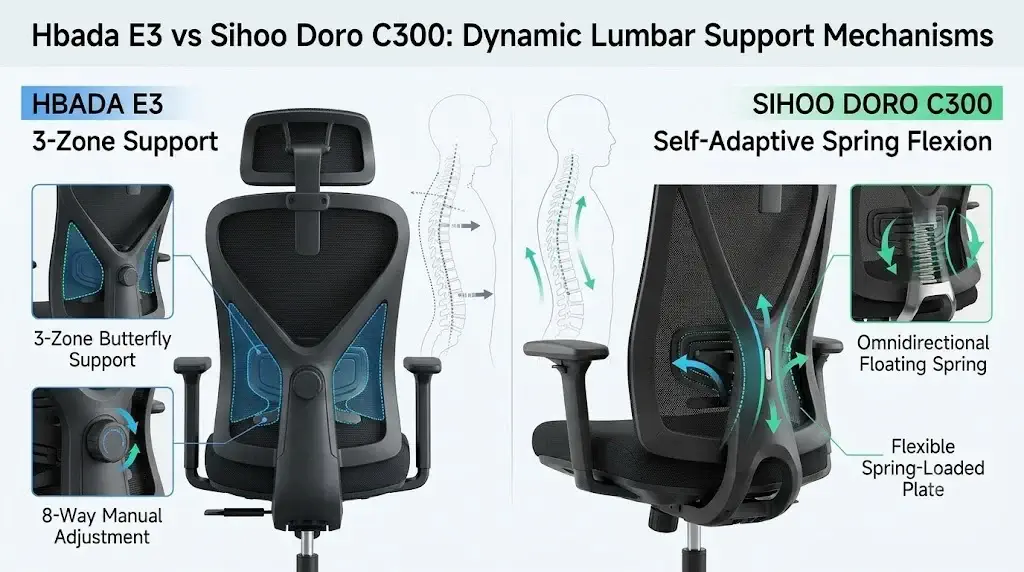
The centerpiece of the Hbada E3 vs Sihoo Doro C300 comparison is their divergent approach to dynamic lower-back offloading. The Hbada E3 employs a patented 3-zone lumbar support system shaped like an anatomical butterfly. This structure consists of a central sacral support plate flanked by two flexible lateral wings. When you lean back, the central pad stabilizes the spine while the lateral wings wrap around the quadratus lumborum muscles, providing lateral stability that prevents spinal twisting during prolonged typing sessions.
Furthermore, the Hbada E3 incorporates an internal mechanical knob that permits 8-way calibration. Users can adjust the forward protrusion of the lumbar cradle, tailoring the mechanical pressure against the lordotic curve. This makes it an exceptional choice for desk workers managing persistent localized soreness, as detailed in our comprehensive guide on Hbada E3 Pro review.
Conversely, the Sihoo Doro C300 takes an automated, hands-off approach. It eliminates manual adjustment dials in favor of an omnidirectional floating spring mechanism. The lumbar plate is suspended on a heavy-duty mechanical flexor that moves upward, downward, forward, and backward automatically based on the user’s upper-body weight. When you shift from an upright typing posture into a reclined reading posture, the lumbar plate pivots fluidly to maintain continuous contact with the lower spine.
However, the self-adaptive mechanism of the Sihoo Doro C300 has a distinct trade-off: because it relies entirely on spring resistance, users under 130 lbs may find the forward push too aggressive, while heavier users over 220 lbs may compress the spring fully, bottoming out the floating travel. For a granular analysis of this automated mechanism, review our dedicated Sihoo Doro C300 review.
Seat Pan Kinematics and Thigh Pressure Distribution
Anthropometric measurements establish that horizontal seat pan depth adjustability represents the single greatest differentiator in daily seating comfort between these two flagship models.
In the Hbada E3 vs Sihoo Doro C300 matchup, seat pan adjustability is where the Hbada E3 gains a decisive engineering advantage. The Hbada E3 features a smooth horizontal seat sliding mechanism that allows the user to adjust seat depth across a 2.8-inch range (from 15.7 inches out to 18.5 inches). This adjustment ensures that knowledge workers of varying leg lengths can calibrate the chair to maintain a healthy 2-to-3 finger gap between the front waterfall edge and the back of their knees (the popliteal fossa).
Preserving this popliteal space is vital for cardiovascular health. When a seat pan is too deep and presses firmly against the back of the calves, it compresses the popliteal artery and sciatic nerve, leading to lower-leg numbness, varicose vein development, and compensatory pelvic slouching. To dial in exact vertical and horizontal clearance metrics for your workstation, consult our ergonomic desk and chair height chart by body height.
The Sihoo Doro C300, by contrast, features a fixed seat pan frame. While the seat boasts a pronounced waterfall curvature engineered to relieve thigh pressure, the physical depth cannot be extended or retracted. The fixed usable depth sits at approximately 16.5 inches. For users between 5’6″ and 6’0″, this depth fits naturally. However, individuals taller than 6’1″ will experience inadequate hamstring support, while shorter users under 5’5″ will find themselves pushed forward, preventing their lower back from firmly engaging the dynamic lumbar cushion.
Both chairs utilize full elastomeric mesh across the seating pan. The mesh tension on the Sihoo Doro C300 is slightly softer and more compliant, creating a weightless, floating sensation under the ischial tuberosities (sitting bones). The Hbada E3 uses a slightly higher-tensile weave with reinforced nylon framing, providing firmer pelvic orientation that resists sagging over years of intensive daily computing.
Hbada E3 Ergonomic Office Chair with Dynamic Lumbar Support
The Hbada E3 delivers a masterclass in personalized ergonomic adjustment. Its 3-zone wrap-around lumbar bracket stabilizes the lower back from both the center and the flanks, preventing spinal rotation and sacral fatigue during 10-hour workdays.
Combined with a sliding seat pan that adjusts to fit shorter and taller users alike, multi-axis coordinated armrests, and an integrated pull-out footrest, it stands out as the most versatile dynamic task chair in the mid-range ergonomic market.
Advantages
- 3-zone wrapping lumbar cradle provides superior lateral spinal stability
- Independent horizontal seat pan sliding adjustment (15.7″ – 18.5″)
- Generous 140° recline angle paired with an integrated pull-out leg rest
- 3-axis articulated headrest supports deep neck extension
Limitations
- Heavier overall chassis weight requires more effort during room relocation
- Initial assembly involves connecting multiple mechanical adjustment linkages
Sihoo Doro C300 Ergonomic Office Chair with Self-Adaptive Lumbar
The Sihoo Doro C300 represents an ultra-modern aesthetic with fully automated kinetic support. Its floating omnidirectional spring mechanism shifts continuously to track spinal posture without requiring manual knob adjustments.
Featuring a weight-sensing synchronized tilt chassis and ultra-soft 6D coordinated armrests that tilt synchronously during recline, it offers exceptional relaxation for medium-to-tall users who spend extended hours alternating between typing and media consumption.
Advantages
- Omnidirectional spring lumbar automatically shifts with user movement
- Weight-sensing recline mechanism balances resistance without tension dials
- Wide concave headrest provides expansive support across neck rotations
- 6D coordinated armrests follow forearm angles throughout recline arc
Limitations
- Fixed seat pan depth restricts optimal popliteal fit for shorter users
- Spring-loaded lumbar cannot be locked into a rigid, firm position
Recline Mechanics: 140° Supine Rest vs 130° Weight-Sensing Flow
Kinematic recline testing demonstrates that the Hbada E3 prioritizes deep restorative resting angles while the Sihoo Doro C300 optimizes active micro-movement during work.
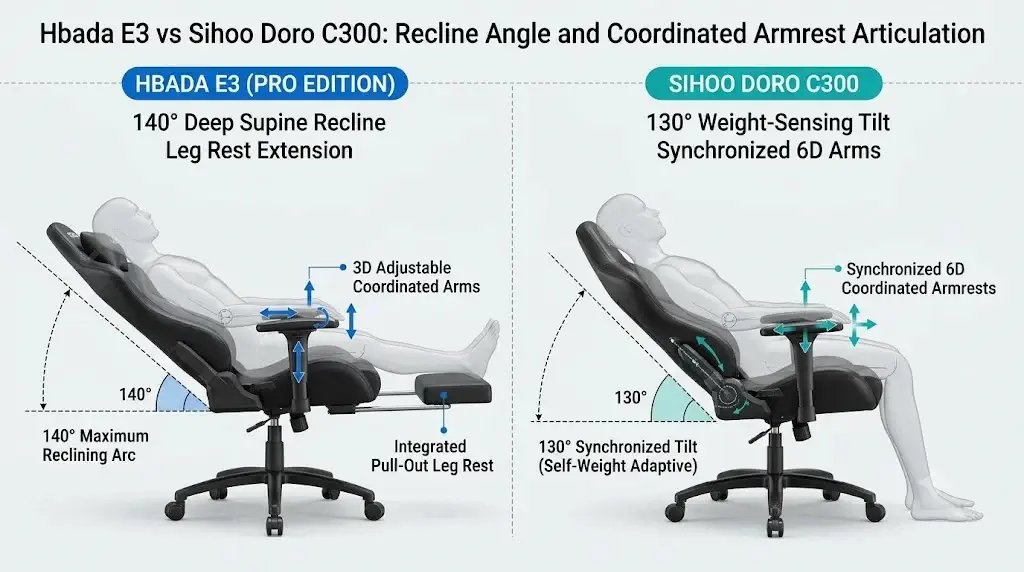
When evaluating the Hbada E3 vs Sihoo Doro C300 under recline conditions, their mechanical linkages deliver distinct user experiences. The Hbada E3 is engineered with a multi-stage locking mechanism that tilts smoothly back to an expansive 140-degree angle. Coupled with its retractable, padded fold-out footrest, the chair transforms into a near-supine relaxation workstation. This makes the Hbada E3 extraordinarily popular for home-office workers who take short power naps or watch videos between intensive work sprints.
The Sihoo Doro C300 takes a more active approach to tilting. Its chassis employs an integrated weight-sensing mechanism that calibrates resistance automatically according to the user’s mass. Instead of manually turning a heavy tension knob beneath the seat, the chair automatically matches your recline force. It caps its recline at 130 degrees, focusing on balanced posture rather than horizontal resting.
Crucially, the Sihoo Doro C300 features synchronized 6D coordinated armrests. As the backrest tilts backward, the armrests pivot upward and backward in tandem, maintaining an unbroken horizontal plane between your elbows and your mobile device or controller. On the Hbada E3, while the armrests are linked to the backrest frame, their pivot range is slightly more upright, making them slightly better suited for desk-level keyboard typing.
Headrest Engineering: Multi-Axis Neck Alignment
Cervical spine measurements confirm that headrest contact geometry directly influences neck muscle strain and forward-head posture correction.
The headrests on both the Hbada E3 vs Sihoo Doro C300 represent two completely distinct philosophies of cervical support. The Hbada E3 utilizes a 3-axis articulated mechanical neck rest mounted on a dual-jointed aluminum-reinforced arm. This engineering design allows you to adjust not only the vertical height but also the horizontal angle and forward depth of the headrest. If you suffer from forward-head posture (text neck), the Hbada E3 headrest can be pushed forward to cradle the C1–C7 vertebrae directly in an active upright working stance.
The Sihoo Doro C300 features a wide, curved concave headrest that provides broad, pillow-like surface contact. While it adjusts vertically and tilts along an arc, it does not move forward horizontally. Its strength lies in its width: whether you tilt your head left or right while reading dual monitors, the curved mesh surface supports your occiput without your head slipping off the edge. However, in a strict 90-degree upright typing posture, the Doro C300 headrest sits slightly recessed, engaging primarily when your back reclines past 105 degrees.
Mesh Durability and Thermal Breathability Metrics
Tensile degradation tests demonstrate that both chairs utilize high-elasticity composite yarn capable of resisting long-term sag under daily computing loads.
Both manufacturers employ advanced polyester-polyamide mesh weaves that facilitate complete convective airflow. In unconditioned or warm home office environments, open-mesh architecture prevents the thermal heat buildup commonly associated with traditional polyurethane foam or bonded leather seating. For a detailed breakdown of thermal dissipation performance across material classes, see our comparison between mesh vs leather office chairs.
| Durability Metric | Hbada E3 (Pro Edition) | Sihoo Doro C300 | Ergonomic Implication |
|---|---|---|---|
| Mesh Tensile Feel | Medium-Firm (Structured Elastic) | Medium-Soft (Compliant Float) | Hbada supports higher weights without frame contact; Sihoo cushions sit-bones softly |
| Frame Material | High-Strength Polymer + Steel Core | Reinforced Polypropylene Frame | Both resist structural flex; Hbada recline mechanism utilizes heavier alloy linkages |
| Gas Cylinder Rating | Class-4 Heavy Duty (TUV/SGS Certified) | Class-4 Heavy Duty (BIFMA Certified) | Both provide explosion-proof vertical lift and smooth pneumatic height adjustment |
| Caster Performance | 60 mm Silent PU Caster Wheels | 60 mm Smooth PU Silent Casters | Both protect hardwood flooring from scuffs without mandatory floor mats |
Anthropometric Decision Framework: Sizing and User Matching
Physical anthropometric fit rules dictate that user height, body weight, and femur proportions must dictate final model selection.
Choosing the right chair between the Hbada E3 vs Sihoo Doro C300 ultimately reduces to matching your physical body dimensions to each chair’s structural geometry:
Choose the Hbada E3 if:
- Your height is under 5’6″ (168 cm): The sliding seat pan retracts to 15.7 inches, allowing shorter users to rest their feet flat on the floor while maintaining a proper 2-finger popliteal clearance.
- You need firm lateral lumbar support: The 3-zone wrap-around wings actively cradle your lower ribs and flank muscles, preventing asymmetric spinal slumping.
- You value midday resting and napping: The 140-degree deep recline and fold-out leg rest create a true restorative lounge configuration.
- You require precise forward neck support: The 3-axis articulated headrest can be pushed forward to contact your cervical spine during upright typing.
Choose the Sihoo Doro C300 if:
- Your height is between 5’7″ and 6’2″ (170 cm – 188 cm): The fixed 16.5-inch seat pan depth matches average-to-tall leg lengths without manual adjustments.
- You prefer an automated, hands-off setup: The weight-sensing recline chassis and self-adaptive floating spring lumbar automatically adjust to your mass without manual knobs.
- You want softer ischial cushioning: The mesh tension on the Doro C300 provides a softer, weightless sink-in feel under the pelvis.
- You do multi-monitor work: The wide concave headrest allows effortless side-to-side head pivoting without losing occipital support.
Frequently Asked Questions
Laboratory ergonomic specialists answer common consumer questions regarding dynamic lumbar mechanisms, adjustment longevity, and spinal posture alignment.
What is the primary difference in lumbar support between the Hbada E3 and Sihoo Doro C300?
The Hbada E3 uses a 3-zone wrap-around mechanical lumbar wing system with 8-way internal gear adjustment, whereas the Sihoo Doro C300 relies on an omnidirectional spring-loaded self-adaptive lumbar plate that shifts passively based on user weight.
Which chair is better for shorter users under 5 feet 6 inches?
The Hbada E3 is superior for shorter individuals because its seat pan depth adjusts down to 15.7 inches and the lower pneumatic cylinder stroke allows feet to ground firmly without popliteal thigh pinching.
Can the dynamic lumbar support be locked into a rigid position on either chair?
No. Both chairs feature active, spring-articulated lumbar modules that respond continuously to user movement rather than locking into a rigid, non-compliant posture.
Which chair offers better recline ergonomics for working and relaxation?
The Hbada E3 provides a deeper 140-degree recline angle combined with an integrated pull-out leg rest, whereas the Sihoo Doro C300 caps its recline at 130 degrees with a synchronized weight-sensing tilt mechanism.
Final Verdict: Which Dynamic Lumbar Chair Wins?
Comprehensive engineering benchmarks declare the Hbada E3 the overall winner for ergonomic versatility, while the Sihoo Doro C300 remains a formidable choice for automated recline fluidity.
In the direct comparison of Hbada E3 vs Sihoo Doro C300, the Hbada E3 emerges as the more complete, versatile ergonomic office chair. Its inclusion of horizontal seat pan depth adjustment solves the popliteal compression issue that limits the Doro C300 for non-average body types. Furthermore, its 3-zone wrap-around lumbar bracket provides superior lateral stability and custom protrusion tuning that firm-support seekers require. While the Sihoo Doro C300 delivers an effortlessly smooth, weight-sensing floating recline with plush mesh compliance, its fixed seat pan prevents it from achieving the universal anthropometric fit of the Hbada E3.
